Please note that the FactCheckHub has not obtained any right from the authors or copyright owners of all third-party contents from embedded links and shall incur no liability in this regard.
Please note that the FactCheckHub has not obtained any right from the authors or copyright owners of all third-party contents from embedded links and shall incur no liability in this regard.
Please note that the FactCheckHub has not obtained any right from the authors or copyright owners of all third-party contents from embedded links and shall incur no liability in this regard.
Please note that the FactCheckHub has not obtained any right from the authors or copyright owners of all third-party contents from embedded links and shall incur no liability in this regard.
A POST circulating on social media claims that French professional football player Kylian Mbappé won the FIFA World Cup at the age of 18.
The post was made in response to a comment by Nigerian musician Tochukwu Gbubemi Ojogwu, popularly known as Odumodublvck, who was praising Spanish football sensation Lamine Yamal ahead of the 2026 FIFA World Cup final.
“IMAGINE YAMAL WITH THE WORLD CUP AT 19 WOW,” Odumodublvck wrote in a post on July 17.
Reacting to the post, an X user @LouieDi13 posted: “Mbappe collect am at 18”
As of July 20, 2026, the post has generated over 1.1 million views, 3,000 reposts, and 28,000 likes.
Kylian Mbappé won the FIFA World Cup at the age of 18.
Screenshot of the viral post
FINDINGS
Findings by The FactCheckHub show that the claim is FALSE.
The original post was published two days ahead of the 2026 FIFA World Cup finaL, which featured 19-year-old Spanish winger Lamine Yamal going head-to-head with Lionel Messi’s Argentina.
Following the online exchange, the final was played, and Spain defeated Argentina 1–0 after extra time thanks to a 106th-minute strike by Ferran Torres, securing Spain’s second World Cup title.
According to records compiled by FIFA, Kylian Mbappé was born on December 20, 1998. He won the FIFA World Cup with the French national team during the tournament in Russia, where France defeated Croatia 4–2 in the final.
Further search by The FactCheckHub revealed a review by The Economic Times stating that the final match took place on July 15, 2018. Based on his date of birth, Mbappé was exactly 19 years and 207 days old when he lifted the trophy, not 18.
Mbappé nevertheless made history during the competition. He became the first teenager to score in a World Cup final since Brazilian legend Pelé achieved the feat in 1958 and was one of the standout performers of the tournament.
While he won the World Cup as a teenager, the available records confirm that he was 19 years old, not 18.
VERDICT
The claim that Kylian Mbappé won the World Cup at age 18 is FALSE. Official tournament data compiled by FIFA shows that he was 19 years old when France won the tournament in July 2018.
A POST circulating on social media claims that the Nigerian military killed and captured several bandits during the rescue operation that secured the release of abducted pupils and teachers from Oriire Local Government Area of Oyo State.
The claim was shared by an X user, @Hon_Jesugbemi, on July 11, 2026, alongside a video showing armed men, military vehicles and weapons allegedly recovered during the operation.
The user captioned the post: “During the rescue of the victims, some bandits were killed while others were captured alive. Kudos to Nigerian army and others.”
The post gained traction shortly after the pupils and teachers were released, attracting thousands of views and engagements.
CLAIM
Video shows the Nigerian military killed and captured bandits during the rescue of abducted pupils and teachers in Oriire Local Government Area of Oyo State.
viral social media post
FINDINGS
Findings by The FactCheckHub show that the claim is FALSE.
On May 15, 2026, gunmen abducted pupils and teachers from Community High School, Ahoro-Esinele, in Oriire Local Government Area of Oyo State. After spending 56 days in captivity, the victims were released, with presidential spokesperson Bayo Onanuga announcing their freedom on July 10, 2026.
However, checks by The FactCheckHub show that the video attached to the viral claim has no connection to the rescue operation.
A reverse image search conducted on keyframes extracted from the footage traced the video to reports about military operations carried out by the Malian Armed Forces against terrorist groups in the regions of Gao, Sévaré and Anéfis in Mali.
Images from the scene shown in the footage had earlier been published by FATA Media, a Burundian media platform, on Facebook on July 4, 2026, before the release of the Oyo pupils. The accompanying caption, translated with the aid of Google Translate, stated that the weapons shown in the video were seized by Malian forces during clashes with armed groups in the affected areas.
The post explained that Mali continues to face significant security challenges from terrorist organisations and armed insurgent groups, prompting military operations across several parts of the country.
No evidence was found linking the footage to Nigeria, the rescue of the Oyo pupils and teachers, or any operation conducted by the Nigerian military.
VERDICT
The claim that the video shows bandits killed or captured by the Nigerian military during the rescue of abducted pupils and teachers in Oyo State is FALSE. The video has been online before the rescue operation.
A POST circulating on social media claims that the National Vice Chairman of the All Progressives Congress (APC) recently stated that President Bola Tinubu could only win the 2027 presidential election through rigging.
The post is accompanied by a video clip of former Vice Chairman (North-West), Salihu Mohammed Lukman, speaking during an interview on Channels Television’s Sunrise Daily.
It was shared by an X user, @AndrewOkere, with the caption: “Bola Tinubu can only win in 2027 through rigging. – APC Vice Chairman Lukman.”
As of July 17, 2026, the post has generated over 12,800 views, 325 reposts, and 500 likes, with people believing the clip to be recent.
APC Vice Chairman recently stated that Bola Tinubu can only win the 2027 election through rigging.
Screenshot of the viral post
FINDINGS
Findings by The FactCheckHub show that the claim is MISLEADING.
A keyframe search of the video in the post done by The FactCheckHub reveals that the footage is an excerpt from an interview on Channels Television’s Sunrise Daily programme.
A review of the original interview published on June 13, 2024, by Channels TV shows that the interview did not take place recently; it was over two years ago, during a programme marking 25 years of uninterrupted democracy in Nigeria.
However, as of the time of the interview, Lukman had already resigned from his position as the national vice chairman (North-West) of the APC.
During the broadcast, Lukman was talking about the overall performance of the party and how citizens would not vote for the party due to how difficult things were in the country.
VERDICT
The claim that the APC Vice Chairman said Bola Tinubu can only win the 2027 election through rigging is MISLEADING. The video used to support the claim is an old broadcast from June 13, 2024, and the man in the video was a former member of the APC.
A POST circulating on social media claims that a photograph showing a yellow, weathered building is the Faculty of Law recently commissioned by Osun State Governor, Ademola Adeleke, in Ilesa.
The post was shared by a Facebook account, Tunmise Reformer, on July 15, with the caption: “Osun State University, Faculty of Law as commissioned by Demola Adeleke in Ilesha yesterday…”
As of July 18, 2026, the post has generated reactions and comments from users debating the state of the infrastructural development at the university.
Photo shows the Faculty of Law of Osun State University recently commissioned by Governor Ademola Adeleke in Ilesa.
Screenshot of the post
FINDINGS
Findings by The FactCheckHub show that the post is MISLEADING.
A reverse image search done by TheFactCheckHub reveals that the building in the photograph is not part of Osun State University. Instead, it is the Faculty of Law building at the University of Ilesa (UNILESA) in Osun state.
Punch and other media outlets reported that on Tuesday, July 14, 2026, Governor Ademola Adeleke visited the UNILESA campus to inaugurate six landmark projects. The commissioned projects included a reconstructed internal road network, new student hostel facilities, a newly remodelled Faculty of Law annex building, and Faculty of Public Health building.
Kaothar Tajudeen, a student of English Language and Education at the University of Ilesa, confirmed to The FactCheckHub that the picture as portrayed by the poster is old. She further sent pictures taken on July 18, 2026, to back her statement.
The top image is the remodelled Faculty of Law building according to the claim, while the one below it is the image of the faculty of Law building, Unilesa, gotten by The FactCheckHub as of July 18, 2026
A visual analysis of the recent photograph compared to the one shown in the viral post shows that the Facebook poster used an outdated image of the facility before it underwent the recent infrastructure upgrade and remodeling by the state government.
Furthermore, the user misidentified the institution as Osun State University instead of the University of Ilesa.
VERDICT
The claim is MISLEADING. The photograph does not show the current state of the Faculty of Law building recently commissioned by Governor Ademola Adeleke. The building belongs to the University of Ilesa, not Osun State University, and the viral post used an old image taken before the facility was renovated and remodelled.
FOLLOWING his participation in a roundtable session organised by the European Council on Foreign Relations (ECFR) in Berlin on July 13, presidential candidate of Nigeria Democratic Congress, Peter Obi, shared four photographs from the event on his social media platforms.
However, one of the images appeared unusually processed, prompting speculation online that Obi never attended the event and that the photographs were artificially generated.
Amid the controversy, an X user, @enitandev, shared an altered version of the photographs in which a white man appeared in the position occupied by Obi in the original image.
The user wrote: “Dear Saint @PeterObi. It has gotten this bad that you are stealing other people’s pictures and editing them.
“The cleanest and most honest politician of all time is posting fake pictures of an event he didn’t attend. Clock it.”
As of July 18, 2026, the post had generated over 400 reposts and more than 600 likes.
CLAIM
Peter Obi used fake or AI-generated photographs to falsely claim he attended an ECFR event in Berlin.
screenshot of the viral misleading picture shared to claim Obi did not attend the ECFR program
FINDINGS
Findings by The FactCheckHub show that the claim is MISLEADING.
Checks were conducted using facial recognition search tools. The supposed ‘original’ version circulated by critics, which replaced Obi with an unidentified white man, yielded no verifiable records linking the individual to the event. This suggests the image was digitally altered or generated.
A visual examination of the edited image also reveals inconsistencies. In one frame showing participants seated during the discussion, most attendees appear naturally engaged in the session and unaware of the camera. By contrast, the man inserted in the altered version appears unusually positioned and posed for the photograph, creating the impression that he was superimposed onto the image.
The rest of the speakers appear to focus on the discussion while the man inserted appears to be posing for camera
More importantly, independent evidence confirms that Obi attended the event.
The FactCheckHub found that on July 13, ECFR Africa shared a lower-quality version of one of the disputed photographs, showing Obi and other participants posing after the session. This indicates that the photograph originated from a real event and was not fabricated.
Low quality version of the image shared by ECFR Africa on July 13.
Further checks by TheFactCheckHub confirmed that Peter Obi attended the event. A statement addressing the controversy was published on the official X account of ECFR Africa, which TheFactCheckHub cross-checked and verified as authentic through links provided on the European Council on Foreign Relations’ official website. The statement read:
“In the past days, numerous concerns were raised on social media concerning the authenticity of images that were taken at an ECFR event, hosted by the ECFR Africa programme, and Mr Peter Obi being one of the attendees.
We hereby expressly confirm that the event with Peter Obi took place on 13 July 2026 at our Berlin office. It was an informal exchange with selected guests on Mr Obi’s vision on the future of Nigeria.
We distance ourselves from all allegations that have been directed at us on social media and via e-mail in recent days.”
The statement was signed by Alex Vines, Director of the ECFR Africa Programme.
Further verification by The FactCheckHub also identified video footage of Obi speaking at the event. The footage, shared by @NjenjeMedia on July 17, 2026, shows him discussing Nigeria’s democratic development beyond 2027, international relations, economic growth, and support for small and medium-sized enterprises.
While one or more of the photographs shared by Obi may have been enhanced to improve image quality, there is no evidence that the event itself was fabricated.
The controversy is similar to an incident reported by The FactCheckHub in January 2026 involving a photograph from President Bola Tinubu’s meeting with Rwandan President Paul Kagame in Paris. That image attracted criticism after social media users noticed a Grok watermark.
Presidential aide Temitope Ajayi later explained that the photograph had been enhanced using AI tools to improve image quality after being taken on a mobile phone, not generated from scratch.
Modern AI tools can enhance photographs by improving sharpness, lighting, resolution, and background quality without altering the underlying event captured in the image.
VERDICT
The claim that that Peter Obi fabricated or AI-generated photographs to falsely claim attendance at an ECFR event in Berlin is MISLEADING. Independent evidence, including photographs released by ECFR, a statement from the organisation, and video footage from the event, confirms that Obi participated in the session. While some images may have been digitally enhanced, the event itself took place and Obi was present.
A United States federal judge has temporarily blocked President Donald Trump administration’s policy that targeted foreign nationals studying online disinformation, hate speech, and content moderation with visa denials and deportation.
Chief District Judge James Boasberg in Washington, an appointee of former Democratic President Barack Obama, ruled on Tuesday, July 14, 2026, in favour of the Coalition for Independent Technology Research (CITR).
The judge found that the administration’s policy likely unlawfully burdens the speech of non-citizen researchers in the United States, in violation of the First Amendment.
The legal challenge was filed on behalf of the coalition by the Knight First Amendment Institute at Columbia University and Protect Democracy.
They argued that the policy, while framed as an effort to combat online censorship, was actually being used to execute a far-reaching campaign targeting independent researchers, fact-checkers, and advocates.
The policy was first announced by Secretary of State, Marco Rubio, in May 2025, banning foreign nationals deemed “complicit in censoring Americans.” Rubio asserted that the measures were designed to secure the free-speech rights of Americans by deterring foreign censorship.
However, the lawsuit argued that the policy quickly expanded beyond foreign government officials. In December 2025, the State Department targeted five prominent Europeans with visa bans, calling them figures of a “global censorship-industrial complex.”
The visa bans were issued shortly after European Union tech regulators fined Elon Musk’s social media company, X (formerly Twitter), 120 million euros ($140 million). The fine was the first major sanction under the EU’s Digital Services Act, which is designed to combat hate speech and disinformation.
Among the individuals hit by the State Department’s visa bans following the fine on Elon Musk’s platform were Imran Ahmed, the British CEO of the US-based Center for Countering Digital Hate, and Clare Melford, co-founder of the Global Disinformation Index. Both of their groups are members of the Coalition for Independent Technology Research.
The State Department also instructed consular officers to scrutinize visa applicants for evidence of their work in fields such as misinformation, disinformation, fact-checking, content moderation, trust and safety, and compliance.
In his decision, Judge Boasberg sided with the researchers, concluding that the policy unconstitutionally discriminates against one set of viewpoints in the public debate surrounding social media.
The judge wrote that the policy sweeps a substantial measure of protected research, reporting, advocacy, and association into the category of “foreign censorship.” He added that non-citizens could reasonably understand the policy to place their immigration status at risk simply because they work in content moderation.
According to the lawsuit, the visa policy had already caused an effect across the research and fact-checking community. CITR reported that several of its non-citizen members living in the US had stopped working on research projects, ceased public speaking engagements, and declined invitations to international conferences for fear of being denied re-entry or facing deportation.
Carrie DeCell, a lawyer for the coalition at the Knight First Amendment Institute at Columbia University, welcomed the judge’s ruling in a statement. She noted that the decision “recognized the serious constitutional harms this policy is already causing.”
“This policy punishes researchers for work the public needs and the First Amendment protects,” she added.
Brandi Geurkink, the executive director of the Coalition for Independent Technology Research, also supported the decision.
She stated that the ruling prevents the government from using immigration threats to intimidate and censor independent researchers who provide a critical window into how digital platforms impact communities.
In December 2025, FactCheckHubreported that the United States introduced a new policy that would see H-1B visa applicants denied entry if they have worked in fact-checking, content moderation or online safety — fields considered crucial in combating misinformation.
Reuters reported that an internal memo issued by the US State Department directed consular officers worldwide to scrutinise applicants’ past roles for any involvement in what Washington now describes as ‘censorship’ of free speech in the US.
The directive, dated December 2, also instructs visa officers to review LinkedIn profiles and résumés of applicants and their accompanying family members to determine whether they have worked in fact-checking, compliance, moderation or misinformation-related roles.
AN X user, @iamscrummy_, has shared a video showing a flooded roadway with the claim that it depicts the situation in Lekki, Lagos, following recent heavy downpours.
The video shows a major road near a bridge submerged in water, with several vehicles struggling to move through the flood.
The user shared the clip on July 14 with the caption: “Situation Report: Lekki, Lagos 💔😭”
As of July 14, 2026, the post had generated over 700 reposts and more than 1,000 likes.
CLAIM
The video shows recent flooding in Lekki, Lagos.
screenshot of the viral post
FINDINGS
Findings by The FactCheckHub show that the claim is MISLEADING.
The claim surfaced amid growing concerns over flooding in parts of Lagos following weeks of heavy rainfall. In recent weeks, several communities across the state have experienced flash floods caused by intense downpours, poor drainage systems, and rising water levels.
However, checks by The FactCheckHub show that the viral video was not recorded in Nigeria.
The FactCheckHub subjected keyframes from the video to a Google Reverse Image Search. The results traced the footage to Banani, an upscale district in Dhaka, Bangladesh.
An earlier version of the video was posted on YouTube on July 12, 2026, with the caption “Banani Sea Beach”, a sarcastic reference to the severe flooding that affected the area. The same video also surfaced here with a similar caption.
Further checks show that the footage corresponds with reports by The Daily Star, a Bangladeshi newspaper, which reported that hours of heavy rainfall on June 11, 2026, left several parts of Dhaka, including Banani, submerged in ankle- to waist-deep water.
According to the report, about 100 millimetres of rainfall fell within nine hours, causing severe waterlogging, disrupting traffic, forcing businesses and schools to close, and exposing longstanding drainage challenges in the city.
Visual comparisons between the viral clip and images from news reports on the Dhaka flooding confirm that the location is in Bangladesh and not Lagos.
VERDICT
The claim that the video shows flooding in Lekki or anywhere in Lagos is MISLEADING. It depicts flooding in the Banani area of Dhaka, Bangladesh, and is being falsely shared as a recent scene from Lagos.
A POST circulating on social media claims that the kidnapped pupils and teachers in Oyo State regained their freedom after spending more than 170 days in captivity.
The post further alleges that the victims were freed through the efforts of Sunday Igboho and his security team, known as Iru Ekun.
It was shared by an X user, @HonestarsenalF, with the caption:
“The kidnapped Oyo pupils and teachers have regained their freedom after spending more than 170 days in the Den of bandits. Reports say they were freed with the help of Sunday Igboho and his team, (Iru Ekun). Some of the bandits involved were apprehended. The government has also promised to support every affected family and rebuild the school.”
As of July 11, the post has generated over 14,000 views, 19 reposts and over 100 likes.
Oyo State pupils and teachers were rescued by Sunday Igboho’s team after spending over 170 days in captivity.
screenshot of the viral post
FINDINGS
Findings by The FactCheckHub show that the claim is MISLEADING.
The ICIRreported that the victims were abducted on May 15, 2026, when heavily armed men launched coordinated attacks on Baptist Nursery and Primary School, Yawota; Community Grammar School, Ahoro-Esiele; and L.A. Primary School in Oriire Local Government Area.
The attackers abducted 39 pupils and seven teachers after killing one teacher during the assault before forcing the victims into the forest.
According to a statement released on July 10, 2026, by Lieutenant Colonel Danjuma Jonah Danjuma on behalf of the 2 Division Army Public Relations, the rescue was executed by troops of the Nigerian Army in collaboration with joint security forces.
Led by Major General CR Nnebeife, the multi-agency operation included officers from the Office of the National Security Adviser, the Directorate of State Services (DSS), National Intelligence Agency (NIA), Nigeria Police Force, Nigeria Security and Civil Defence Corps (NSCDC), and local vigilante groups who pressured the terrorists into unconditionally releasing the victims at the Old Oyo National Park Forest.
Even though media reports indicate that Sunday Adeyemo, popularly known as Sunday Igboho, joined the efforts at one point to assist in the search of abductees, deploying drones alongside his team to scan the Old Oyo National Park in support of the rescue operations, such effort could only complement those of the nation’s security forces.
Furthermore, a timeline verification reveals that the victims did not spend 170 days in captivity. The ICIR and other media outlets report that the abduction occured on May 15, 2026, and the victims were successfully rescued on July 10, 2026.
This indicates they spent exactly 56 days in captivity, contrary to the viral social media claim.
VERDICT
The claim that Sunday Igboho’s team rescued the Oyo pupils and teachers after 170 days is MISLEADING. Official records show the final operation that secured their freedom was executed by the Nigerian Army and joint security forces after the victims spent 56 days in captivity.
A GRAPHIC circulating on social media claims that the Federal Government of Nigeria has officially announced the relocation of Kwara State from the North Central geopolitical zone to the South West.
The picture alleges that as part of this boundary restructuring, the state will also be renamed “Odo Oya State” with the change expected to take official effect from October 1st, 2026.
The claim has been widely shared across Facebook groups here and here, triggering debates among users over the political implications of the purported realignment.
Kwara State is moving to the South West geopolitical zone and changing its name to Odo Oya State on October 1st, 2026.
screenshot of the viral graphic.
FINDINGS
Findings by TheFactCheckHub show that the claim is FALSE.
On February 7, 2025, BBC reported that the House of Representatives Committee on Constitution Review made a proposal to the government for creation of new states in the country. The chairman of the committee, Benjamin Kalu proposed the creation of six new states for North Central, four for North East, five for North West, five for South East, four for South-South and seven for South West.
Similarly, on January 29, 2026, Legit.ng reported all the additional states proposed for creation in the Southwest region, beyond the six existing states. Which were: Ijebu State from Ogun State, Coastal State from Ondo State, Igbomina State from parts of Osun, Ekiti and Kwara States, Ibadan State from Oyo State, and New Oyo State from Oyo State
However, a look at the actual ongoing legislative proposals and bills reveals that none of them mention moving Kwara State out of the North Central zone, nor do they include any plans to rename it as Odo Oya State.
A reverse image search conducted by TheFactCheckHub on the graphic shared showed that it did not originate from any official government channel. The flyer, which mimics an official federal government announcement by using national emblems and a photograph of President Bola Tinubu, is completely fabricated and has not been published by any credible or verified media organisations.
Furthermore, changing a state’s name or altering geopolitical boundaries in Nigeria is a statutory process governed by Section 8 of the 1999 Constitution. It requires a two-thirds majority vote in the National Assembly, a formal referendum, and approval by at least 24 State Houses of Assembly. No such legal or legislative steps have been taken concerning Kwara State.
VERDICT
The claim that Kwara State is moving to the South West and changing its name to Odo Oya State is FALSE. The misleading graphic is digitally manipulated and does not originate from any official government channel.
THE race between generative Artificial Intelligence tools and the software built to detect them is heavily lopsided. While AI image and video generators are improving at a rapid pace, automated detection tools are failing to keep pace. This technical gap is creating a significant challenge for fact-checkers, as software built to catch fabrications is now flagging them as authentic.
When these automated tools fail, fact-checkers are left with either debunking AI-generated misinformation based on their intelligence or leaving it out, because the software used to flag it can no longer be trusted.
For Mutalib Jibril, a fact-checker with FactCheckAfrica, this technical failure turned a standard investigation into a game of trial and error. Working to debunk a viral video that carried distinct visual anomalies, Jibril ran the file through an AI detection tool. He expected the analysis to return a high probability score confirming the video was synthetic. Instead, the tool stated the video was real, showing only a 17 per cent probability of AI generation.
“There was a story I was working on, a video I was trying to debunk was AI-generated, and had the attributes of AI in it, but when I ran it by AI detection tools with the expectations that it would be 90 per cent probability or above, the analysis came out with 17 per cent probability, and stated that the video was real,” Jibril noted. “I had to run it on another detection tool, which later came out with an 87 per cent probability.”
Jibril is not the only fact-checker who has faced this kind of challenge. Mohammed Taoheed, a researcher at Dubawa, said he has encountered similar challenges while verifying suspected AI-generated content. He explained that although he could often identify AI-generated content through visual cues, he still needed forensic analysis to support his findings. However, when AI detection tools incorrectly classify deepfakes or AI-generated content as authentic, fact-checkers are sometimes left with no choice but to abandon the claim.
“I’ve experienced this many times, and most of my work has been turned down because of it. While I could tell that the content was AI-generated, I still needed forensic analysis to back it up. But when AI detection tools flag deepfakes and AI-generated content as real, I had no choice but to leave such claims,” Mohammed said.
He added that as AI-generated tools continue to advance, AI detection systems must also improve to keep pace.
Failure of AI detection tools
The rise of disinformation and misinformation due to Artificial intelligence is alarming. According to the World Economic Forum’s Global Risks Report 2026, misinformation and disinformation ranked as the second most severe risk in the short-term horizon, driven by AI-generated content and synthetic media.
As a result, the integrity of online news and information is increasingly under threat, as distinguishing between authentic and synthetic content, whether video, audio or written, is becoming more difficult.
According to a survey by the Reuters Institute, 58 per cent of respondents globally are concerned about how to distinguish truth from falsehood in online news. The figure rises to 73 per cent in both Africa and the United States.
The FactCheckHub has observed various instances where AI detection tools fail to detect clearly AI-generated visuals.
For instance, ZeroGPT’s website states its multi-model detection technology achieves 98.5 per cent accuracy across GPT-4, Claude, Gemini, and other large language models. The company says it uses Deep Analyse Technology to scan text patterns.
In an independent benchmark conducted by researchers from the Universities of Kansas and Rochester, Sightengine ranked #1 in AI-media detection accuracy with a 98.3 per cent accuracy rate on 80,000 images.
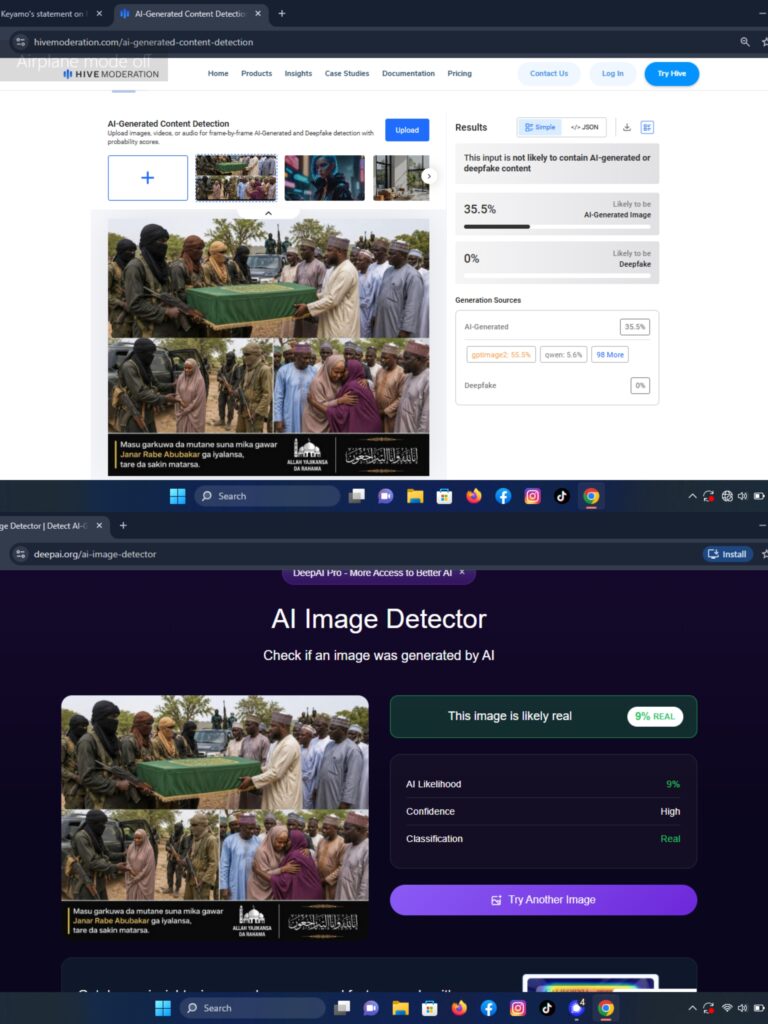
For instance, The FactCheckHub recently debunked a collage of images shared by the former lawmaker, Dino Melaye. The image purportedly showed heavily armed bandits in Katsina State handing over a casket to a local delegation.
While the image showed clear signs of AI generation, including distorted background features and inconsistent framing. Yet, when The FactCheckHub ran the imagery through Hive Moderation, an AI detection tool, the system returned only a 35.5 per cent probability of it being synthetic, concluding the image was real and had no AI-generated or deepfake content. The FactCheckHub then subjected the same image to Deep AI, another AI detection tool, which delivered a nine per cent probability, stating that the image was real.
Collage of the wrong forensic analysis
While alternative forensic checks eventually confirmed the images were fake, the initial failure of the two major detection platforms proved that automated tools are falling behind current generative technology.
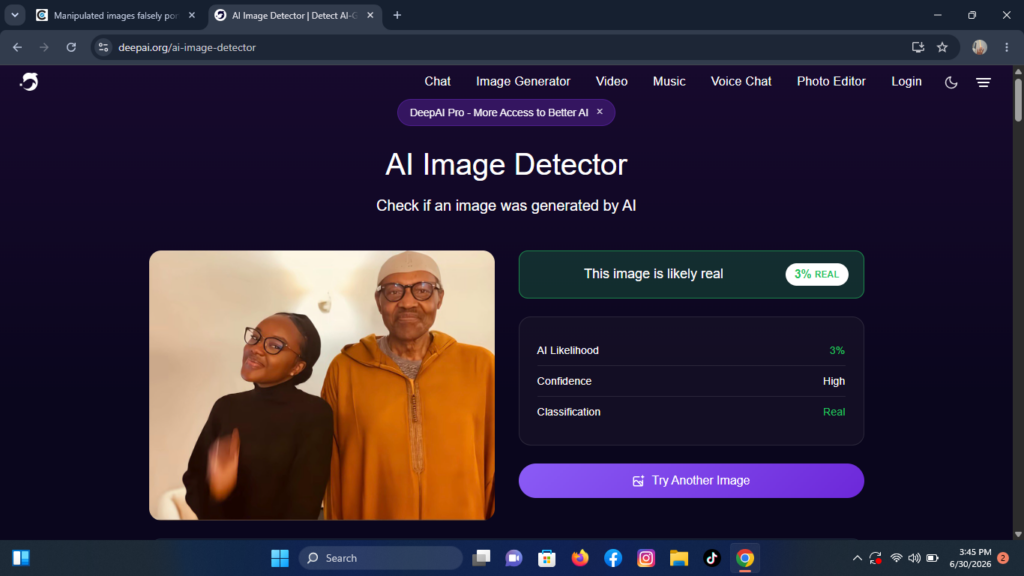
This isn’t all. The FactCheckHubdebunked viral images of the late former president Buhari on May 19, 2026.
An X user posted Buhari’s images, claiming that he was alive and residing in Egypt. Many comments on the post showed people were confused because the former president had died months before the images surfaced online.
To verify the authenticity of the images, The FactCheckHub analysed them using DeepAI, and the result returned a three per cent probability and still declared the images to be real. The FactCheckHub then subjected the images to another tool, Hive Moderation, which then returned an 84.3 per cent probability score for a deepfake face swap and a 31.9 per cent score for fully AI-generated images.
The ICIR and other media outlets had reported the death of the late former president on June 13, 2025, ten months before the images surfaced online.
screenshot of the forensic analysis on DeepAI
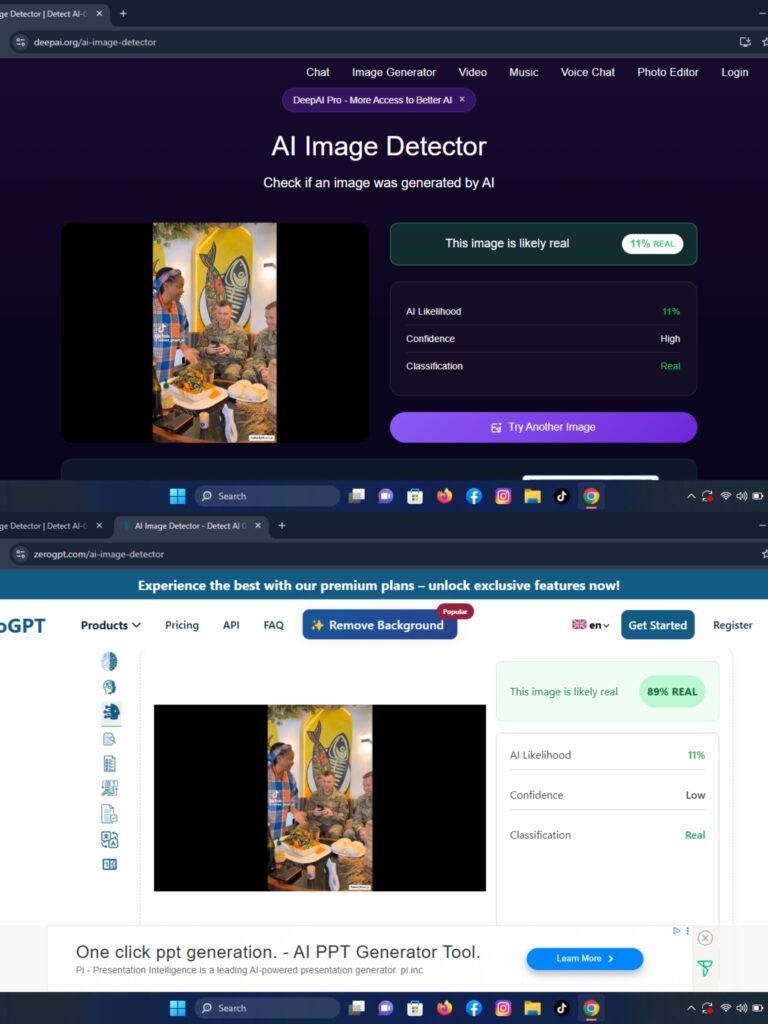
Also, in February 2026, FactCheckHubdebunked a viral video of American soldiers eating egusi soup and fufu, a starchy African food in Nigeria, which surfaced online. The anomalies in the video reeked of AI-generated content due to the inconsistent movements in the video.
When The FactCheckHub subjected the video to an AI detection tool, ZeroGPT, for analysis, the result said that the video was 89 per cent real. The video was subjected to another AI detection tool, DeepAI, which corroborated that the video was real. It was after a series of verifications and human verification that the result showed that it was AI-generated.
A reverse image search done by The FactCheckHub led to the account that first posted it on social media. The account showed a consistent pattern of posting AI-generated content.
collage image of the result of two detector tools used.
Speaking with The FactCheckHub, the editor of Dubawa, Kemi Busari, noted that a fact-checking organisation risks becoming a validator for falsehood when its internal tools fail.
“The understanding is that a fact-checking organisation helps you decipher truth from falsehood, but when such an organisation becomes a conduit for fake content, it means they are giving some kind of validation or amplification for a deepfake,” he explained.
Busari warned that repeated failures to detect deepfakes could erode public trust in news organisations and fact-checking platforms. According to him, if audiences repeatedly see manipulated content slip through an organisation’s verification process, they may lose confidence in its ability to distinguish fact from fiction.
He noted that the consequences could be particularly severe during elections, where misinformation can influence voters’ decisions. Busari said that if a fact-checking organisation mistakenly verifies a fake video as authentic, the public could rely on that false information when deciding whether or not to vote.
On her part, disinformation researcher Rejoice Taddy explained that resolving the failure of AI-detection tools requires journalists to prioritise human analysis over software results, adding that verification must start with human observation rather than an algorithmic score.
“It often starts with a human sense of what feels AI-generated or manipulated,” Taddy said. “That then guides how you approach the tools available to you. Sometimes you also have to question what the tools are saying because you might look at something and be convinced it is not realistic, even when a system is flagging it as not synthetic. That is where deeper verification becomes necessary.”
She said while these tools are good at recognising patterns, flagging harmful language, and identifying known narratives, they still rely heavily on human input, adding that human verification is what brings context, helps assess intent, identifies coordinated behaviour, and applies ethical judgment that machines cannot fully replicate, especially in high-risk situations.
To address the limitations of existing detection tools, Busari called for greater collaboration among technology companies, researchers and journalists to develop attribution systems that embed verification data directly into digital media.
According to him, such systems would enable anyone viewing an image or video to see the verification checks it had undergone and independently replicate the process before accepting the outcome.
Busari, however, stressed that no software should replace editorial judgement. He maintained that while artificial intelligence could support verification, decisions on the authenticity of content must ultimately rest with human reviewers.
He urged fact-checkers to treat AI-powered detection tools as assistants in the verification process rather than as final arbiters of truth.
“We need to keep humans in charge,” Busari emphasised, stressing that “Whatever you’re getting from AI detection tools must also go through your own human detection process to be sure that it’s accurate. Eventually, we have all these tools to help us, but your most important tool is still your own brain, your own instinct.”