Home Blog Page 57

Video does not show Ondo governor caught with ‘side chick’ in London

0

A viral video purportedly showing the current governor of Ondo State, Lucky Aiyedatiwa, caught in an affair with a woman has surfaced online ahead of November 16 governorship election in the state.

In the video, a woman grabs the man by his collar, calling him derogatory names, while another woman holding a camera threatens to release the footage on social media and show the video to his wife.

READ: Viral photos do not show recent arrest of ritual suspects in Ondo State

An X user, @davetorty, posted the video with a caption that read:

“This is the  Ondo State governor in London,  having a real brawl with a side chic! What a shame!

Men, honour Urselves! The real plan of the strange woman, spiritually and physically is to bring U down! Make thy loins tight! Keep thy prestige!”

The video has garnered over 700,000 views plus more than 2,000 reposts and over 2,500 likes as of October 13, 2024.

Another X user, @whatsappblog9ja, posted the video with a caption thus:

“Viral video of Ondo State sitting governor in London,  having a real brawl with a side chic.”


CLAIM

Video shows Ondo governor, Lucky Aiyedatiwa caught in an affair with a woman.


THE FINDINGS

Findings by The FactCheckHub show that the claim is FALSE.

Our fact-checker analysed the video using some keyframes obtained from it. The results show that while the man shares a striking resemblance with Governor Aiyedatiwa, some facial features distinguish them.
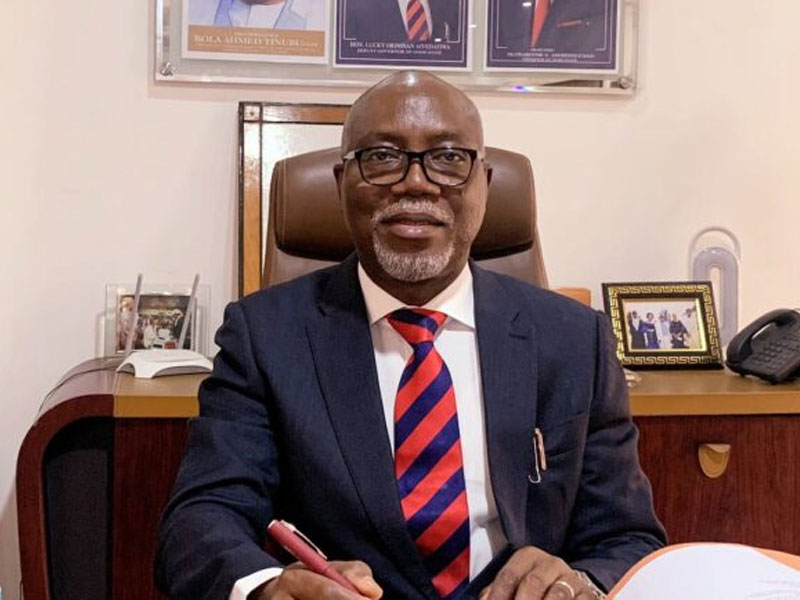
Lucky Aiyedatiwa, Ondo State governor.

For instance, the man in the video is gap-toothed, while Aiyedatiwa is not. Their nose shapes also differ. Aiyedatiwa has a wider nose bridge with a more rounded tip, while the man’s nose seems narrower, with a sharper tip.

Meanwhile, the Ondo State government through Allen Sowore, a media aide to the governor had debunked the claim. In a statement yesterday, he said the video is a ploy to tarnish Aiyedatiwa’s image ahead of the November 16 governorship election in the state.

ALSO READ: Edo/Ondo elections: INEC urges journalists to guard against fake news

Sowore pointed out several differences between the facial and vocal features of the man in the video and those of Governor Lucky Aiyedatiwa.

He clarified that for the benefit of unsuspecting public, it was important to make clear that the man in the video was not the Ondo State governor.

The man in the viral video.

He explained that a closer look at the video showed noticeable differences: Governor Aiyedatiwa no longer wears the type of beard seen on the man in the clip, having changed his appearance over a year ago and the voices of the two men are distinct, with the individual in the video speaking loudly and in a tone different from the governor’s.

He added that Aiyedatiwa has never worked in the United Kingdom, as suggested in the video; and that while the governor has an oval face, the man in the video has a round face.

“The public is encouraged to carefully examine the video and notice these clear distinctions before arriving at the erroneous conclusion that the man in the video is Governor Aiyedatiwa,” he added.


THE VERDICT

The claim that the video shows Ondo governor, Lucky Aiyedatiwa caught in an affair with a woman in London is FALSE; facial evidence, as observed, shows that the man in the video is not Aiyedatiwa.
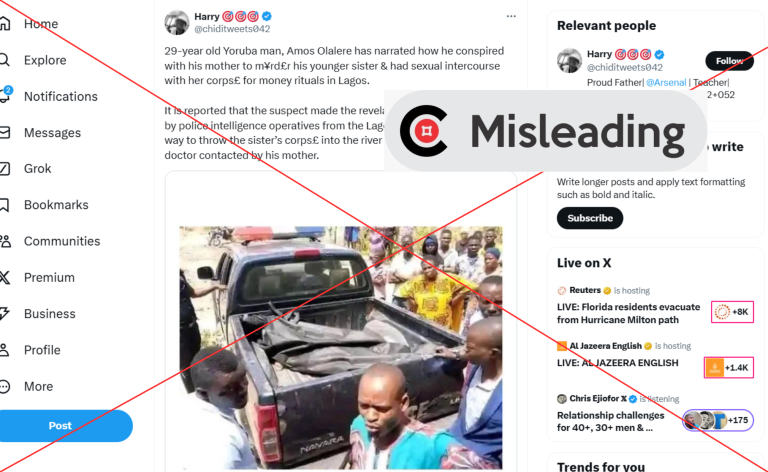
X user used image from Ghana to depict alleged ritual killing in Lagos

0

An X user, @ChiditweetØ42, has posted an image showing people gathering around a Hilux pick-up van with a claim that it shows a Nigerian man, Amos Olalere, who conspired with his mother to murder his younger sister for money rituals in Lagos.

The post read:

“29-year old Yoruba man, Amos Olalere has narrated how he conspired with his mother to m¥rd£r his younger sister & had sexual intercourse with her corps£ for money rituals in Lagos. “It is reported that the suspect made the revelation after he was arrested by police intelligence operatives from the Lagos State Command on his way to throw the sister’s corps£ into the river as instructed by the native doctor contacted by his mother.”

READ: Viral photos do not show recent arrest of ritual suspects in Ondo State

The claim has garnered over 240,000 views with more than 1,000 reposts and over 2,000 likes as of October 13, 2024.


CLAIM

Image shows Nigerian man arrested for ritual killing in Lagos.


THE FINDINGS 

Findings by The FactCheckHub show that the claim is MISLEADING, as the image has been online since May 2023 and not related to the Lagos incident.

Image of murder suspect arrested in Ghana falsely attributed by the X user.

When our researcher subjected the image to a Google reverse image search, the result shows that the image has been online since over one year ago and it’s unrelated to any murder incident in Lagos, Nigeria.

An earlier version of the photo shows that it depicts a murder incident which occurred at Wa, a town in Ghana. The media report indicated that the image shows the body of a male adult buried in a shallow grave at Bamahu, a suburb of the town and recovered by the Ghanaian police.

Some similar incidents have preceded the murder which already led to the death of eleven persons in five months prompting the Ghanaian police to put GH¢100,000 (cedis) reward for information that could lead to the arrest of any individual or group involved in the killings.

In addition, when our fact-checker ran a keyword search on Google.com, the result shows that the incident the X user was referring to occurred in May 2023 in Lagos and not related to the Ghanaian murder suspect’s image used in the X post.


THE VERDICT

The claim that image shows Nigerian man arrested for ritual killing in Lagos is MISLEADING; the image has been online since 2022 and depicts a murder incident in Ghana, not Lagos.

Bobrisky has NOT been sentenced to 2 years imprisonment!

0

A claim that a Nigerian cross-dresser and socialite, Idris Okuneye, popularly known as Bobrisky has been sentenced to two years imprisonment has circulated widely on TikTok.

The claim posted online by a TikTok user, @kyc_comedy, consists of a collage of two videos – one which shows a federal lawmaker moving a motion and the second that shows where an named man was reacting to the first video.

The audio of the footage transcribed below read:

The speaker, honorable colleagues, my name is honorable Dr Patrick Umoh … I rise to move the motion on the urgent need to investigate the disturbing allegation of corruption against the Economic and Financial Crimes Commission (EFCC) and the Nigerian correction service to save Nigeria from ridicule the house notes the disturbing and widely circulated publication emanating from Martins Vincent Otse also known as VeryDarkMan against critical Nigerian Law Enforcement institutions. it also notes that the EFCC drop money laundering charges against Idris Okuneye also known as Bobrisky upon collection of the sum of 15 million Naira. This house further notes that the publication alleges that the Idris Okuneye upon conviction of the abuse and defacing of the naira by the court did not serve his time at the Nigerian Correctional Service but was lodged outside the confines of the service. Disturbed about the damning allegations against the critical Nigerian law Enforcement agencies, of the EFCC and NCos established by  these [sic] chambers. to fight correction and [sic] persons convicted of crime for correctional purposes respectively worried about the negative image and portrayal of Nigeria as a corrupt nation and Nigeria struggled to redeem itself from such perception. This house resolves to urge the house to set up an ad hoc committee comprising of persons of unquestionable integrity to immediately probe the allegations and report to the house within three legislative weeks.

There was an inscription on the video with a caption that read:

Bobrisky has been sentence to two years imprisonment

The post had garnered a total of over 65,000 likes, more than 3,000 comments, over 4,000 bookmarks and over 4,700 reposts as of October 13, 2024.


CLAIM

Bobrisky has been sentenced to two years’ imprisonment.


THE FINDINGS

Checks by The FactCheckHub show that the claim is FALSE!

Screenshot of the claim from TikTok; Insert FALSE verdict
Screenshot of the video post on TikTok. Insert: FALSE verdict.

In April 2024, The ICIR reported that Bobrisky was sentenced to six months in prison for defacing Naira notes without the option of fine. He was later released in August after serving his term.

However, Martins Otse, popularly called VeryDarkMan on social media, recently released an audio recording claiming that Bobrisky bribed Economic and Financial Crimes Commission (EFCC) officials with ₦15 million to drop the money laundering charges leveled against him.

The recording also alleged that Bobrisky served his prison time in a private apartment instead of a prison facility, facilitated by his influential connections. These allegations were the motion moved by the lawmaker to investigate the claims. The minister of Interior, Olubunmi Tunji-Ojo, also ordered an investigation into the bribery allegation.

In response, Bobrisky filed a ₦1 billion lawsuit for defamation, accusing VeryDarkMan of using AI-generated audio to damage his reputation. Bobrisky demanded a retraction, public apology, and monetary compensation.

On Monday, September 30, 2024, the House of Representatives began an inquiry into the allegations surrounding Bobrisky’s bribery saga. However, Bobrisky was notably absent from the House proceedings but his lawyer attended in his place, citing his client’s illness as the reason for not appearing at the hearing.

The session was then adjourned indefinitely after the committee heard several presentations from the Nigerian Correctional Service (NCoS) and the EFCC.

Throughout the 2 minutes, 8 seconds video, there was no mention of Bobrisky being imprisoned which indicated that the caption of the post was likely intended as a clickbait.

Checks by our fact-checker also show that the news was not reported by any credible media platform.


THE VERDICT

The claim that Bobrisky has been sentenced to two years’ imprisonment is FALSE; Bobrisky was earlier sentenced to six months imprisonment which he had already served; even though the latest bribery allegation is still being investigated, there is neither legal trial nor court verdict yet on the issue.

Video of ‘Igbo Must Go’ protest in Ghana is over 1 year old

0

A video showing a group of women holding tree branches and chanting “Igbo Must Go” has resurfaced online with a claim that it shows a recent protest against Nigerians of Igbo extraction in Ghana.

An X user, @pontrol_777, posted the claim alongside a screenshot with a caption that read:

“A current video of Ghanaians protesters shouting “Igbo must go”. What have they done to Ghanaians this time around. They are not the only tribe in Ghana o.”

READ: No! Video does not show Igbos killed in Mozambique over money rituals

The claim has generated over 100,000 views, more than 700 likes and over 300 reposts as of October 13, 2024.

Another X user, @NoNonsensezone, also posted the same video and screenshot with a similar caption thus:

IGBO MUST GO: A trending video from Ghana shows Ghanaians protesting for the Igbo tribe of Nigeria to leave their Country.

The claim has generated over 38,000 views and more than 200 reposts as of October 13, 2024.

Other X users have shared the same claim multiple times as seen here and here etc.


CLAIM

Video shows a recent “Igbo Must Go” protest in Ghana.


THE FINDINGS 

Findings by The FactCheckHub show that the claim is MISLEADING.

screenshot of the viral video showing women chanting Igbo Must Go
Screenshot of the viral video showing women chanting ‘Igbo Must Go’.

The Igbo people are one of the major ethnic groups in Nigeria, concentrated in the southeast around the Niger River. They can also be found in the South-South part of the country.

The FactCheckHub subjected the keyframes in the video to Google reverse image search and the result shows that the video has been online since at least September 2023.

READ ALSO : Can the UN take over any country where protests continue for 15 days or longer?

Our fact-checker obtained an earlier version of the video which an X user, @TheBiafraChild, posted on September 11, 2023. He claimed that the women were protesting to demand the exit of an Igbo man from their community in Ghana.

“Imagine Fulani immigrants in Ghana protesting that Igbo man should go.. sometimes I wonder what Igbo people in authority do in order to salvage our reputation or just wearing red caps and organising functions every minute of the day,” his post read.

The FactCheckHub also analysed some keyframes in the video using Geospy.ai, a geo-location AI tool. Our checks confirmed that the location of the protest is Ghana based on the architecture of the buildings and clothes worn by the people in the video.


THE VERDICT

The claim that the video shows a recent protest against Igbos in Ghana is MISLEADING; the video has been online more than one year ago.

Malicious actors using ChatGPT to influence elections – Report

0

A recent report by OpenAI has revealed how its AI model, ChatGPT is being used to generate fake content, including long-form articles and social media comments, aimed at influencing elections across the globe.

In a 54-page report published on October 9, 2024, the company said it has already detected 20 campaigns around the world since January, with more expected in the build-up to the US presidential elections in November.

According to the report, malicious actors have discovered that AI models like ChatGPT can generate coherent, persuasive text at an unprecedented scale. By leveraging this technology, malicious actors can create fake news articles, social media posts, and even fraudulent campaign materials designed to mislead voters.

These AI-generated messages can mimic the style of legitimate news outlets, making it increasingly difficult for the average citizen to discern truth from fabrication.

OpenAI said, in its report that this year, it has stopped people who tried to use ChatGPT to generate content about elections in the U.S., Rwanda, India, and the European Union. It’s not clear whether any were widely seen.

In one instance, the company described an Iranian propaganda operation of fake English-language news websites that purported to reflect different American political stances, though it’s not clear that those sites have ever gotten substantial engagement from real people. They also used ChatGPT to create social media posts in support of those sites, according to the report.

In a media call last September, U.S. intelligence officials said that propagandists working for Iran, as well as Russia and China, have all incorporated AI into their ongoing propaganda operations aimed at U.S. voters but that none appear to have found major success.

“In this year of global elections, we know it is particularly important to build robust, multi-layered defences against state-linked cyber actors and covert influence operations that may attempt to use our models in furtherance of deceptive campaigns on social media and other internet platforms,” OpenAI’s latest report stated.

The company also banned a number of accounts from Rwanda in July 2024 that were used to generate comments about the elections in that country for posting on the social media platform, X.

They were part of a larger campaign that repeatedly spammed pro-party posts on X, a documented propaganda campaign that posted messages — often the same few messages — more than 650,000 times.

BBC, Faso-check win big at 2024 Africa Facts summit

0

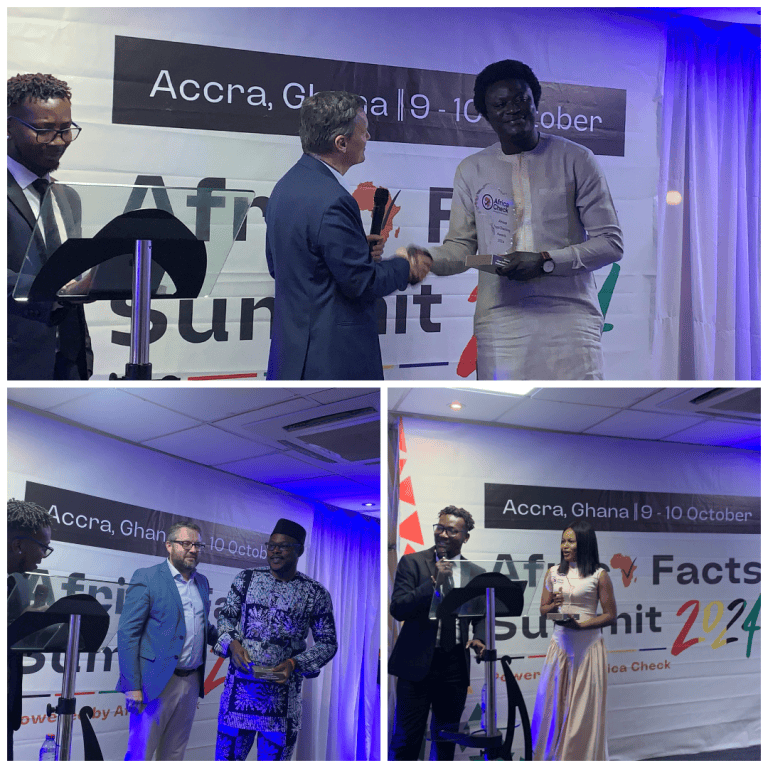
FACT-CHECKERS from The BBC global disinformation team in Nigeria and Faso Check from Burkina Faso have emerged winners at the 2024 African Fact-checking Awards held on Thursday, October 10, 2024, in Accra, Ghana.

The award ceremony, hosted by Africa Check, was the peak of the two-day Africa Facts Summit held from October 9 – 10 at the University of Ghana in Accra.

The award had participants from various African countries and winners were announced in three categories, namely: Fact-check of the year by a working journalist, Fact-check of the year by a student journalist, and Fact-check of the year by a professional fact-checker.

READ: AFP, Dubawa, TheCable, others win 2023 African Fact-checking Awards

In the professional fact-checkers category, Adnan Salif Sidibe from Faso Check, emerged winner with his fact-check of a claim that was made at the opening ceremony of COP28 in 2023.

While acknowledging the honour of receiving the award, Sidibe thanked the summit organisers for giving fact-checkers the platform to showcase their crafts.

In the working journalist category, the trio of Chiagozie Nwonwu, Fauziyya Tukur & Olaronke Alo from the BBC global disinformation team were declared the winner with their fact-check on a claim about the alleged certificate forgery of the current Nigerian President, Bola Ahmed Tinubu.

Speaking with The FactCheckHub at the gala award event held at the Lancaster Hotel, in Accra, Ghana, Nwonwu thanked the organizers of the event while noting that he was happy to receive accolades from colleagues as this is the second accolade they would be receiving for the story due to the sensitive nature of the fact-check.

“It’s very important for us to be recognised for this; these came with a lot of death threats. We had to shut down our Twitter (X) handles… we wanted to hold the government accountable, we wanted to hold the president accountable. There was a lot of internal rebuke done on this story and this is the second time I’m being very happy about this story. This is the second time we are getting thumbs up from colleagues. Thank you,” he told the elated audience at the event.

ALSO READ: Fact-checkers, media urged to sanitise Africa’s information landscape

In the student journalist category, Rita Enemuru, a student at the University of Uyo, in Akwa Ibom, Nigeria took home the prize.

Enemuru expressed her gratitude to Africa Check for giving young people including students like her the opportunity to showcase their talent and professionalism while also thanking her superiors for their motivation.

AF2024: Fact-checkers, media urged to sanitise Africa’s information landscape

0

EXPERTS at the Africa Facts summit have urged journalists and fact-checkers across the continent to sanitise Africa’s information landscape amidst surge in global information disorder.

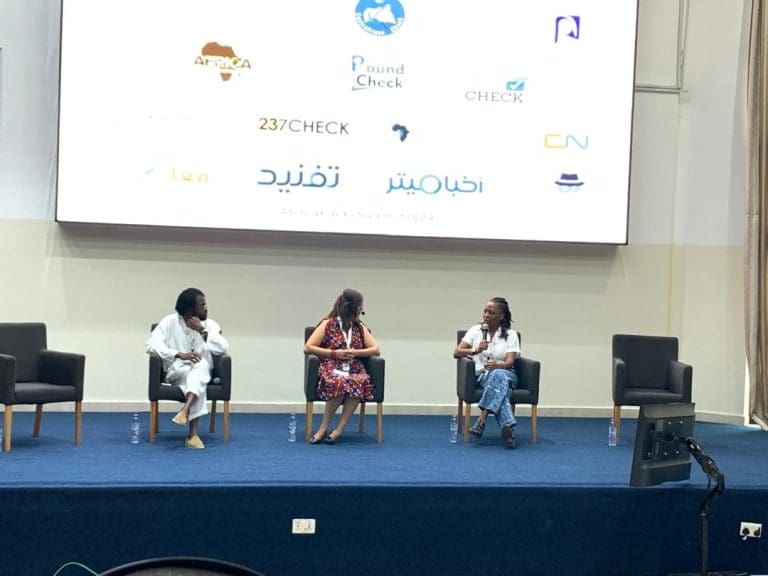
They gave the charge at the Africa Facts Summit 2024 which kicked off on October 9, in Accra, Ghana and which brought together some of the continent’s brightest minds in the fight against misinformation and disinformation.

With the theme “Challenges, Innovations, and Strategic Responses to Countering Mis- and Disinformation in Africa,” the two-day summit aims to reshape the narrative on fact-checking and build resilience against digital deception across Africa.

Noko Makgato, Executive Director of Africa Check, opened the summit with a rallying call for unity in the fight against misinformation and disinformation.

READ: AFP, Dubawa, TheCable, others win 2023 African Fact-checking Awards

“Let us draw inspiration from each other and unite in our mission to uphold the principles of transparency and trust,” he urged the gathering of fact-checkers, academics and journalists from various parts of the African continent.

His message set the tone for a summit filled with stimulating discussions, workshops, and a renewed focus on collaborative solutions.

“Your voice is crucial in shaping the future of fact-checking on the continent,” Makgato emphasized, encouraging active participation from all attendees.

Also speaking, Professor Abena Yeboa-Banin from the University of Ghana‘s Department of Communication Studies highlighted the critical need to clean up Africa’s information landscape. She noted that while global attention on misinformation grows, African nations often bear the brunt of disinformation campaigns, exacerbated by government responses that sometimes restrict free speech.

“If you move across our continent, there is a constant target of misinformation directed at our various countries and citizens,” she said, pointing out Africa’s vulnerability to foreign information manipulation.

Her remarks underscored the urgency to address these challenges not just from a technological perspective, but also through policies that protect the integrity of information without stifling freedom of expression in the continent.

In her keynote address, Onica Makwakwa, Executive Director of the Global Digital Inclusion Partnership, stressed the need for a culturally sensitive approach to combating misinformation and disinformation on the continent.

“While these issues are global in nature, we have a unique situation in our continent,” she said. “We’ve got multiple cultures, languages, and histories, as well as an inherited legacy of mistrust. The colonial legacy of manipulating information still lingers.”

Makwakwa highlighted the absence of Africa’s linguistic and cultural diversity in the digital space, calling it a missed opportunity both for preserving indigenous languages and for reducing misinformation.

“We need to see this diversity as a strength, not a barrier,” she added, pushing for an African-centered strategy that respects the continent’s unique context.

A panel discussion titled “Lessons Learned from Covering the Presidential Elections in the DRC and Senegal” brought real-world insights into the mix. Ange Kasongo of Balobaki Check and Valdez Onanina of Africa Check shared their experiences on how collaboration among fact-checkers helped curb misinformation during these critical elections.

Onanina lauded the Nigerian Fact-Checkers Coalition for its innovative approach, which served as a model for guiding fact-checking efforts across Africa and especially during Senegal’s presidential election in 2023.

Among the summit’s most thought-provoking presentations was “Tall Tales: When Journalists Invent Fiction,” delivered by Professor Peter Kimani of the Aga Khan Graduate School of Media and Communications in Kenya. He dissected the phenomenon of fabricated news stories and their impact on public trust.

Another session led by Kwaku Krobea Asante from FactCheck Ghana tackled the troubling rise of gendered and sexualized disinformation in Africa. Asante’s analysis shone a light on the specific tactics used to target women in public life, urging for more robust strategies to counteract these digital attacks.

As the Africa Facts Summit 2024 ends on Thursday, this summit marks not just a gathering of experts but a pivotal step toward a future where misinformation is met with swift, strategic and collaborative responses, ensuring that truth and accuracy hold firm in the face of digital deception.

Image does NOT show soiled cash bundles recovered from Maiduguri flooding

0

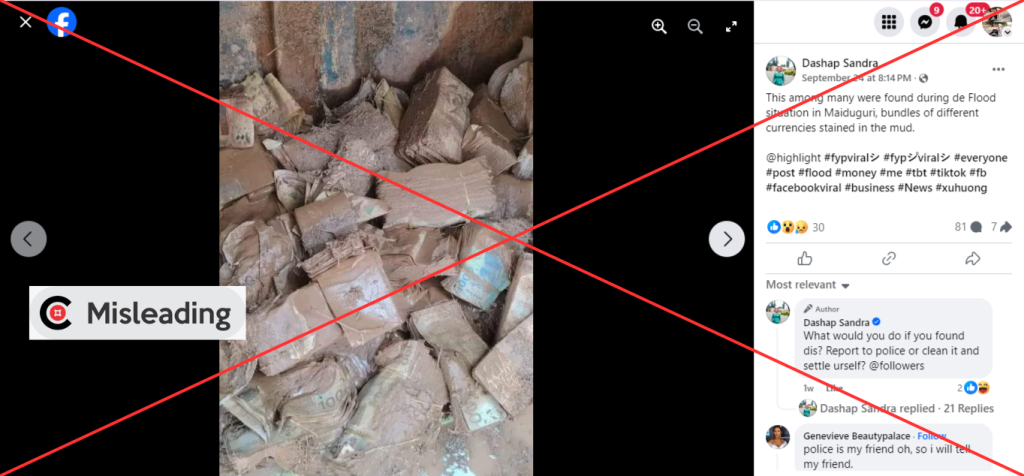
A Facebook user, Dashap Sandra, has shared an image of bundles of a legal tender with a claim that it was part of the items found and recovered from the Maiduguri flooding.

In the image, stack of cash bundles could be seen with soil stains all over it, making it hard to decipher which type of currency it is.

READ: Video of ‘flooding in Italy’ shared by Joe Igbokwe is from mudslide in Japan

The caption on the image read:

This among many were found during de Flood situation in Maiduguri, bundles of different currencies stained in the mud.

As at the time of filing this report on October 7, 2024, the post had garnered a significant amount of reactions from other online users who believe it to be true.

Recall that the collapse of Alau Dam on September 9, 2024, had led to severe flooding in Maiduguri, Borno State, causing considerable humanitarian challenges. Reports show that at least 37 people have died, and more than 1 million residents have been displaced throughout the region.


CLAIM

Image shows soiled cash bundles recovered from Maiduguri flood in Borno State.


THE FINDINGS

Findings by The FactCheckHub show that the claim is MISLEADING, as this particular incident happened in northern Sudan and unrelated to flooding in Nigeria’s Borno State.

Screenshot of the Image extracted from Facebook : insert MISLEADING verdict
Screenshot of the image extracted from the Facebook account. Insert: MISLEADING verdict.

When our fact-checker conducted a reverse image search on the image using Google Lens, few Arabic texts, which suggests an headline, were noticed on the image.

After translating the Arabic texts with Google Translate, it read:

It was hidden in a warehouse.. A huge financial fortune in Sudanese currencies was swept away by flood waters.. Local news

Media reports note that in August 2024, severe floods hit northern Sudan, causing significant damage to over 10,000 homes, in the regions north of Dongola city and the city of Abu Hamad in River Nile State, where the rains and flooding have been particularly intense.

“In the past few days, massive floods have swept through several areas in northern Sudan, completely or partially destroying more than 10,000 homes. The intensity of the rains and floods was great in the areas north of Dongola city, in addition to the city of Abu Hamad in River Nile State”, part of the report read.

ALSO READ: No! Video does not show dead bodies recovered from Borno flood

Several local and international media houses also reported the same incident in August 2024, thus corroborating the fact that the flooding involving the cash bundle happened in Sudan and not Maiduguri as claimed.

The report further stated that this has sparked significant environmental concerns, as floodwaters have mixed with waste from numerous mining sites in the area, carrying it into the Nile River, which serves as the primary source of drinking water and irrigation for agricultural projects in the country.

Image of a Sudan Currency

After observing the one of the currency in the image, checks showed that it was part of the official legal tender in northern Sudan.


THE VERDICT

The claim that image shows soiled cash bundles recovered from Maiduguri flood is MISLEADING; they were recovered from a flooding incident in northern Sudan, not Nigeria.

No! Photo does not show Rivers’ INEC Commissioner wearing Tinubu’s cap

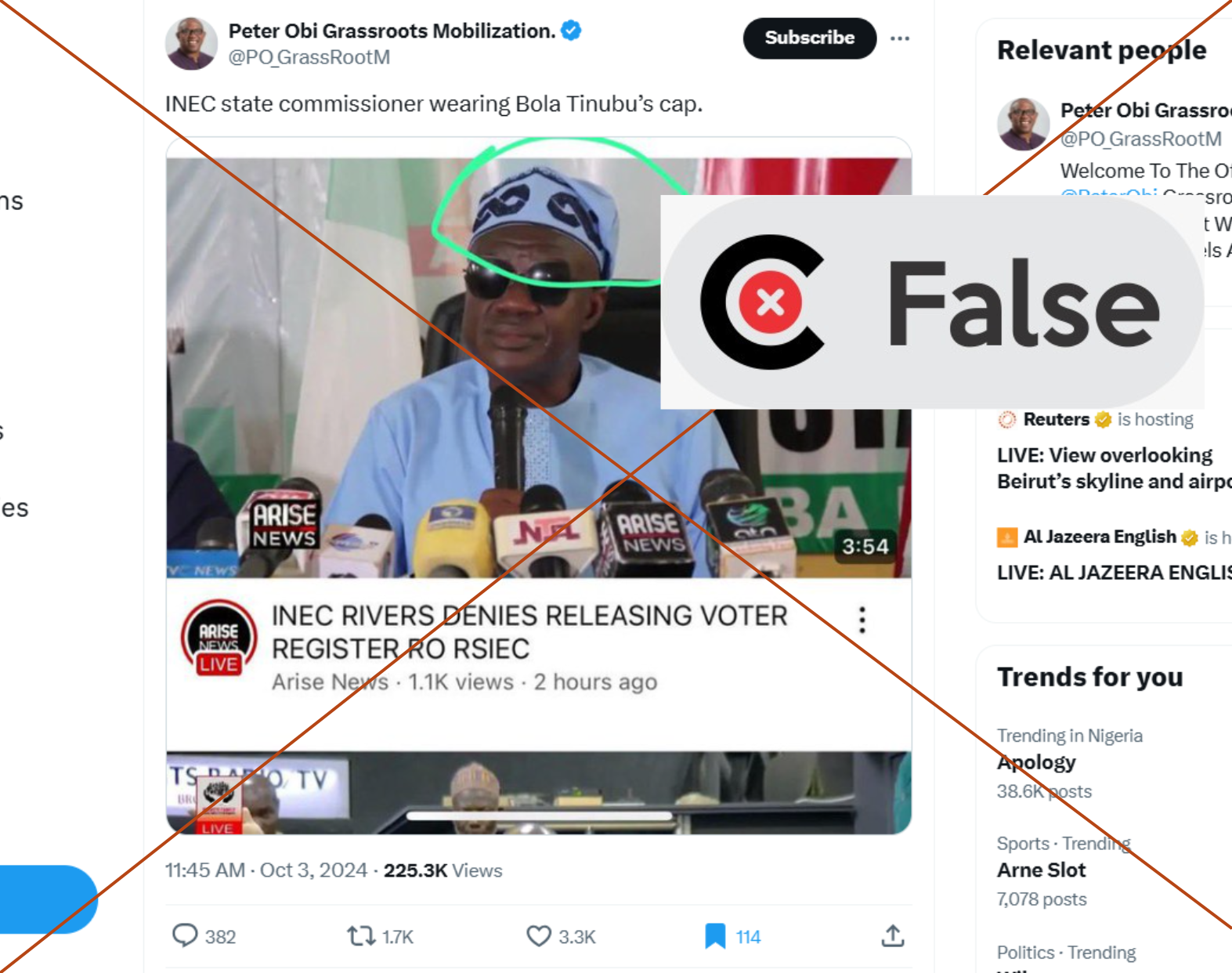
AN X account, @po_grassrootm, has posted an image showing a man wearing a cap with a logo identical to the one on President Bola Ahmed Tinubu’s cap with a claim that it shows the Rivers State commissioner of the Independent National Electoral Commission (INEC).

The claim is circulating ahead of the Local Government election scheduled to hold on Saturday, October 5, 2024 in Rivers State.

The post read: “INEC state commissioner wearing Bola Tinubu’s cap.”

READ: 2023: Photoshopped picture of Peter Obi in Tinubu’s ‘cap’ circulates online

It has generated over 245,000 views with more than 1,800 reposts and over 3,600 likes as of October 4, 2024.


CLAIM

Image shows Rivers’ INEC Commissioner wearing a cap with Tinubu’s logo.


THE FINDINGS 

Findings by The FactCheckHub show that the claim is FALSE.

screenshot of the the viral post purportedly showing INEC commissioner wearing a cap with Tinubu's logo
Screenshot of the viral X post purportedly showing the INEC commissioner in Rivers State wearing a cap with Tinubu’s insigna.

Rivers State governor, Similanayi Fubara, has insisted that the local government election in the state will be held on October 5, 2024 despite a court order which barred the Independent National Electoral Commission (INEC) from releasing voters’ registers to the Rivers State’s Independent Electoral Commission (RSIEC).

The ICIR reports that the governor’s decision is in violation of the order by the Federal High Court presided over by Justice Peter Lifu.

Lifu had barred the INEC from releasing voters’ registers to RSIEC. The court also stopped the Inspector General of Police (IGP) and the State Security Service (SSS) from providing security during the election.

The judge, Peter Lifu, issued the order on a lawsuit filed by the All Progressives Congress (APC). Lifu ruled that the RSIEC erred in scheduling the poll for October 5, 2024, without adhering to the necessary laws governing the local council election.

ALSO READ: 2023 elections: Did Ayade lose APC senatorial ticket in Cross River?

Findings show that the viral screenshot was taken from an Arise TV’s broadcast aired on October 3, 2024.

Our fact-checker further used Pimeyes to run an online search on the image obtained from a screenshot of the man in glasses in the video. The result shows that he’s not the state’s commissioner for the electoral body but rather the embattled Caretaker Committee Chairman of the All Progressives Congress (APC) in Rivers State, Tony Okocha.

File photo: Tony Okocha.

Okocha, who served as Chief of Staff to Amaechi from 2007 to 2015, was recently ousted as the Rivers APC Caretaker Committee chairman by a Port Harcourt High Court presided over by Justice Sika Aprioku.

Justice Adolphus Enebeli.

Additional findings by The FactCheckHub show that the Chairman of the Rivers State Independent Electoral Commission (RSIEC) is Justice Adolphus Enebeli. He was once a High Court chief judge in Rivers State before he was appointed as the chairman of the state electoral commission.


THE VERDICT

The claim that the image shows an INEC commissioner in River State wearing a cap with Tinubu’s logo is FALSE; the man in the photo is an APC member, Tony Okocha.

Did FG exclude institutions in Southeastern Nigeria from its student loan?

AN X user, @engrico2015, has claimed that the Nigerian government excluded tertiary institutions from the Southeastern region from its students loan scheme it launched earlier this year.

He made the claim on October 1, 2024 on his X post. It read:

“When they borrowed $5b from China , they excluded southeast in the railway project! Currently the school loan also southeast was excluded!

Southeast not also good to be president, but you are bringing Boko Haram from Borno to DUMP in IMO state ! We igbos will resist you.”

The post has garnered more than 80,000 views with over 1,500 reposts and over 3,200 likes as of October 3, 2024.


CLAIM

Federal Government excludes institutions from the Southeastern region from its students loan scheme.


THE FINDINGS 

Findings by The FactCheckHub show that the claim is FALSE, as four tertiary institutions from the region have benefited from the initiative so far, according to NELFUND.

Screenshot of the viral post claiming that South East was excluded from Student Loan
Screenshot of the viral X post which claimed that South East was excluded from Students Loan initiative.

The Bola Tinubu administration introduced the Nigerian Education Loan Fund by signing the Students Loan Act in June 2023. This initiative aims to provide interest-free loans to Nigerian students in public tertiary institutions, enabling them to afford tuition fees amid the economic hardships in Nigeria. The Act was later amended and revised in April 2024.

Under the scheme, eligible students can apply for loans that cover their tuition fees, with the expectation that they will begin repayment two years after completing their education or securing a job. 

The loans are managed by the Nigerian Education Loan Fund (NELF), in collaboration with commercial banks and other financial institutions. The goal is to alleviate the financial constraints that prevent many Nigerians from completing their tertiary education.

In August 2024, the organization said it disbursed N2,946,927,155 of the students loan to 27,667 students from 19 institutions nationwide.

This development was after it had said students from 22 state-owned tertiary institutions had been cleared to apply for the students loan after a review by the committee for the Student Verification System, which brought the total number of approved state institutions to 108 across the country. 

However, none of these institutions which received the first tranche of the disbursement was from Southeastern Nigeria. This development prompted the speculation of alleged discrimination against the region. 

Meanwhile, the NELFUND clarified that the reason was due to the failure of institutions from the region to respond to its request for verification of students for disbursement.

The FactCheckHub reviewed the list of eligible institutions for the loan and confirmed that the initiative included 9 institutions from the Southeastern region which are: Abia State University, Uturu; College of Education, Nsugbe; Chukwuemeka Odumegwu Ojukwu University; Ebonyi State University, Abakaliki; University of Medical and Applied Sciences, Enugu State; Imo State University of Agriculture and Environmental Sciences, Umuagwo; Kingsley Ozumba Mbadiwe University; Benjamin Uwajumogu State College of Education, Ihitte Uboma; Imo State Polytechnic, Omuma.

On September 6, 2024, the NELFUND revealed that four universities from the South-East region received the loan disbursement bringing the total number of beneficiaries across the country to 59. 

The Federal Polytechnic Nekede in Imo State received N368,400.00; and the Michael Okpara University of Agriculture, Umudike in Imo State was allocated N71,016,220.00 while Ebonyi State University in Ebonyi State was allocated N78,313,000.00. Additionally, Alex Ekwueme Federal University in Ndufu, Anambra State, received N193,377,100.00, NairaMetrics.com reported.


THE VERDICT 

The claim that institutions from Southeastern Nigeria were excluded from the Nigerian government’s students loan scheme is FALSE; at least, four tertiary institutions from the region have benefited from the initiative so far, according to NELFUND.