Home Blog Page 55

Image showing Tinubu on sickbed is doctored!

0

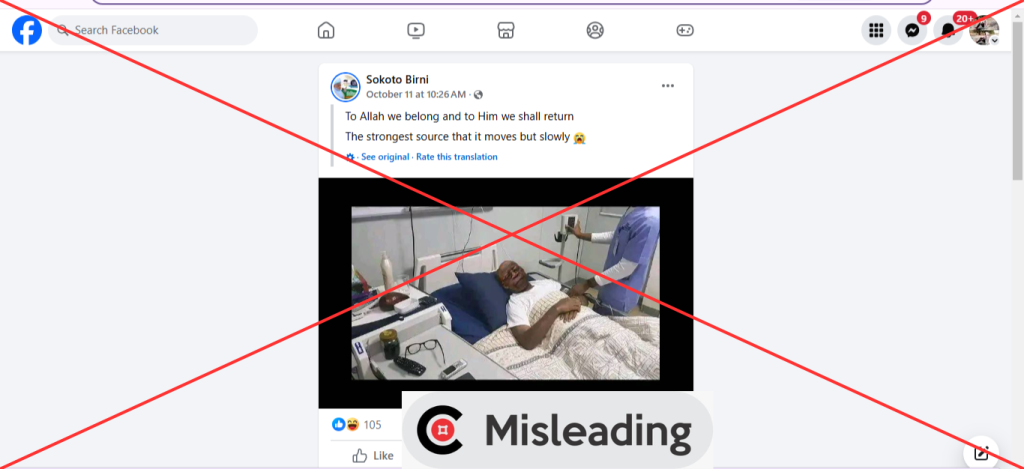
A Facebook user, Sokoto Birni has shared an image that shows the Nigerian President, Bola Ahmed Tinubu, lying down on a sickbed in a hospital.

In the image, Tinubu could be seen lying down on the bed while a doctor examined him.

The image also had a caption which was originally written in Hausa language but was translated automatically using Google Translate to read:

“To Allah we belong and to Him we shall return The strongest source that it moves but slowly.”

READ: Doctored video of Tinubu promising to reduce purchasing power resurfaces online

The FactCheckHub observed in the post’s comments section that some of the followers of the poster believed the message to be true, hence why we fact-checked them.

CLAIM

Image shows Tinubu on sickbed.

THE FINDINGS

Findings by The FactCheckHub show that the claim is MISLEADING, as the image has been doctored.

Screenshot of the claim extracted from Facebook; Insert MISLEADING verdict
Screenshot of the claim extracted from Facebook. Insert: MISLEADING verdict.

When our fact-checker subjected the image to a Google Reverse Image Search, the results indicate that the image dates back to 2018.

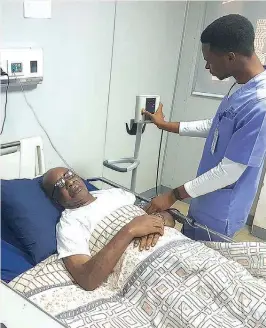
The original image was taken after Sunmi Smart-Cole, a veteran Nigerian photojournalist, was discharged from a Lagos hospital following a week-long stay there.

The actual Image showing Sunmi Smart-Cole in the hospital
The actual Image showing Sunmi Smart-Cole in the hospital.

According to The Guardian, Mr. Smart-Cole had been hospitalized for injuries sustained when some presidential security personnel allegedly manhandled him during former President Muhammadu Buhari’s visit to Lagos State in March 29, 2018.

The same Smart-Cole’s images were shared online during the period as seen here and here.

ALSO READ: TB Joshua – Video of Tinubu criticizing BBC documentary is doctored!

In addition, our fact-checker reviewed media reports around October 11, 2024 and confirmed that President Tinubu was actually in Paris, France, on a work leave then, as reported by some media outfits including Channels TV and The Cable etc. He has made other public appearances since then.


THE VERDICT

The claim that the image shows Tinubu on sickbed is MISLEADING; the original image shows Sunmi Smart-Cole, a veteran photojournalist on the hospital bed.

Navigating misinformation in the 2024 US election: What voters need to know

0

THE 2024 US presidential election billed for Tuesday, November 5 will determine the country’s leadership and set the course of policy and governance for the next four years.

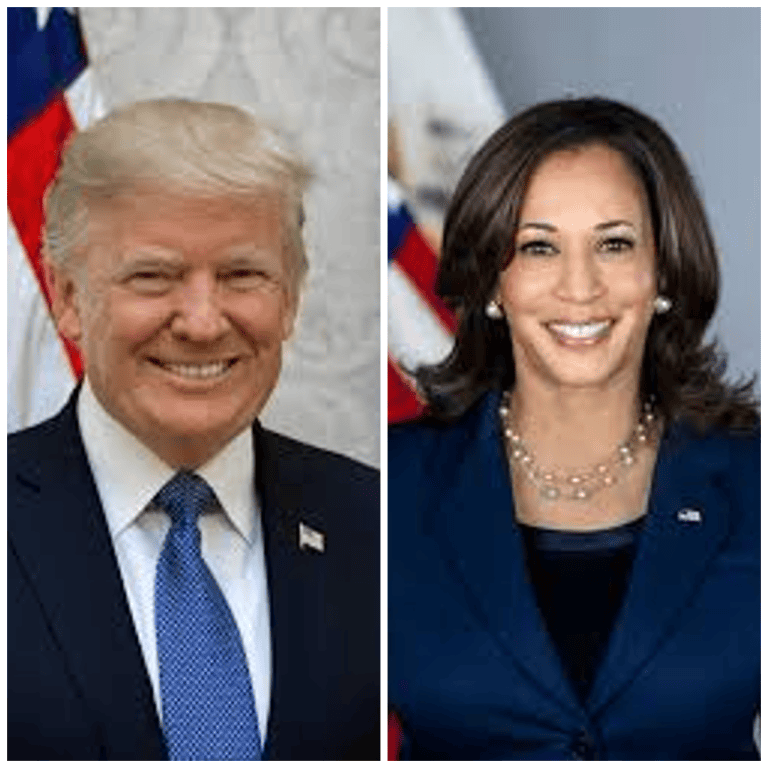
With Republicans’ Donald J. Trump and Democrats’ Kamala Harris as the top contenders in this election, it is expected to focus on key issues like economic policy, healthcare, climate change, foreign relations, immigrant rights and social justice.

Given the polarized political landscape and ongoing debates around voting access, misinformation, and election integrity, the race is anticipated to be scrutinized intensively both within the United States and globally.

READ: Disinformation actors are using crypto to influence elections – Report

As with previous elections, misinformation has flooded online and social platforms, with a notable increase in deepfake content targeting prominent candidates like Vice President Kamala Harris and former President Donald J. Trump. 

Voters should be on the lookout for these manipulative tactics, which may include false portrayals of candidates making inflammatory statements or engaging in unethical behavior.

Understanding and identifying deepfake technology, along with other misinformation tactics like false claims about voting requirements, fabricated polling location closures, and incorrect result projections, is essential for navigating this election with critical thinking skill to avoid being misled with false narratives.

The FactCheckHub has compiled some types of election-related misinformation to watch out for, how to report misinformation on social media platforms and where and how to verify information.


Election-related misinformation to watch out for

False claims about voting processes

Common misinformation includes false eligibility rules, incorrect election dates, misleading polling location information, and claims that people can vote by text or social media—all of which are FALSE.

Additionally, some posts may wrongly suggest extra documentation is needed at the polls, while others spread rumors of tampered voting machines or materials to undermine trust. These tactics aim to mislead voters and erode confidence in the election process.

AFP had also reported some voting falsehoods being spread by misinformation purveyors.

Misleading polls and statistics

Misleading polls and statistics are a common form of election-related misinformation that can shape public perception by distorting support for candidates.

For instance, polls with small sample sizes or selective reporting may exaggerate a candidate’s lead or downplay their opposition, creating a false sense of momentum. This can discourage voter turnout or sway undecided voters based on an illusion of popular opinion.

By carefully timing these misleading poll releases, campaigns or interest groups may attempt to influence voter behavior and erode trust in legitimate polling, contributing to a larger environment of election misinformation.

Disinformation about candidates

Disinformation targeting candidates, including fake news and doctored media, has intensified during this year’s U.S. election, with advanced deepfakes being deployed to spread convincing but false depictions of prominent figures like Trump and Harris. These deepfakes, which can make it appear as if candidates have said or done things they haven’t, quickly circulate on social media, influencing perceptions and reinforcing biases before fact-checking can intervene.

Earlier in March this year, the BBC reported how some Trump supporters target black voters with AI faked images, as Elon Musk also shares manipulated Harris video, thus violating the X platform’s policies.

Amidst the surge in AI-generated Trump and Harris voices, the Washington Post has listed how to avoid falling victim to audio deepfakes of the leading contenders. The platform also published a report which shows how Russian documents it reviewed expose the workings of a Moscow network that has become a potent source of fake news targeting American voters.

Such election-related misinformation is especially harmful, as it damages candidates’ reputations and sows doubt among voters about what is real, eroding trust in legitimate information sources and likely to cast doubt on the election integrity.

Verifying Information

Many false or misleading claims can be countered by checking credible news outlets, official election websites, and reputable fact-checking organizations.

Additionally, it’s important to be aware of confirmation bias, or the tendency to accept information that aligns with one’s views. By acknowledging this bias, individuals can stay objective and better assess information, avoiding the trap of believing unverified or biased sources.

For fact-checking resources, turn to trusted organizations like FactCheckHub, FactCheck.org, PolitiFact, Snopes, AFP Fact Check and The Washington Post’s Fact Checker etc.

ALSO READ: OpenAI disrupts Iranian influence campaigns targeting US election

These platforms help ensure that voters are informed with accurate information and are better equipped to navigate the complex landscape of election-related content.

To learn how to report misinformation on different social media platforms, you can read this report here and here. You may also reach out to us at The FactCheckHub to help quickly verify any information relating to ongoing 2024 US election here via WhatsApp.

How true are Sanwo-Olu’s claims on Lagos budget performance, education?

0

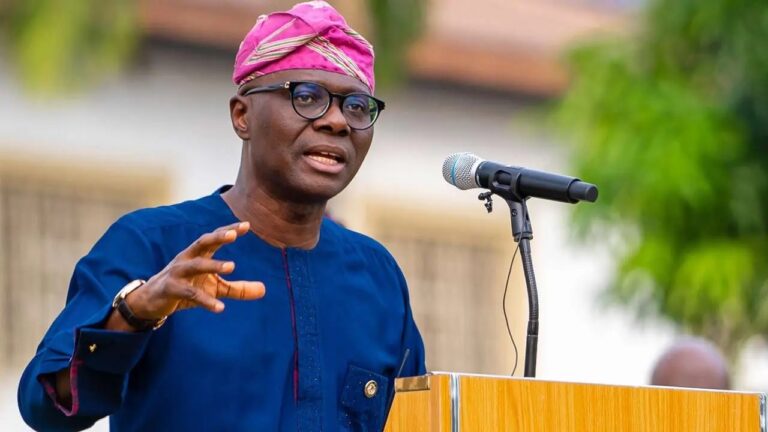
THE Lagos State governor, Babajide Sanwo-Olu, has made multiple claims regarding his achievements as governor since 2019 during an interview on Channels Television’s Politics Today on October 16, 2024.

According to him, Lagos achieves 95 per cent budget performance every year, with the 2024 budget already 90 per cent executed.

He said, “If you see what our budget growth has been in the last five years when we came in, we inherited a budget of about N620 billion, today Lagos State is doing about N2.3 trillion.

“We are probably going to close this year’s budget at about N2.5 trillion. We have tripled the budget of this state and mind you, year-on-year we are doing about 95 per cent budget performance; this year alone we are well over 90 per cent,” the governor said.

Responding to the recent increase in school fees, the governor said the development only affects boarding schools in the state.

“We have over 600 schools in Lagos state that are all public schools. The model schools are just 33-34 of them. The boarding schools are just like half.”

READ: Sanwo-Olu did not announce minimum wage increment in viral video

Sanwo-Olu first became the governor of Lagos State in 2019, following a competitive political journey within the ruling All Progressives Congress (APC). This was after he had earlier emerged as the APC’s gubernatorial candidate defeating the then incumbent governor, Akinwunmi Ambode, in the party’s primary elections in October 2018.

His victory in the primaries was largely backed by influential political figures, including President Bola Ahmed Tinubu, who is a former Lagos governor and key figure in the state’s politics. Sanwo-Olu’s campaign focused on infrastructure development, traffic management, and improving social services under his THEMES agenda (Traffic Management and Transportation, Health and Environment, Education, Technology, Security, and Governance)​.

He secured 739,445 votes, defeating his closest rival, Jimi Agbaje of the People’s Democratic Party (PDP), who garnered 206,141 votes. His tenure officially began on May 29, 2019.

The FactCheckHub reviewed some of the governor’s claims below:

CLAIM 1

Sanwo-Olu said Lagos state budget has tripled from about N620 billion to N2.3 trillion in 5 years.

THE FINDINGS

Findings by The FactCheckHub show that the claim is FALSE.

Checks show that the last budget signed by Sanwo-Olu’s predecessor, Akinwumi Ambode was in February 2018 and it is estimated to be N1.04 trillion.  The budget was tagged, ‘Budget of Progress and Development.’

The budget size comprised N347,038,938,872.00 to be funded from the Consolidated Revenue Fund, and N699,082,242,808. to be funded from Development Fund for both capital and recurrent expenditure for the year ending December 31, 2018.

However, before Sanwo-Olu took over on May 29, 2019,  the state’s House of Assembly had on April 29, 2019 passed into law the 2019 appropriation bill of N852.316 billion presented to the lawmakers by Ambode on Feb.5, 2019. But the budget was upgraded to N873.5 billion and signed into law by Sanwo-Olu after he took over.

The last budget assented to law by Ambode in 2018 and the one met by Sanwo-Olu in early 2019 was higher than the N620billion quoted by the latter during the interview.

In addition, the Lagos annual budget which currently stands at ₦2.267 trillion has not also tripled N1.04 trillion which was the last budget signed by Ambode before he left the office.

THE VERDICT

The claim by Sanwo-Olu that Lagos’ annual budget has tripled in the last 5 years is FALSE; the last budget signed by Ambode, his predecessor, was N1.04 trillion and NOT N620 billion as he claimed.


CLAIM 2

Sanwo-Olu said Lagos is recording 90-94 per cent budget performance year in and year out.

THE FINDINGS

Findings by The FactCheckHub show that the claim is FALSE.

Sanwo-Olu assented to the N2.26 trillion 2024 Appropriation Bill passed into law by the state House of Assembly, on Friday, January 5, 2024. The budget, titled ‘Budget of Renewal’, comprised N1.02 trillion recurrent expenditure, which is 45 per cent of the total budget, and N1.22 trillion capital expenditure, which is 55 per cent of the budget.  Even though a few changes were made to the budget in September, it did not change the size of the budget.

ALSO READ: Omotoso makes false claim as evidence shows Sanwo-Olu paid law firms N200m from state’s coffer

The FactCheckHub reviewed the Lagos state budget performance over the years under Sanwo-Olu to appraise Sanwo-Olu’s claim.

According to the latest state’s budget performance report which is for the second quarter of 2024. The Q2 Cumulative Budget performance of Lagos state was 37.6%, while the Quarterly Budget Performance was 75% for the period which ended 30th June 2024.  This indicates that, as of mid-year, only 37.6% of the total budget had been executed, significantly lower than the 90-94% claimed by Sanwo-Olu.

Moreover, a review of the 2023 budget performance showed that out of a total budget of ₦1.768 trillion, only ₦1.564 trillion was achieved by the end of the year, representing an 88.5% performance. This contradicts Sanwo-Olu’s assertion that Lagos consistently records 90-94% budget performance each year since he took office. Additionally, previous years’ performances revealed that the state recorded 72.2% in 2022 and 85.7% in 2021, indicating that Sanwo-Olu’s claim is FALSE.

THE VERDICT

Sanwo-Olu’s assertion that Lagos State records a budget performance of 90-94 per cent annually is FALSE; the state’s yearly budget has consistently fallen below that range.


CLAIM 3

Sanwo-Olu stated that Lagos State has over 600 public schools, with around 33-34 being model schools, and only a fraction of these are boarding schools.

THE FINDINGS

Findings by The FactCheckHub show that the claim is MOSTLY TRUE.

According to the Lagos State Ministry of Basic and Secondary Education, the state operates 1,021 primary schools, 369 junior secondary schools, and 329 senior secondary schools, bringing the total to 1,719 public schools. Additionally, the ministry confirms that there are 32 model colleges, most of which are boarding schools, except two schools (Vetland Junior and Senior Secondary Schools).

While the governor’s estimate of 33-34 model schools is close, the actual number is 32. However, his claim of over 600 public schools significantly underestimates the total number, which is 1,719.

THE VERDICT

Sanwo-Olu’s claim that Lagos State has over 600 public schools, with around 33-34 being model schools is MOSTLY TRUE; data by the state’s ministry of Basic and Secondary Education ministry show that there are 1,719 public schools in the state, with 32 being model schools.

Image showing SSS officials at national assembly entrance is old!

0

A claim that the State Security Services (SSS) have taken over the National Assembly to impeach the sitting senate president, Godswill Akpabio has surfaced the internet.

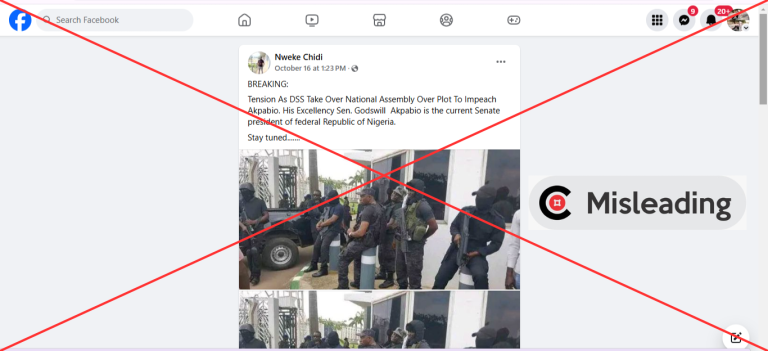
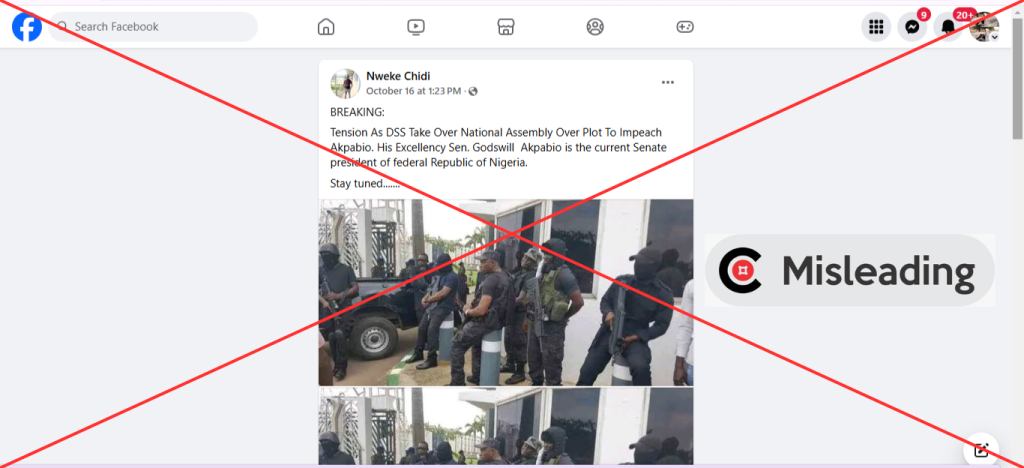
The claim which was contained in a Facebook post by a user on the app, Nweke Chidi stated that there was tension at the National Assembly due to an ongoing plot to impeach Godswill Akpabio.

Alongside the claim, there was an image of men wearing black attire with a camouflage jacket or bulletproof vests while holding guns.

READ ALSO: Video of DSS barring lawmakers from entering National Assembly is over 4 years old

The caption of the post read:

BREAKING:
Tension As DSS Take Over National Assembly Over Plot To Impeach Akpabio. His Excellency Sen. Godswill Akpabio is the current Senate president of federal Republic of Nigeria.
Stay tuned…….

CLAIM

Image shows SSS taking over national assembly to impeach Godswill Akpabio.

THE FINDINGS

Findings by The FactCheckHub indicates that the claim is MISLEADING!

Screenshot of the claim extracted from Facebook. Insert MISLEADING verdict
Screenshot of the claim extracted from Facebook. Insert: MISLEADING verdict.

When a Google reverse image was conducted on the image it provided earlier versions of the image that has been on the internet.

The image was featured on a Facebook post in 2021 and it was also featured in a blog post about SSS officials blocking the entrance to the National Assembly, reportedly due to a plan to impeach then-Senate President Bukola Saraki.

A keyword search on the words “Saraki SSS Impeach National Assembly” provided search results of news reports regarding the issue.

Several media outlets, including Premium Times, The Punch, and The Cable, reported that State Security Service (SSS) officers had blockaded the national assembly, preventing lawmakers and staff from entering the premises.

Some lawmakers had suggested the security lockdown was intended to support senators aligned with the former President Muhammadu Buhari in a bid to impeach the then Senate President, Bukola Saraki and his deputy, Ike Ekweremadu.

ALSO READ : False claim on presidential aircraft attributed to Akpabio circulates online

Further findings showed that the claim had been dismissed by Senate President Godswill Akpabio.

He had assured lawmakers that claims circulating on social media about the SSS surrounding the assembly to block a potential impeachment of principal officers were false.

THE VERDICT

The claim that the image shows SSS taking over national assembly to impeach Akpabio is misleading; the image have been on the internet as far back as 2018.

50 African fact-checking organisations sign declaration on information integrity

0

AFRICAN  fact-checkers from over 50 organisations spanning at least 30 countries have united under a new declaration to confront the spread of false information on the continent.

This was contained in a statement signed by the Executive Director of Africa Check, Noko Makgato on Wednesday, October 30, 2024.

The statement noted that the Accra Declaration on Information Integrity and Resilience, which was unveiled at the sixth annual African fact-checking summit in Ghana, outlines a commitment to bolster information integrity and expand media literacy among Africa’s youth and underserved communities.

ALSO READ : AF2024: Fact-checkers, media urged to sanitise Africa’s information landscape

“In signing the Accra Declaration on Information Integrity and Resilience, the organisations pledged to engage civil society, responsive governments, technology platforms, regional, global and multilateral institutions and communities to build information hygiene, integrity and entrench information resilience.

The fact-checkers will offer information resilience clinics to Africa’s young people – who make up more than 60 per cent of the continent’s population – to help them read smarter, listen objectively, spot dodgy information and debunk falsehoods” part of the statement read.

Makgato noted that after promoting honest debate and information hygiene for a decade, these principles are now formally set to rebuild information integrity across Africa.

“For the last decade, we have been speaking about the value of honest public debate, maintaining information hygiene, and ensuring that public figures in Africa make decisions based on quality data and facts. Now, we have put all the ideas on paper as a first step to building – or rebuilding – information resilience and integrity on the continent.” Makgato said.

The statement further highlighted that the organisations plan to broaden their reach to community radio and local media—key news sources in rural areas with limited or no internet. Fact-checkers will also visit schools, community centers, and homes lacking internet, empowering people to critically assess information, verify sources, and counter falsehoods.

The head of outreach and impact at Africa Check, Hlalani Gumpo stated that the Africa Facts Network’s reach across 30+ countries in twelve years highlights the urgent need to tackle misinformation.

“Seeing the Africa Facts Network’s footprint in more than 30 countries within twelve years of Africa Check’s pioneering role on the continent signals the enormity of the harm done by false information and the urgency to innovate and work together to fight mis- dis- and malinformation.”  Gumpo stated.

ALSO READ : Media literacy: equipping Nigerian youths against misinformation

The statement further highlighted that the declaration emphasizes key concerns for African fact-checkers, including gendered disinformation, language diversity, vulnerable offline communities, climate issues, media distrust, resource limitations, and politically sensitive contexts.

It also acknowledges the risks of harassment and violence faced by fact-checkers and investigative journalists, urging governments and advocacy groups to support policies and rapid-response measures for their protection.

Additionally, the organisations have committed to working with tech partners on AI-driven tools to strengthen their operations and aid communities in combating misinformation.

Did Jonathan inherit over $50bn foreign reserve? 

1

AN X user, Wale Adebayo(@Mari09ja) has claimed that former President Goodluck Ebele Jonathan inherited a foreign reserve of over $50bn when he assumed the position of president in 2010 but spent it all before he left office.

He posted, “If Jonathan and his mismanagement team did not happen to Nigeria, we should be on about $200bn foreign reserves by now. Man inherited over $50bn and blew it away without any concrete thing to point to.”

The claim has generated over 161 reposts and more than 600 likes as of October 30, 2024.

A screenshot of the post.

CLAIM

President Goodluck Ebele Jonathan inherited over $50bn as foreign reserve

THE FINDINGS 

Goodluck Jonathan became Nigeria’s president in 2010 following the death of President Umaru Musa Yar’Adua, under whom Jonathan had served as vice president. When Yar’Adua fell ill and was unable to govern, Jonathan was appointed acting president. After Yar’Adua’s death on May 6, 2010, Jonathan was sworn in as president to complete the term.

In 2011, he contested and won the presidential election. In 2015, Jonathan sought re-election but lost to Muhammadu Buhari. After losing the 2015 presidential election to Muhammadu Buhari, he officially handed over power on May 29, 2015

The FactCheckHub reviewed the data recorded by the Central Bank of Nigeria over the years and the result showed that Nigeria’s foreign reserve stood at $40bn [$40,101,372,983.21] when Jonathan became the President on May 6, 2010, lower than the figure quoted by the X user. The figure is as of May 5, 2010.

Meanwhile, when he was leaving the position, he handed over $29.6bn [$29,595,2847,88.81] as gross foreign reserve to his predecessor, Muhammadu Buhari. The figure is as of May 28, 2015. 

When he was named acting president on February 9, 2010 the gross foreign reserve was $43bn [43,090,686,356.03] as of February 8 and was $42.8bn [42,823,046,920.17] as of February 9.

THE VERDICT 

The claim that Jonathan inherited over $50bn as a foreign reserve and squandered it all is FALSE as findings showed the ex-president met $40bn when he assumed office on May 6, 2010 and left $29.6bn when he left office on May 29, 2015.  The foreign reserve when he was named acting president was also less than $50bn. It was $43bn.

Update: a paragraph was added to note how much was the foreign reserve when Jonathan became the acting president. 

Media literacy: equipping Nigerian youths against misinformation

0

In today’s fast-paced digital space, Nigerian youths are constantly immersed in an endless stream of information, primarily driven by social media platforms. While this access offers numerous opportunities for learning and engagement, it also comes with significant challenges, most notably digital information overload.

This overload, fuelled by the sheer volume of content, often leads to short attention spans, quick consumption of information, and exposure to conflicting narratives from various sources. The result is information disorder, where misinformation, disinformation, and mal-information mix, creating confusion. For young people, this can also lead to psychological stress and disorder, making it harder to navigate the complexities of the digital world.

Media literacy as a solution

The Global Media Literacy Week highlights the importance of media literacy and the question of how young Nigerians can become more media-savvy and avoid falling victim to fake news.

Global media and Information Literacy (MIL) Week, organised by UNESCO, is an annual event from October 24-31 that promotes media and information literacy worldwide. It aims to empower individuals with skills to critically evaluate information, combat misinformation, and engage responsibly with media.

READ: How ICIR-led fact-checking clubs in Nigerian universities are taking media literacy campaigns to grassroots

The impact of misinformation in society and on individual decision-making is overwhelmingly negative. It can harm public health, as seen during the COVID-19 pandemic, escalate conflicts, influence election outcomes, and undermine social cohesion. In times of crisis, such as political or social unrest, misinformation can heighten tensions, further complicating efforts to restore order.

A recent report from The FactCheckHub details how information disorder can fan the embers of chaos, especially during times of public unrest. To mitigate these harmful effects, combating misinformation through media literacy education, fact-checking, and responsible digital citizenship is crucial.

The executive director of Round Check, Caleb Ijioma highlighted that media literacy empowers youths to think critically, recognise information’s impact, and grasp the intent behind media messages.

“In most situations, many Nigerian youths do not understand certain narratives, policies, acts, bills, or laws and therefore act and respond blindly. This is not to say they aren’t active citizens; however, to be actively involved in society, they must learn to understand the messages communicated to them.

Media literacy helps people think critically, understand the impact of information, and grasp the motives and actors behind it; it also focuses on understanding how these media messages are created. When this is done, people can make informed decisions, rather than decisions made with a half-formed understanding of events.” Ijioma stated.

Empowering youth through fact-checking

The ICIR, through its Countering Misinformation and Media Literacy project, took this challenge head-on by training students from 12 Nigerian universities. In these sessions, students acknowledged that they had, at some point, fallen victim to misinformation or disinformation.

However, after two days of intensive training, they honed their fact-checking skills and attested to their newfound ability to recognise and counter information disorder.

The impact was profound and in some of the universities, fact-checking clubs were established, helping to pass on these critical skills to others. These clubs also organised awareness campaigns, spreading the message of responsible media consumption far beyond the classroom.

One student, Abdulrasheed Akere from Usman Danfodiyo University Sokoto, highlighting the tangible impact of the training, said, “the prevalence of misinformation on campus has significantly reduced. Now, most students reach out to the fact-checking club before reposting or sharing any information they see on social media.”

Influencers and Misinformation

An analysis by The FactCheckHub showed how social media influencers tried to launder the image of former Minister of Humanitarian Affairs Betta Edu after her suspension by President Bola Tinubu.

Following allegations of approving the transfer of N585 million into a private account, social media users launched a coordinated campaign, posting at specific times to whitewash her image.

The negative impact of such coordinated campaigns, particularly when driven by influencers, can be far-reaching.

Their trusted voices easily amplify disinformation, manipulating their followers without them even realising they are being targeted.

Over time, these operations can damage the credibility of the influencers, polarise audiences, and exacerbate social, political, or ethnic tensions—leading to conflict.

Ijioma further noted that to critically assess media, one must understand how messages are crafted and their impact. Disinformation often exploits biases, prompting impulsive sharing without scrutiny, which can be dangerous.

ALSO READ:How information disorder heightens tension, confuses public during crisis

“Disinformation actors use different approaches to spread their messages, one of which is leveraging people’s biases and emotions. People need to be cautious about this and avoid deciding to share something simply because it aligns with their biases. These actors want you to believe the message, so due to your biases, you may share without critically examining it, and that information can endanger lives.

“Also, consider what the message is promising: is it realistic? Do the promises in the message sound plausible? Is it achievable? Question these messages. Another important skill is identifying and understanding the difference between fact and opinion and recognising media manipulation,” he stated.

Old video of flooded Ore bridge recirculates online

0

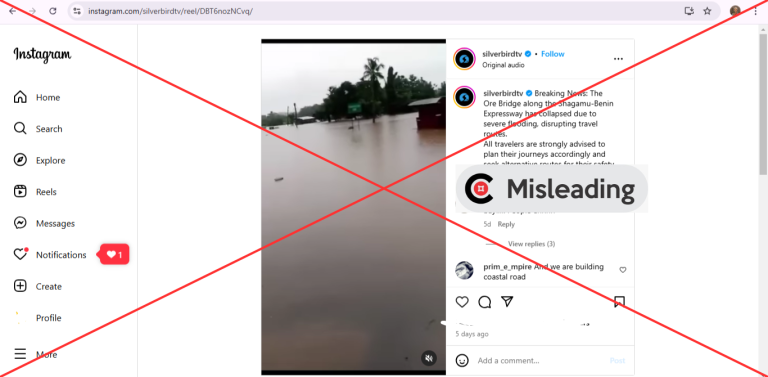
A claim that the Ore bridge on Shagamu-Benin expressway has collapsed has been making rounds particularly on Instagram.

The claim was contained in a video which is over a minute long. In the video, people could be seen stranded with cars parked on the road while the road looked flooded.

The audio of the video is of a man saying, “This is Ore, heavy flood, Lagos road don close, flood don cover everywhere for Lagos road. This is Ore, no road Ore. This is Ore. Una dey see the flood. Lagos road Ore, See flood,  Lagos road don jabrata.  Flood don block the road, una dey see the flood. Una dey see the flood [sic]”.

READ: No! Video does not show dead bodies recovered from Borno flood

The Caption read:

Breaking News: The Ore Bridge along the Shagamu-Benin Expressway has collapsed due to severe flooding, disrupting travel routes.
All travelers are strongly advised to plan their journeys accordingly and seek alternative routes for their safety.

The video was posted on Monday October 21, 2024 by different accounts on Instagram as seen here, here, and here

Two of the accounts that posted the video are popular organisations namely Silverbird Television and Nigerian Tribune newspaper and the video has amassed significant number of tractions from its appearances.

Ore road often referred to as the Benin-Ore Expressway, is a major highway connecting the southwestern city of Benin in Edo State to Ore in Ondo State.

This road is part of the larger Benin-Shagamu Expressway, serving as a critical transportation link for moving goods and people between Lagos, and other southern and eastern regions. The Ore Bridge spans across a major road junction where the Lagos-Benin Expressway meets the Ondo-Ore axis.

CLAIM

Video shows recent flooding due to Ore bridge collapse.

THE FINDINGS

Findings by The FactCheckHub shows that the claim is MISLEADING!

Screenshot of an appearance of the claim on Instagram; Insert MISLEADING verdict

A keyframes analysis conducted on the video led our fact-checker to a previous appearnce of the video on YouTube.

The video uploaded on YouTube by Njenje Media TV was a longer version which was nearly four minutes long and it was uploaded on August 2, 2023.

Further findings by The FactCheckHub shows that a recent flooding incident on October 4, 2024, affected Akure road in Ondo state following a heavy downpour, the flood damaged over 1,000 homes, 25 schools, and 20 worship centres, with more than 7,000 people displaced and rendered homeless as reported by Thisday and The Punch. which is not connected to the ore bridge collapse as it was not listed amongst the affected places due to the recent flooding.

READ: Video does not show Ondo governor caught with ‘side chick’ in London

THE VERDICT

The claim that the video shows recent flooding due to Ore bridge collapse is misleading; the video is over a year old and is not connected to the recent flooding in Ondo state.

Tinubu did not appoint Fani Kayode as finance Minister nor Omokri as CBN Governor

0

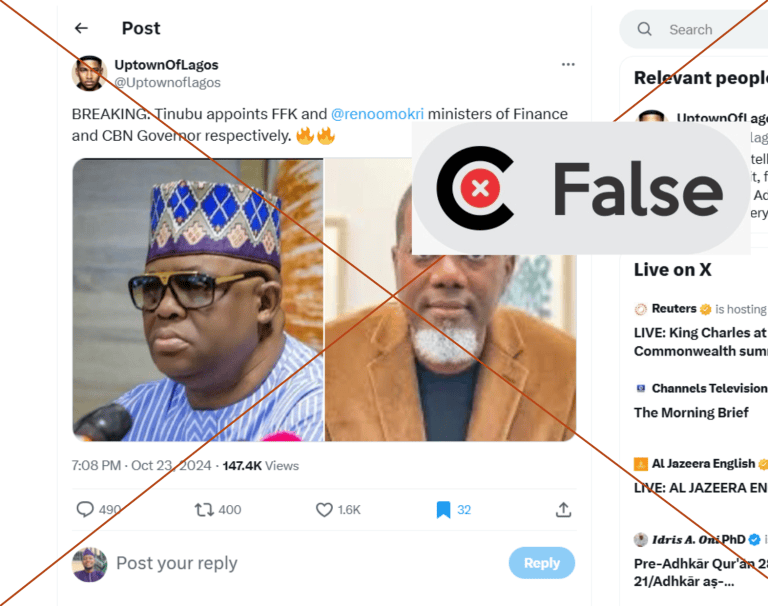
AN X user, @Uptownoflagos has claimed that President Tinubu Bola appointed Femi Fani Kayode and Reno Omokri as the ministers of Finance and governor of the Central Bank of Nigeria respectively.

Omokri is a former aide to ex-President Goodluck Jonathan. He served as a special assistant on new media and was responsible for managing Jonathan’s online presence. 

While Femi Fani Kayode (FFK) is a former aviation minister. He has held various political positions over the years and was a member of the People’s Democratic Party (PDP) before joining the ruling All Progressives Congress (APC). 

The X user posted the claim with a caption : 

“BREAKING: Tinubu appoints FFK and @renoomokri ministers of Finance and CBN Governor respectively.“

The post has generated over 400 likes and more than 1,500 likes as of October 25, 2024.

CLAIM

Tinubu appoints Femi Fani Kayode as Minister of Finance and Reno Omokri as CBN Governor.

THE FINDINGS

Findings by The FactCheckHub show that this claim is FALSE.

Recent reports on President Bola Tinubu’s cabinet reshuffle, announced on Wednesday, October 23, 2024, confirm that Wale Edun remains the Minister of Finance and Coordinating Minister of the Economy. Meanwhile, Olayemi Cardoso is the Governor of the Central Bank of Nigeria (CBN), having been confirmed by the Senate earlier in September 2023. Neither Femi Fani Kayode (FFK) nor Reno Omokri hold any positions within Tinubu’s current administration.

In the recent cabinet reshuffle, President Tinubu sacked five ministers and reassigned ten others to different portfolios. He also appointed seven new ministers, who are awaiting Senate confirmation, none of whom include Fani Kayode or Reno Omokri​.

The President sacked Uju-Ken Ohanenye as Minister of Women Affairs; Lola Ade-John as Minister of Tourism; Tahir Mamman as Minister of Education; Abdullahi Gwarzo as Minister of State, Housing and Urban Development; and Jamila Ibrahim as Minister of Youth Development.

Tinubu subsequently nominated Bianca Odumegu-Ojukwu as the Minister of State Foreign Affairs, while Nentawe Yilwatda as the Minister of Humanitarian Affairs and Poverty Reduction, officially bringing an end to the tenure of suspended Betta Edu.

The President also nominated Maigari Dingyadi as the Minister of Labour and Employment, Jumoke Oduwole as the Minister of Industry, Idi Maiha as Minister for the newly created Livestock Development Ministry, Yusuf Ata as the Minister of State, Housing and Urban Development, with Suwaiba Ahmad as Minister of State Education.

In Nigeria, appointments of ministers and key positions like the CBN Governor require Senate confirmation and official announcements. There have been no reports in credible media outlets indicating that Fani Kayode or Reno Omokri have been nominated or confirmed for these roles. Furthermore, presidential spokespersons have made no such announcements.

THE VERDICT

The claim that Femi Fani Kayode has been appointed as Minister of Finance and Reno Omokri as CBN Governor is false. The current officeholders are Wale Edun (Minister of Finance) and Olayemi Cardoso (CBN Governor). 

Claim that Oyo has been split to two states is misleading!

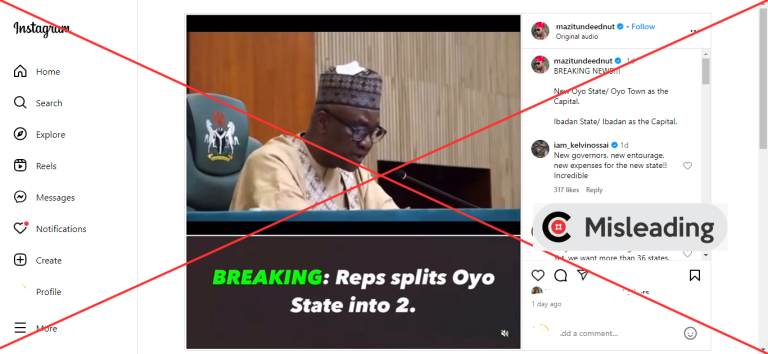
TUNDE Ednut, a popular social media influencer and blogger, has claimed that the House of Representatives has split Oyo state into two states.

He made the claim in a post on Instagram as a caption to a 2+ minutes long video.

In the video, the speaker of the House of Representatives, Tajudeen Abass could be heard seeking the motion to pass the bill through a second reading.

ALSO READ: CBN did not ban Opay, Palmpay, others

Part of the video transcribed reads thus:

“The second order of the day is commencement of debate on the general principles of a bill for an act to alter the constitution of the Federal Republic of Nigeria 1999 as amended to create new Oyo state with Oyo town as the capital city from Oyo state. Effect consequential change of the name of the remaining part of Oyo state to Ibadan state with Ibadan city as capital city and define the local government areas comprising the two states and for related matters. Standing in the name of in the names of Honorable Adeyemi Akeem Adeniyi and six others.

Honourable members who recall that the bill was read the first time on Thursday, October 10, 2024. I now invite Honourable Adeniyi to move that the bill be read a second time.” 

The caption alongside the video read:

BREAKING NEWS!!! New Oyo State/ Oyo Town as the Capital. ⁣Ibadan State/ Ibadan as the Capital.

This is followed by the inscription on the video which reads Breaking : Reps split Oyo state into 2

The post as at Wednesday, October 23, 2024,  has gained a traction of over 52,000 likes, 6,327 comments and 10,800 reshares.

CLAIM

House of Representatives split Oyo state into 2 states.

THE FINDINGS

Findings by The FactCheckHub shows that the claim is MISLEADING!

Screenshot of the claim extracted from Instagram; Insert MISLEADING verdict

On Tuesday, October 22 2024, media organisations like The Cable, Premium Times and The Punch reported that a bill proposing the division of Oyo into two new states has passed its second reading in the House of Representatives.

Co-sponsored by Akeem Adeyemi from Oyo and six other lawmakers, the constitutional amendment bill was advanced during Tuesday’s plenary session. The bill aims to create a New Oyo state, with Oyo town as its capital, while renaming the remaining part of the state as Ibadan State, with Ibadan city as the capital.

In Nigeria, for a bill be passed to an act it has to pass through several stages such as the ;

  • Proposal stage, or the identification for the need of a bill
  • First reading
  • Second reading
  • Committee stage : where the analysis of the bill may include a public hearing where members of the public are invited to provide input, with their feedback being considered in the review process.
  • Third reading
  • Signing of the bill
  • Presidential assent; The approved version of the bill from both chambers is sent to the president for signature. The president’s signature is necessary to turn the bill into law, and according to Section 58(4) of the Constitution, the president must sign the bill within 30 days of receiving it.

Currently, the bill to split Oyo state into two has not been assented and the minority leader, Tajudeen Abass, has only forwarded the bill to the Committee on Constitutional Review for additional legislative action.

While the contents of the video are accurate, the keywords and captions used by the claimant depicts otherwise thereby making the headline misleading and a clickbait.

Clickbait headlines typically emphasize sensationalism rather than accuracy, contributing to the spread of disinformation. This approach can distort public perception of various issues, as readers might focus solely on misleading headlines without grasping the actual facts behind them.

READ: Five quick tips to identify fake news shared on social media

THE VERDICT

The claim that the House of Representatives split Oyo state into 2 states is misleading; it is a clickbait headline. The bill has only passed its second reading and has been forwarded to the committee on constitutional review.