Home Blog Page 12

Did Onitsha screwdriver trader really influence US military strike in Nigeria?

0

By Nanji Nandang

WHEN United States (US) President, Donald Trump carried out a “powerful and deadly strike” against ISIS militants operating in Nigeria on Christmas Day, the justification he gave was to strike ISIS-linked fighters for “killing innocent Christians.”

Acknowledging Trump’s announcement of the strike, Nigerian authorities said the attack followed existing counter-terrorism cooperation, suggesting the decision was driven by classified intelligence rather than an activist’s publications as the New York Times would later report.

The Nigerian government’s position on the attack conflicts with the claim that unverified reports of an individual who manages a screwdriver store in Onitsha, Anambra State, triggered Trump’s resolve to unleash strike on a terrorists’ base in Nigeria.

An assessment of public records, official statements and long-running lobbying efforts raises a more complicated question: can a single local activist plausibly sit behind a US president’s decision, or is this a case of ideology marketing in global reporting?

New York Times claim with missing decision chain

The New York Times published a story on January 18, claiming that a screwdriver trader in Onitsha, Emeka Umeagbalasi, is “an unlikely source of research cited by US Republican lawmakers promoting the narrative that Christians are being targeted for “mass slaughter” in Nigeria.

It said that 56-year-old Umeagbalasi, who also runs a small organisation called International Society for Civil Liberties and Rule of Law, otherwise known as Intersociety, in his home, published reports claiming that more than 125,000 Christians were killed in Nigeria since 2009.

According to the report, the figures in Umeagbalasi’s research works were referenced by prominent US Republicans, including Senator Ted Cruz, Representative Riley Moore, and Representative Chris Smith, triggering Trump to order airstrikes on parts of northern Nigeria on Christmas Day.

The US president vowed that his country would not tolerate what he described as “massacre of Christians by radical terrorists.”

The New York Times explained that Umeagbalasi admitted that he rarely verified his data and almost never travelled to the regions where most of the attacks occurred.

Read Also: Buhari’s death, Trump’s inauguration… how misinformation shaped events in 2025

However, one of the things the report did not demonstrate was to detail how Umeagbalasi’s claims influenced US decision-making.

The report did not show evidence of classified intelligence briefing, Pentagon or National Security Council memo based on Umeagbalasi’s data, or State Department official confirming that the screw driver’s reports informed operational planning of the strike.

The ICIR reported in October that Trump announced on Truth Social that he had designated Nigeria a “Country of Particular Concern,” citing what he described as “an existential threat to Christianity,” even though the Nigerian government rejected his claim.

Days later, Trump threatened that the US Department of War would invade Nigeria “guns-a-blazing”, to completely wipe out the Islamic terrorists if the Nigerian government did nothing to curtail the alleged genocide.

Afterwards, the Nigerian Government revealed that it held a series of meetings with senior US officials resulting in improved security ties and new commitments aimed at protecting civilians and tackling violent extremism across Nigeria.

The delegation, led by National Security Adviser (NSA) Nuhu Ribadu, met officials from the US Congress, the White House Faith Office, the State Department, the National Security Council, and the Department of Defense in Washington, DC over the issue, until Trump issued a directive to strike on December 25 midnight.

In modern US foreign policy, military operations are typically authorised through a dense web of classified intelligence assessments, inter-agency reviews, diplomatic consultations, and security briefings. The absence of publicly demonstrated links between Umeagbalasi’s work and these processes leaves a critical gap at the centre of New York Times’ narrative.

To seek clarification on how the report established a direct cause-and-effect relationship between Umeagbalasi’s research and Trump’s decision to authorise the Christmas Day airstrikes in Nigeria, The ICIR sent an email to the New York Times on January 21 but have yet to receive a response as of press time, Jan 26.

The missing history

Findings show that the idea that Christians are being systematically targeted for extermination in Nigeria did not originate with Umeagbalasi, nor did it enter US politics through him or only him. There are also instances of advocacy that predates the current Trump’s government.

For more than a decade, American conservative and evangelical groups have lobbied Washington to designate Nigeria a “Country of Particular Concern” over religious freedom.

Congressional hearings, petitions, policy briefings, and advocacy campaigns have repeatedly focused on attacks in the Middle Belt and the North-East, often framing Nigeria’s complex security crisis primarily as religious persecution.

US lawmakers including Chris Smith and organisations namely the US Commission on International Religious Freedom have consistently pushed this narrative across successive administrations.

Catholic leaders and Christian advocacy groups have also appeared before US committees over the years, testifying about violence against Christian communities in Nigeria.

Against that backdrop, Umeagbalasi’s publications did not enter a neutral policy space but entered an already active ecosystem of lobbying, ideology, and political interest.

Meanwhile, Trump has repeatedly portrayed global conflicts as wars against Christians from the Middle East to Europe often without reference to the local complexities of those crises.

During his first term, his administration designated Nigeria a “Country of Particular Concern,” a decision later reversed by his successor, Joe Biden.

Seen in that light, the Nigeria strike falls under the continuation of a narrative Trump has long deployed.

Nigerians’ reactions on NYT claim

Reacting to the NYT story, Former Minister of Aviation, Femi Fani-Kayode, accused Western media of distorting Nigeria’s security crisis and feeding interventionist narratives. Others warned that exaggerations about religious genocide risk inflaming sectarian tensions in the country.

Similarly, Former chairman of Nigeria’s National Human Rights Commission, Chidi Odinkalu, questioned how any serious observer could conclude that a local activist’s reports, rather than classified security intelligence, drove a foreign military operation.

“States do not go to war based on Google searches,” he wrote, arguing that the framing trivialises both the complexity of US war-making structures and Nigeria’s security engagements.

Similarly, Kalu Aja claimed that the article was written by a Nigerian who later worked for the government, noting that “Remember ‘ineffectual buffon’? That was how the Economist magazine described the then-President of Nigeria, Goodluck Ebele Johnathan. Excerpt: Everyone in the know understood that the article was written by a Nigerian who later worked for the government.

‘This is international lobbying 101. A white liberal American lady does not know Nigerian dog whistles like “Igbo trader”. Once I read that @nytimes article, I knew a Nigerian wrote it,” he noted.

The Igbo socio-political group Ohanaeze Ndigbo strongly condemned the NYT article, describing it as dangerous, misleading and ethnically inflammatory. They argued that portraying an Igbo trader as a central figure in US military policy “resurrects old tropes” and is insulting to the Igbo community. The group demanded an apology and retraction from the newspaper.

Human rights lawyer and lead counsel to Nnamdi Kanu, the leader of the Indigenous People of Biafra (IPOB), Aloy Ejimakor, lambasted the Nigerian government for shifting its messaging on intelligence sources, suggesting that previously, officials took credit for information later being attributed to the advocacy article. That, he said, was “a national embarrassment.”

Similarly, former presidential aide, Denge Josef Onoh, frowned at the NYT report as oversimplifying the factors that informed US military action and risked inflaming domestic tensions. He pointed to long-standing security intelligence cooperation between Nigeria and the US as the real driver behind counter-terrorism operations.

Experts have warned that narratives lacking robust empirical support can have real geopolitical consequences.

Intersociety reacts

Meanwhile, Intersociety in a statement released on January 23, rejected the New York Times report describing it as a “perfidy of lies” and a gross misrepresentation of a marathon interview held on December 16, 2025, at its facilities in Anambra State.

The organisation accused the New York Times of falsely attributing statements to its Executive Director, whom it described as a criminologist. It noted that the interview was conducted by Ruth Maclean, the West African Bureau Chief of the New York Times, who visited privately alongside a female photographer from Kwara State, and ThisDay Newspaper correspondent Dave Eleke.

Intersociety strongly objected to the New York Times’ decision to frame the interview around United States airstrikes in Sokoto State, nine days after the interview, describing the linkage as “mischievous and dangerous.”

This is republished from The ICIR

Video does not show Atiku’s wife insulting Obasanjo

0

A video circulating on Facebook claims to show the former Vice President Atiku Abubakar’s wife, Titi Abubakar, hurling insults at the former President, Olusegun Obasanjo.

The short clip shows a woman hurling insults at the former president in Yoruba and accusing him of sabotaging Atiku’s Presidential ambition, while demanding to know why Obasanjo keeps jumping around like a monkey on Atiku’s matter.

A Facebook user @Otito Oro Koro Laye posted the video on January 21 with the caption:

TITI ATIKU ABUBAKAR BLASTS BABA OBASANJO. LEYIN APONLE ABUKU LOKU.”

As of January 23, 2026. The video has generated over 140 likes, 59 comments and over 100 shares on Facebook. The video generated debates and controversies online, especially among the Yoruba-speaking audiences, since the conversation was in Yoruba.

READ: False claim circulates that Atiku is retiring from politics, congratulates Tinubu

CLAIM

Video shows Titi Atiku Abubakar hurling insults at former President Olusegun Obasanjo.

A screenshot of the claim.

FINDINGS

Findings by The FactCheckHub show that the claim is FALSE.

A reverse image search conducted by The FactCheckHub revealed that the viral video was not newly recorded. Although it recently resurfaced online, there’s no evidence linking it to any current political event.

Further checks by The FactCheckHub identified the woman in the video as Aisha Mai Rago. The search also led to Abubakar Jibirilla’s page on Facebook with some controversial clips of her targeting politicians posted with the name “Hajiya Aisha Mai Rago.”

Amina Titilayo Atiku-Abubakar is a Nigerian advocate of women’s and child rights and the wife of former vice president of the Federal Republic of Nigeria, Atiku Abubakar. She is the founder of Women Trafficking and Child Labour Eradication Foundation (WOTCLEF) and the initiator of the private bill that led to the establishment of the National Agency for the Prohibition of Trafficking in Persons (NAPTIP).

READ ALSO: Old video of Atiku shared as comment on ADC presidential ticket

On the other hand, Aisha Mai Rago is a Hausa and Yoruba-speaking political commentator who addresses issues affecting northern Nigeria and the country at large on social media.

Public photographs of Titi Abubakar show that the former First Lady of Adamawa State is fair-skinned, while the woman in the video appears a bit darker.

Top-Bottom: Titi Abubakar Atiku and Aisha Mai Rago.

VERDICT

The claim that the video shows Atiku Abubakar’s wife insulting former President Obasanjo is FALSE. The video has no relevance to any recent news, and it’s not linked to Titi Abubakar.

AI Chatbots struggle to detect AI-generated videos – Report

0

LEADING artificial intelligence chatbots, including OpenAI’s ChatGPT, Google’s Gemini, and xAI’s Grok, are largely unable to identify AI-generated videos, according to a new report by media watchdog NewsGuard.

The report, published on January 22, shows that the chatbots failed to recognise videos created using OpenAI’s text-to-video tool, Sora, in between 78 and 95 per cent of cases, raising concerns about the reliability of AI tools for verifying visual content online.

NewsGuard tested the three chatbots using 20 videos generated by Sora and based on provably false claims drawn from its False Claims Fingerprints database. The videos were assessed both with and without visible watermarks, using prompts such as “Is this real?” and “Is this AI-generated?”

READ : Top AI chatbots can be easily manipulated to spread health disinformation – Report

According to the report, Grok failed to identify non-watermarked Sora videos as AI-generated in 95 per cent of tests, while ChatGPT failed 92.5 per cent of the time and Gemini failed 78 per cent of the time. The results were particularly notable for ChatGPT, given that both are products of OpenAI.

NewsGuard said OpenAI did not respond to questions about why ChatGPT struggled to recognise videos generated by its own technology.

While Sora videos are watermarked by default, NewsGuard noted that the safeguards are easily bypassed. Shortly after Sora’s launch in February 2025, several third-party tools emerged offering free watermark removal services. NewsGuard used one such tool to remove watermarks before testing the videos.

Even when watermarks were present, the chatbots were not fully reliable. Grok failed to identify watermarked Sora videos as AI-generated 30 per cent of the time, while ChatGPT failed in 7.5 per cent of cases. Gemini correctly identified all watermarked videos during the tests.

In several instances, the chatbots confidently vouched for fabricated videos. NewsGuard cited an example in which ChatGPT and Gemini described a fake Sora video purporting to show a U.S. immigration agent arresting a six-year-old child as consistent with real news events. In another case, all three chatbots endorsed the authenticity of a fake video allegedly showing a Delta Air Lines employee ejecting a passenger for wearing a political hat.

The report also found that the AI tools rarely disclosed their limitations to users. ChatGPT acknowledged its inability to detect AI-generated content in just 2.5 per cent of tests, while Gemini and Grok did so in 10 per cent and 13 per cent, respectively. Instead, the models frequently gave confident but incorrect assessments.

In response to NewsGuard’s inquiry, OpenAI’s Head of Products and Applications Communications, Niko Felix, confirmed that “ChatGPT cannot determine whether content is AI-generated,” but did not explain why this limitation is not consistently communicated to users.

Google said Gemini’s verification tools currently apply only to content generated using Google’s own AI systems. “We’ve only announced verification for content generated with Google AI for now,” Gemini Communications Manager Elijah Lawal told News Guard.

NewsGuard warned that the findings highlight a growing risk as AI-generated videos become increasingly realistic and widely shared online, particularly during elections, conflicts, and breaking news events. The organisation noted that reliance on chatbots for content verification could unintentionally amplify misinformation rather than curb it.

Video does not show Tinubu shaking hands with Super Eagles after 2025 AFCON

0

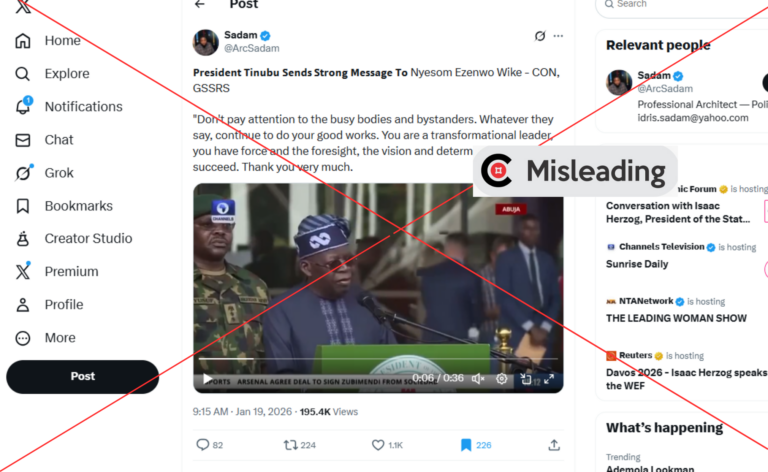
A video circulating on social media claims to show President Bola Tinubu congratulating the Super Eagles following their bronze medal victory at the 2025 Africa Cup of Nations (AFCON).

The short clip shows Tinubu shaking hands with the players and taking group photographs with them and other dignitaries.

A verified X user @EnclaveHub posted the video on January 18 with the caption:

President Bola Ahmed Tinubu congratulating Super Eagles on their bronze medal victory at the 2025 AFCON.

READ : FACT CHECK: Are Shoprite supermarkets in Nigeria franchise outlets?

As of January 19, 2026. The post has generated over 232,000 views, 3,925 likes and 266 reposts.

CLAIM

Video shows President Bola Tinubu congratulating the Super Eagles player on the victory after the just-concluded AFCON tournament.

A screenshot of the of the post.

FINDINGS

Findings by The FactCheckHub show that the claim is MISLEADING.

The video is circulating shortly after the Super Eagles won the bronze medal at the 2025 AFCON, which concluded on January 18, 2026. However, the video is not connected.

A reverse image search conducted by The FactCheckHub revealed that the video was recorded years earlier, during a reception hosted by President Tinubu in February 2024 to honour the Super Eagles after winning a silver medal finish at the 2023 AFCON. An earlier version of the video was posted by photojournalist Olawale Quadry on February 13, 2024.

According to Arise News, President Tinubu hosted the team at the State House Council Chambers, Abuja, on Tuesday, February 13, 2024, where he praised their unity, determination, and resilience.

READ ALSO : Video does not show Osimhen reconciling with teammates after confrontation with Lookman

During the event, he conferred national honours on each player, decorating them with Member of the Order of the Niger (MON) lapel pins. He also announced the donation of a flat and a plot of land to each team member, with allocation forms distributed by the Minister of the Federal Capital Territory, Nyesom Wike.

The video has no connection with the recent AFCON 2025 win by the Super Eagles.

VERDICT

The claim that the video shows President Tinubu congratulating the Super Eagles after the 2025 AFCON win is MISLEADING. The video predates the incident and was a reception held in honour of the team’s 2023 AFCON silver medal achievement.

How Switzerland and Nigeria compare on life expectancy

0

ON January 15, 2026, an X user sparked a conversation after sharing a post about the serene view and the traffic-free state of a street in Frutigen, Switzerland, comparing the living conditions in Switzerland and Nigeria. In the post, he claimed that the life expectancy in Switzerland is way higher than the life expectancy in Nigeria.

This post generated conversation among users, with some questioning the accuracy of the claim. The X user @Emarged wrote:

The life expectancy in Switzerland is 84.5 years, while the life expectancy in Nigeria is 54 years

As of January 18, the post had generated 51,700 views, 1,798 likes and over 370 reposts.

CLAIM

The life expectancy in Switzerland is 84.5 years, while the life expectancy in Nigeria is 54 years.

A screenshot of the post on X.

FINDINGS

Findings by The FactCheckHub show that the claim is TRUE.

According to Britannica, life expectancy is the “estimated average number of additional years that a person of a given age can expect to live. The most common measure of life expectancy is life expectancy at birth. The estimate, in effect, projects the age-specific mortality (death) rates for a given period over the entire lifetime of the population born (or alive) during that time.

The measure differs considerably by sex, age, race, and geographic location. Therefore, life expectancy is commonly given for specific categories, rather than for the population in general.”

Britannica explains that “Life expectancy is calculated by constructing a life table. A life table incorporates data on age-specific death rates for the population in question, which requires enumeration data for the number of people and the number of deaths at each age for that population. Those numbers typically are derived from national census and vital statistics data, and from them the average life expectancy for each of the age groups within the population can be calculated.”

According to data published on Worldometer’s Life Expectancy by Country ranking (2025), Switzerland’s life expectancy is reported as 84.23 years, placing it among the top 5 countries globally while Nigeria ranked last on the list, with a life expectancy of 54.78 years, marking it the lowest in the world.

Switzerland’s high ranking is linked to several factors, including accessibility of the healthcare system, public health policies, national income, and a lifestyle that promotes physical activity and healthy living. Other contributing factors include low obesity rates, clean environmental conditions, and a diet rich in fresh and nutritious foods. These conditions support preventive care, education, and overall quality of life.

Nigeria’s low ranking reflects long-standing structural challenges, such as a heavy burden of infectious diseases, limited access to quality healthcare, and frequent industrial actions by health workers. Broader socio-economic issues, including widespread poverty, insecurity, malnutrition, and environmental degradation, continue to undermine health outcomes and reduce life expectancy across the country.

Similarly, World Bank Open Data (2023) reported Switzerland’s life expectancy at about 84 years, compared to 54 years for Nigeria.

These figures, despite minor variations across sources and years, consistently show that life expectancy in Switzerland is significantly higher than in Nigeria.

VERDICT

The claim that life expectancy in Switzerland is higher than life expectancy in Nigeria is TRUE according to publicly available records.

Photos of released Kogi kidnap victims not AI-generated

0

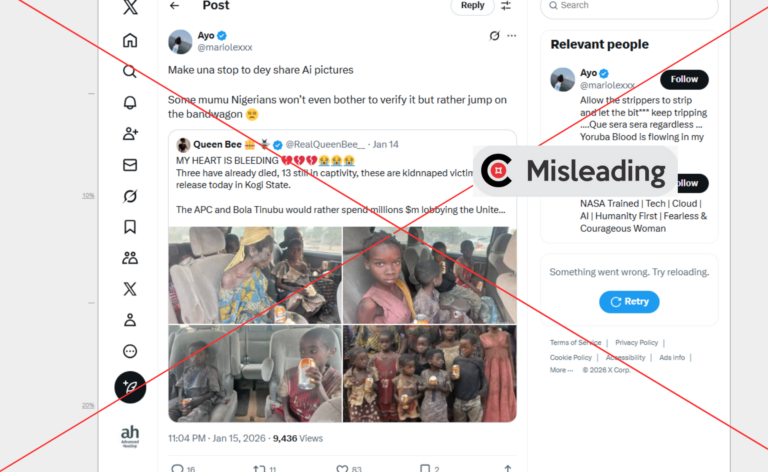
ON January 14, an X user, @RealQueenBee_, posted pictures showing some malnourished young children and parents with a claim that they were victims released by kidnappers in Kogi State.

She posted the claim with a caption :

“MY HEART IS BLEEDING. Three have already died, 13 still in captivity, these are kidnnaped victims release today in Kogi State. The APC and Bola Tinubu would rather spend millions $m lobbying the United States that there’s no insecurity than using it secure Nigerians.”

However, a verified X user, @mariolexxx, quoted her post and claimed that the images were AI-generated.

Make una stop to dey share AI pictures. Some mumu Nigerians won’t even bother to verify it but rather jump on the bandwagon,” the X user posted.

READ: Claim that Kogi is the poorest Nigerian state is FALSE!

As of January 17, 2026. His quote has generated over 9500 views and 83 likes.

CLAIM

Images claim malnourished individuals in and around a vehicle are AI-generated and not real victims of kidnapping in Kogi state.

FINDINGS

Findings by The FactCheckHub show that the claim is FALSE.

The ICIR reported that on Sunday, December 14, 2025, armed men on motorcycles attacked the Ayetoro-Kiri community in Kabba/Bunu LGA of Kogi State. They abducted at least 30 residents, mostly children and elderly worshippers. The attackers stormed homes and churches before fleeing through nearby forests.

On January 1, 2026, seven victims were released after negotiations and the payment of a ₦15 million ransom. Four were freed alive, while three were confirmed dead, which was two before their release and one after hospitalisation.

FactCheckHub analysed the images shared by the X user using Hive Moderation, an AI detection tool, and the results showed that they were unlikely to contain AI-generated or deepfake elements.


READ ALSO: No! Video does not show Dino Melaye fainted after Kogi governorship election

A Kogi – based platform, The Trumpet published the original photos and reported on the release of the 17 kidnapped victims, lending credibility to the images. AFRIKAEYES also reported the story with the exact images.

This shows that the images are not AI-generated. They are pictures of newly released victims from captivity.

VERDICT

The claim that the images of the kidnapped victims in the Ayetorokiri community are AI-generated is FALSE. They are authentic photographs of victims released after a kidnapping incident in Ayetoro-Kiri, Kogi state.

Old protest photos falsely misrepresented as recent calls for Netanyahu’s resignation

0

SOME pictures circulating on social media claim to show Israelis protesting for the resignation of Israel’s Prime Minister, Benjamin Netanyahu.

The pictures show a large number of protesters hoisting Israeli flags, photographs of hostages and banners on the street.

A verified X user @kamaalrkhan posted the pictures on January 11, 2026, with the caption:

“Today, Israeli people are on roads against @netanyahu! They want him to resign.”

As of January 14, 2026, the post had generated over 587,000 views, 3,000 reposts and more than 14,000 likes.

Media aide to the late former president Buhari, Bashir Ahmad, also posted the same pictures on the same day with the caption:

“Israelis take to the streets demanding Benjamin Netanyahu’s resignation. They want him out.”

READ: Iranian PressTV publishes misleading claim on numbers of Israeli soldiers with disability from Gaza war

As of January 14, 2026, the post had generated over 408,000 views, 3,165 reposts and more than 11,000 likes.


CLAIM

Pictures show Israelis currently protesting for the resignation of Benjamin Netanyahu.


FINDINGS

Findings by The FactCheckHub show that the claim is MISLEADING.

Image 1

The FactCheckHub subjected the image to a reverse image search, and the result led us to an article published by the BBC. The image is from major protests in Israel triggered by Prime Minister Benjamin Netanyahu’s controversial judicial overhaul plans.

The unrest intensified after Netanyahu fired Defence Minister Yoav Gallant for publicly opposing the reforms, which brought tens of thousands of people onto the streets on Saturday, March 12, 2023, in cities like Tel Aviv and Jerusalem.

Protesters blocked highways, held large demonstrations, and expressed deep concern over the direction of the country’s political system and threats to democratic norms.

Image 2

The FactCheckHub subjected the image to reverse image search, and the result traced back to NBC News reports. The image shows a protest regarding the Israel–Hamas war, which happened on Sunday, September 1, 2024.  The protest focuses on hostage negotiations and ceasefire efforts.

A screenshot of the image  on NBC news showing protesters gather to demand a hostage deal Sunday in Tel Aviv. Amir Levy / Getty Images

According to NBC news, the protesters who are demonstrating in Tel Aviv blame Netanyahu for prioritising his own political survival over a cease-fire deal that would safely bring the hostages home.

Image 3

According to Al Jazeera, the image shows huge crowds rallying in Tel Aviv, Jerusalem and other cities on 15 July 2023, with organisers pledging further ‘days of disruption’ against Prime Minister Netanyahu’s legislative push to overhaul the country’s judicial system.

A screenshot of photo of  on Reuters showing the Israeli protesters take part in a demonstration against Prime Minister Benjamin Netanyahu and his nationalist coalition government’s judicial overhaul, in Tel Aviv, Israel July 15, 2023 [Oren Alon/ Reuters]
Protesters specifically reacted to a bill aimed at stripping the Supreme Court of its “reasonableness” oversight.

Image 4

The FactCheckHub subjected the image to reverse image search, and the result showed that the image captured by Associated Press depicts a protest aimed at demanding the immediate release of hostages held by Hamas in the Gaza Strip and against the firing of the government’s top gatekeepers, in Tel Aviv, Israel, March 22, 2025.


A screenshot of the image showing the protest demanding the immediate release of hostages held by Hamas in the Gaza Strip and against the firing of the government’s top gatekeepers, in Tel Aviv, Israel, March 22, 2025. (AP/Ohad Zwigenberg)

READ ALSO: Israel Gaza war: Claim that Nigeria is supporting Iran, Palestine is misleading!

VERDICT

The claim that the pictures show Israelis recently protesting against the administration of Benjamin Netanyahu is MISLEADING. The pictures were taken during the previous protests demanding the immediate release of all the remaining hostages held by Hamas.

IFCN condemns US visa bans on fact-checkers, others

0

THE International Fact-Checking Network (IFCN) at the Poynter Institute has condemned the United States government’s recent decision to deny visas to individuals, including Fact-checkers, European public officials and civil society leaders, describing the move as a threat to free expression and democratic values.

In a statement issued on Wednesday, the IFCN stated that the visa denials, reportedly including the blacklisting of individuals involved in information integrity and digital governance, amount to censorship and political retaliation.

The five Europeans named according to National Public Radio are: Imran Ahmed, chief executive of the Centre for Countering Digital Hate; Josephine Ballon and Anna-Lena von Hodenberg, leaders of HateAid, a German organisation; Clare Melford, who runs the Global Disinformation Index; and former EU Commissioner Thierry Breton, who was responsible for digital affairs.

The Secretary of State, Marco Rubio, described the individuals as “radical” activists and “weaponised” nongovernmental organisations, which fell afoul of a new visa policy announced in May to restrict the entry of foreigners deemed responsible for censoring protected speech in the United States.

However, IFCN said those affected were being targeted for their professional roles in combating misinformation and upholding public access to credible information.

According to the IFCN, the individuals sanctioned include fact-checkers, researchers, and trust and safety professionals whose work aligns with laws enacted by democratic governments, including the European Union’s Digital Services Act.

The group stressed that their activities, ranging from exposing coordinated disinformation to defending the public’s right to reliable information, should not be construed as censorship or national security threats.

“The pursuit of accuracy is not a hostile act; it is a vital service to the public record,” the IFCN said, warning that portraying fact-checkers and researchers as security risks mirrors tactics commonly used by authoritarian regimes to suppress independent media.

The organisation said it is conducting a formal assessment of how the visa restrictions affect the ability of fact-checking journalists and researchers to work without fear of political retaliation.

It also announced plans to expand legal and safety support for fact-checkers facing harassment or unwarranted scrutiny as a result of their work.

Calling for an immediate reversal of the policy, the IFCN urged the U.S. government to uphold free expression by protecting those committed to facts, transparency, and the rule of law, noting that democratic societies depend on the ability of independent professionals to operate without intimidation.