Home Blog Page 102

Fact-checkers, researchers urged to balance reportage to combat fake news effectively

0

FACT-CHECKERS have called on academic researchers to put more efforts in making their output relevant to disinformation experts.

Academic researchers on the other hand have implored fact-checkers to acquire knowledge on researching while employing it in writing fact-checks.

This was emphasized in a report on a recent survey on fact-checking carried out by Angie Drobnic Holan, the IFCN director.

READ : Nigerian police to clamp down on fake news purveyors

“Fact-checkers said they had good awareness of most research about fact-checking, but not overwhelmingly so: 78% of respondents strongly agreed or agreed that they were aware of most of the research that exists about fact-checking,” she stated.

“Among fact-checkers, 73% said that academics could do more to make their work relevant to fact-checkers, while only 54% of academic researchers said that.”

“Conversely, 69% of academic researchers agreed or strongly agreed that fact-checkers needed to do more to learn about research and incorporate it into their work, while only 17% of fact-checkers felt the same way. This indicates disagreement between fact-checkers and academic researchers about which community has more responsibility to build bridges with the other,” she added.

Establishing the participation of academic researchers in the study of fact-checking, the report highlighted that most researches rather focus on the effectiveness: whether fact-checking correct and reduce the influx of false beliefs.

“Academic researchers have studied fact-checking since the recent wave of fact-checking organizations launched in the early 2000s. Many of their studies focus on fact-checking effectiveness — whether fact-checking corrects false beliefs and under what conditions. Other studies examine specific methods for debunking false information. Still others focus on topical fact-checking, such as the recent COVID-19 epidemic.”

“Many academic researchers apply rigorous statistical measurements to empirically grounded samples. This research regularly appears in peer-reviewed journals, further validating these research methods,” it stated further.

Part of the fact-checking research survey.

Participants of the survey, which comprised of primarily fact-checkers who are part of the International Fact-Checking Network (IFCN) and academics who participate in the combating fake news listserv found academic research highly useful to their work.

Participants rated most types of research as either “very useful” or “useful.” Among the types of research most often deemed “very useful or “useful” were: Research on the effectiveness of new formats for fact-checking (video fact-checks, graphics, illustrations, multimedia, etc.) stood at 87%.

Studies of how misinformation spreads at 84%. Studies of the audience for fact-checking (people’s openness to correction, demography, sharing behavior, etc.) was at 82% while experimental studies testing the effectiveness of fact-checking in correcting false beliefs at 80%.

Participants also highly valued more topical research and selected studies on the fact-checking of elections and voting as the most valuable.

The percentages of participants who found the value of topical studies included as “very useful” or “useful” were: Elections and voting at 89%. Climate change at 85%. Vaccines at 81%. Health care at 78%. Political polarization at 74%.

While responding to the topics that need more fact-checking research, the most commonly requested topics centered around questions of fact-checking effectiveness, such as the impact of fact-checking on media consumption; whether fact-checking is effective at countering propaganda; and how effective fact-checking is on social media. Other requests for more research centered on professional issues such as training and tools, artificial intelligence and gender issues/LGBTQ+ issues.

Suggestions provided for improvements to both research and fact-checking includes; researchers and fact-checkers should work together more closely in order to create studies that have practical applications to fact-checking work.

The report noted that more research is needed for non-English-speaking contexts, especially in India and Latin America.

It noted that research needs to be more accessible to fact-checkers, either by removing journal paywalls or by including action-step summaries, adding that researchers and fact-checkers need more in-person or live interactions at conferences and other meetings to facilitate communication.

The report also highlighted that the fact-checking community should regularly use research that is crafted for general audiences, such as “The Debunking Handbook.”

“An editor could assign fact-checkers to read the material, which is very accessible, then convene a group discussion on how fact-checking reports might follow some of the handbook’s recommendations.

“Additionally, the International Fact-Checking Network could report and write more regularly on academic research that is particularly applicable to fact-checking journalism while conducting online question-and-answer sessions with individual researchers for the benefit of fact-checkers and other interested communities.

“The network could also serve as a convening power to bring academics and fact-checkers together for conferences or regular webinars,” Holan said.

While emphasizing on the importance of impact between the academic and fact-checking communities, the report concluded that fact-checkers should acknowledge that they need to apply more effort to finding and integrating research findings into their works.
2023 Elections: EU observers list Keyamo, Fani-Kayode as purveyors of fake news

0

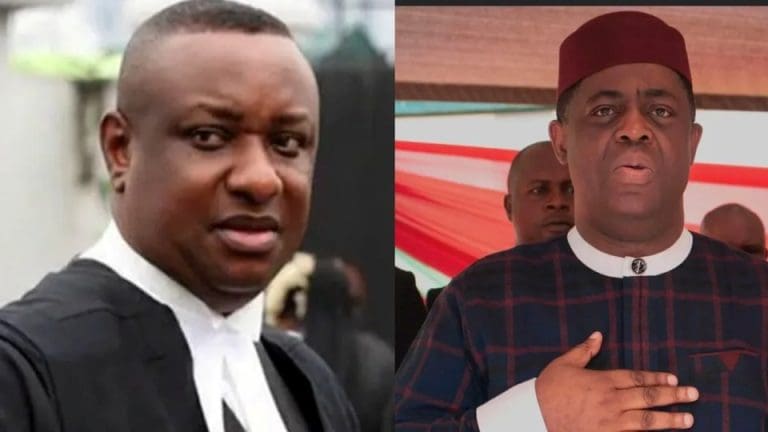
THE European Union (EU) Election Observation Mission (EOM) to Nigeria, has listed two prominent Nigerians, Festus Keyamo and Femi Fani Kayode (FFK), as purveyors of misleading content in the federal and state elections held in Nigeria on February 25 and March 18, 2023 respectively.

This was contained in its final report on the poll released recently.

According to the report, the EU EOM social media team came across a substantial number of false news captured during the monitoring process.

READ : False claims attributed to European Union delegation, NDI/IRI election observers circulate online

It added that there was an increased incidence of misleading information in the days leading up to and during Nigeria’s 2023 election.

The report noted that in many cases, false reports were spread by well-known personalities associated with political parties.

According to the report, Festus Keyamo, a member of the All Progressive Congress (APC), on February 12, promoted information published by a suspicious website accusing Peter Obi of bribery. It added that the story quickly went viral though it was later debunked.

On his part, Fani-Kayode, a former minister of aviation and member of the APC also made a claim on February 11, 2023 stating that Atiku Abubakar, the presidential candidate of the Peoples Democratic Party (PDP) in the election, had a secret meeting with serving military generals in Abuja.

He accused Atiku of wanting to incite chaos, provoke a coup d’etat and establish a new and unconstitutional order via his social media posts.

“The claim was posted across multiple social media platforms and it generated 281.2k impressions,” the report stated.

However, the report gave priority recommendations for electoral processes to uphold regional and international commitment.

DUBAWA’s report on ‘Baba Aisha herbal medicine’ wins at Global Fact 10

0

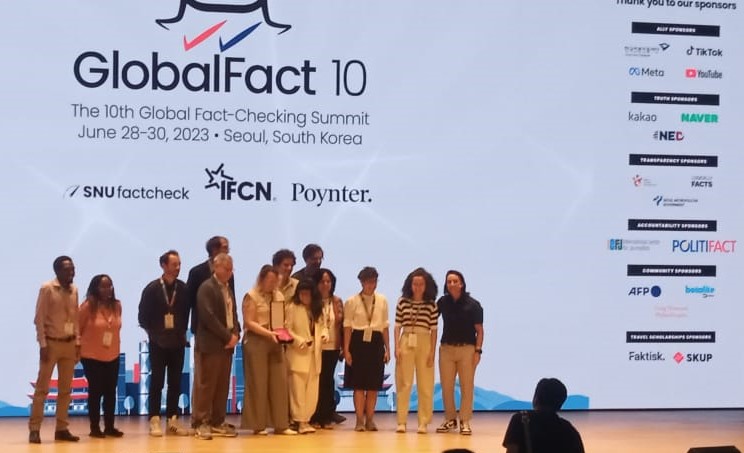
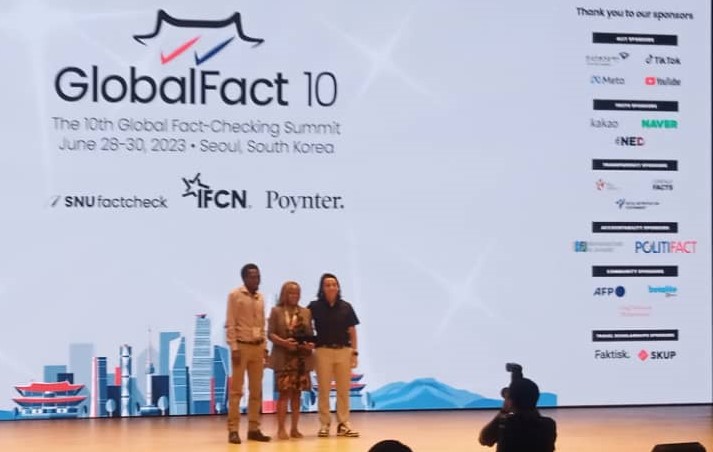
Dubawa has emerged winner of the highest impact fact-check at the Global Fact 10 awards held in Seoul, South Korea on Friday.

Announcing the winners on June 30, 2023 at the closing ceremony of the annual gathering of the global fact-checking community, Enock Nyariki, the Community and Impact Manager at the International Fact-Checking Network (IFCN), said this year’s recipients of the Global Fact awards topped the list of organisations whose best fact-checks from the past year were nominated for each of the three categories of the awards, namely:  Most Creative Format; Highest Impact Fact Check; and Most Innovative Collaboration.

The fact-check authored by Kemi Busari, the Nigerian editor of Dubawa, won the highest impact category. Other notable organisations shortlisted alongside Dubawa include the AFP Fact-Checking (France/USA), Myth Detector (Georgia), and Taiwan Factcheck Center (Taiwan).

Busari’s report focused on Nigeria’s fake ‘doctor’ cashing out on a deadly concoction that cures nothing.

Also, Cek Fakta-Liputan 6 (Indonesia) won the Most Creative Fact-check format for their published comic book “lawan hoaks” or fighting hoax. The comic book contains verification of 21 pieces of misinformation, plus infographics and fun facts, to reach young people.

Similarly, the Most Innovative Collaboration award was won by the six-member group of Estadao Verifica, Agencia Lupa, Aos Fatos, Projeto Comprova, Universo Online (and Meedan).

The 6-member group with IFCN's Enock Nyariki and Alanna Dvorak during the award ceremony in Seoul.
The 6-member group with IFCN’s Enock Nyariki and Alanna Dvorak during the award ceremony in Seoul.

Their collaboration produced ‘Confirma 2022‘ to collect 347,000 anonymous questions and distributed 150,000 fact-checks with six (6) WhatsApp tip lines.

Their innovation drove misinformation response efforts of the Brazil’s Superior Electoral Court (a non-partisan electoral authority).

Speaking on the award, Busari expressed joy at the global recognition, saying he endured severe challenges in the course of the investigation.

“The investigation itself took about five months, if I even want to add the research part, is far more than that. There were a lot of challenges, we needed to source funds to do the investigation, and secondly, it was hard to get respondents who will be willing to talk about the effect of taking the herbal product.

“Apart from that, it is really a very wide field. I had to read up a lot of scientific articles, terms, and documents so I could understand and clearly interpret the outcome from the laboratory to the public,” he noted.

He added: “We received the best award a few weeks ago when we saw that NAFDAC immediately swung into action to ensure this product is off the market and we also see their continued effort to make sure that they sanitize the space.

“When some of these little things we do in our small closet get international recognition, it brings a lot of joy and happiness to someone like me and the entire team who worked on the story.”

He urged budding fact-checkers to go beyond the basics in their reportage, saying fact-checkers should hold the government accountable anywhere in the world regularly.

Dubawa is a member of the Nigerian Fact-checkers Coalition, a 12-member organisation that focuses on curbing misinformation and disinformation in Nigeria.


EDITOR’S NOTE

* Kemi Busari’s comment was added to this report.

Global Fact-Check Fund: FactCheckHub, Dubawa, 33 others get Google/YouTube grant

0

THE FactCheckHub and Dubawa were among the 35 organisations named on Thursday as recipient of the Global Fact-Check Fund which is run by the International Fact-Checking Network (IFCN) at the non-profit Poynter Institute and supported by a $13.2 million grant from Google and YouTube.

The IFCN on June 29, 2023 announced the 35 grant recipients serving in 45 countries. It will be recalled that The ICIR had in April 2023 reported that the global fact-checking body was seeking application entries for the global fact-check fund.

The first phase of funding which is the BUILD phase aims to help fact-checking organizations scale or upgrade their online presence.

The organisations awarded $25,000 each for projects that will modernize websites, hire staff, train people to identify misinformation and many other initiatives to build and strengthen their capacity.

The fund which would run over the course of three years and eight phases, would support eligible organizations to increase the level of professionalism in fact-checking associated with media outlets, as well as help citizens better assess what they see in mass media and social media.

“Misinformation is on the march in many parts of the world. This important funding will enable fact-checking organizations to become better at their work, stronger in their capabilities and wider in their reach,” says Angie Drobnic Holan, the newly appointed first female director of the IFCN.

“That will pay dividends for the citizens of their countries by helping to support free and accurate expression and providing tools to critically assess the information they consume,” she added.

Fact-checking organizations that are signatories of the IFCN’s Code of Principles applied for the funding earlier this year, and grantees were selected in an open process. Recipients include organization from Africa, South America, Asia, Europe and Oceania, with projects to be completed within a nine- to 12-month time frame.

Applications for the second phase (GROW) of the funds would be open in August 2023, Holan noted.

She said while the BUILD phase was limited to IFCN signatories, eligibility for the GROW grant extends to non-fact-checking organizations partnered with or endorsed by a verified IFCN signatory, which can include non-profit organizations, NGOs, for-profit organizations, research organizations, and academic institution that are working to advance fact-checking.

The third phase, ENGAGE, will open for applications in November, she affirmed.

Doctored images of Peter Obi at Paris summit circulate online

0

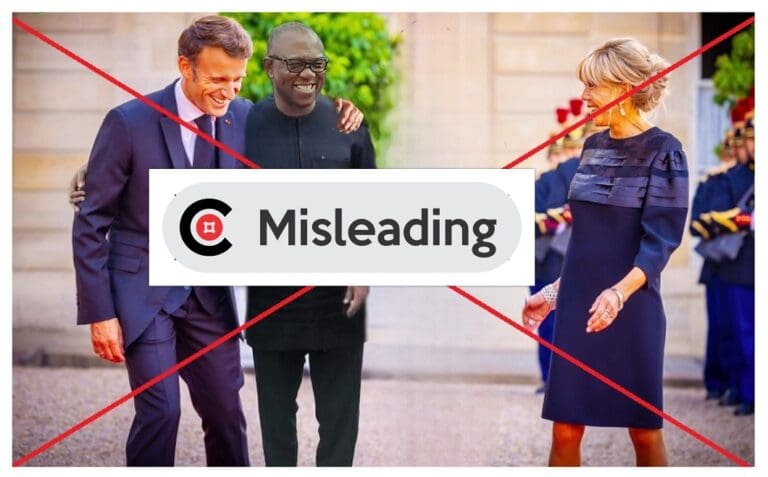
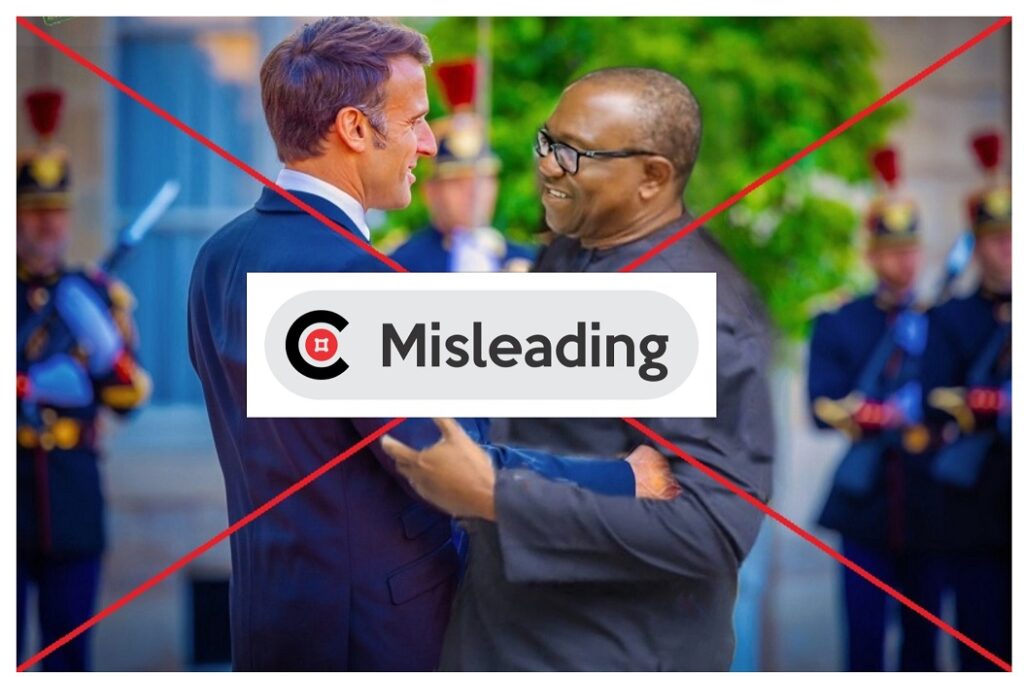
IMAGES of Peter Obi with the French president, Emmanuel Macron at the Paris summit held in France have been circulating on social media space in Nigeria.

Peter Obi is the Labour Party’s presidential candidate

The photos archived here were posted by a Twitter user, Wale Adedayo with the username: @mario9jaa, on Sunday, June 25, 2023 with a caption that reads: “for peace to reign.”

It has since then gained traction with of over hundred thousand views, more than a thousand likes and over 300 retweets as of Monday, June 26,2023.

Another doctored image of Peter Obi at the Paris summit with the French president, Emmanuel Macron.
One of the doctored images of Peter Obi at the Paris summit with the French president, Emmanuel Macron.


The Paris summit, which was hosted by President Macron, was held at Palais Brongniart on between June 22 and 23, 2023.

The meeting, was attended by the Nigerian President, Bola Ahmed Tinubu, and other global leaders, multilateral institutions, financial experts and economists.

The aim of the two-day climate and finance summit was to set up concrete measures to help poor and developing countries whose predicaments have been worsened by the devastating effects of the COVID-19 pandemic and the war in Ukraine better tackle poverty and climate change, a Reuters analysis revealed.


CLAIM

Images show Peter Obi with French President, Emmanuel Macron, at the Paris summit in France.

THE FINDINGS

Findings by the FactCheckHub show that the claim is MISLEADING.

Checks revealed that Obi was not present at the global summit in Paris.

A Google Lens search on the viral images led our researcher to the original photos which were taken at the event. The original images show Nigerian president, Bola Ahmed Tinubu, with President Macron instead, especially on the exact spots where Obi was photoshopped in.

Original image shows French President, Emmanuel Macron, with his Nigerian counterpart, Bola Ahmed Tinubu at the Paris summit.
Another original image shows French President, Emmanuel Macron, with his Nigerian counterpart, Bola Ahmed Tinubu at the Paris event.

THE VERDICT

The claim that the images show Peter Obi with French President, Emmanuel Macron, at the Paris summit in France is MISLEADING; findings show that they were doctored.

More Nigerian media outlets are embracing digital publication — Report

0

TRADITIONAL media outlets in Nigeria are embracing new digital formats and channels, as more people gain access to the internet, a 2023 Digital News Report by Reuters Institute has shown.

According to the report, as fewer people turn to traditional news sources such as television and print media for information, their business models have come under pressure. 

“Print, in particular, has been in sharp decline in recent years with a further 5 percentage point drop in weekly reach in our data. Despite these problems, there are still around 100 national and local print titles, of which the best known include The Punch, The Nation, Vanguard, Guardian and Premium Times,” the report stated.

“Television and radio remain critical sources of information, especially for those that are not online, but internet access is growing fast. Nigeria hit 122.5 million internet users as of January 2023, according to DataReportal, and Nigerians have been quick to adopt a wide range of social media platforms. Meta-owned products such as Facebook and WhatsApp remain most widely used for news, followed by Twitter and YouTube. 

“The messaging service Telegram has grown rapidly in recent years and Nigeria’s youthful population is now vigorously embracing short-form video via TikTok – accessed by 56% of 18–24s, according to our Digital News Report survey, with around half of these now accessing news on the platform,” it added.

The report stated that many Nigerian media organisations are now introducing premium subscription services demonstrating potential new avenues for media funding in Nigeria.

According to the report, Nigeria media outlets are also now using podcasts and email newsletters to increase engagement with websites.

It stated further: “Hotly contested presidential elections in Nigeria in February 2023 passed off largely peacefully but turnout was affected by fuel shortages, insecurity, and evidence of voter suppression in some parts of the country. Election rallies and political speeches were widely covered by the media but questions linger regarding the objectivity of some news coverage, considering that traditional media outlets are heavily dependent on political (and government) advertising.

“Despite the evolution of the media sector, the pursuit of press freedom, as enshrined in the constitution, remains elusive. The government arrested and detained several journalists and publishers in the run-up to the election for publishing reports deemed offensive. Those affected include Haruna Mohammed, publisher of WikkiTimes, Ayodele Samuel, the publisher of Taraba Truth and Facts, and Agba Jalingo, publisher of Cross River Watch, while others were physically assaulted.”

The report stated that misinformation  was rampant on social media before, during, and after the election and a new initiative, Nigerian Fact-checkers Coalition helped to monitor and debunk the misinformation online.

“In an effort to combat the problem, a new initiative was set up by major news platforms and civil society organisations working together under the umbrella of the Nigerian Fact-checkers Coalition (NFC). Participants included the International Centre for Investigative Reporting (ICIR), Dubawa, Africa Check, FactMattersNG, the Insight, FactCheckHub, TheCable, and Daily Trust and the group was active in fact-checking live presidential debates and set up an Election Observatory Room to monitor misinformation and disinformation in the months leading up to the election.

“In recent years, several laws regulating social and other digital media have been proposed by the government, in the face of international and local criticism about the wider potential impact on freedom of speech and on journalists’ ability to operate. Partly as a result, a number of stakeholders have been exploring new ideas for how to govern information on digital platforms,” it stated.

False claim circulates that no Igbo among Nigeria’s new Service Chiefs

0

A claim has circulated online that no Igbo was among Nigeria’s Service Chiefs newly appointed by President Bola Ahmed Tinubu.

On Monday, June 19, 2023, Tinubu approved the immediate retirement of all service chiefs and appointed new ones to replace them.

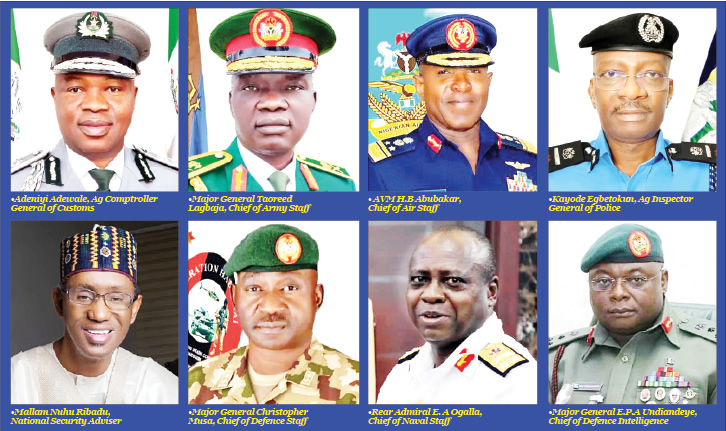
Willie Bassey, the Director of Information, Office of the Secretary to the Government of the Federation, in a statement noted that Major General Taoreed Abiodun Lagbaja is now appointed the Army Chief of Staff, while Rear Admiral Emmanuel Ikechukwu Ogalla takes over as the new Chief of Naval Staff.

It added that Major General C. G. Musa is the new Chief of Defence Staff, while Air Vice Marshal H. B. Abubakar gets the Chief of Air Staff position.

Kayode Egbetokun, a deputy inspector-general, is now the Acting Inspector-General of Police, while Major General EPA Undiandeye becomes the new Chief of Defence Intelligence, among others appointed.

Following this development, a Twitter account @Waspapping_ tweeted the claim archived here with a caption that read:

”There’s not a single Igbo person in the newly appointed officers by President Bola Ahmed Tinubu

The Igbos had the chance to align and support Atiku Abubakar’s bid for presidency but they refused

You’re now seeing the results of that decision

Congratulations to all involved.”

The post has generated over 1,500 likes, 207 retweets, and more than 140,000 views as of the time of this report.

Similarly, another Twitter account @RealCNsuccess tweeted the same claim with another caption thus:

”No Igbo man made it to Tinubu’s list of service chiefs. It sign is crystal clear, Igbos are no longer needed in the zoo.”

The post has also generated 453 likes, 318 retweets, and 42,000 views as of Tuesday, June 20, 2023.

A Facebook user, Sunny Igboanugo, also posted a similar claim with a caption thus:

”Close to 100 appointments, not a single Igbo. All hail Jagaban! I’m sipping my zobo!- The tiny voice!”

The claim was also found here and here.


CLAIM

No Igbo man among the newly appointed Service Chiefs in Nigeria.


THE FINDINGS

Findings by The FactCheckHub show that the claim is FALSE.

On Monday, Rear Admiral Emmanuel Ikechukwu Ogalla was appointed the new Chief of Naval Staff (CNS).

ChannelsTV reports that Ogalla hails from Enugu Ezike, Igbo-Eze North Local Government Area of Enugu State.

He is another Chief of Naval Staff of Igbo extraction after the 12th CNS, Rear Admiral Allison Amaechina Madueke, who also hails from Enugu State. Madueke served in that capacity from November 1993 to August 1994.

Enugu State is one of the five states that made up the South East geo-political zone of Nigeria.

According to Britannica Encyclopedia, it is bounded by the states of Kogi and Benue to the north, Ebonyi to the east, Abia to the south, and Anambra to the west.


THE VERDICT

The claim that no Igbo man is among Nigeria’s newly appointed Service Chiefs is FALSE; findings revealed that E.I. Ogalla is of Igbo extraction from South Eastern Nigeria.

Soludo makes false claim about Milton steel company being first in South-Eastern Nigeria

0

ON Friday, June 9, 2023, Anambra State Governor, Charles Chukwuma Soludo, inaugurated a firm, Milton Steel manufacturing company, in the state.

At the occasion, Soludo said the company was the first steel production firm in the entire South-East region.

“Today, I commissioned Milton Steel Manufacturing Company founded by Hon. Innocent Ojike (Ojicam), who is also the company’s majority shareholder.
“The company, which is the first steel facility in the South-East of Nigeria, is located in Awkuzu, Oyi LGA. It will manufacture rods and steel of all sizes, one of the basic resource required for full industrialization,” the governor said in a message published on his verified Facebook page.

Reports by The ICIR show that the region, currently battling insecurity, is one of Nigeria’s economic hubs. Among other reports it has done on insecurity in the South-East, the media organisation, in a two-part investigation, in January 2023, exposed how the region pays a heavy price for insecurity.

A section of Milton Steel Manufacturing company. Photo credit: Governor Soludo.

Speaking on the unveiling of Milton Steel Manufacturing Company, Soludo said his administration’s objective was to transition from a primarily informal commercial sector to an industrialised one, a technology hub, and a spot for leisure and entertainment.

His words, “As a government, we stand ready to provide every assistance. We have signed an agreement with EEDC (Enugu Electricity Distribution Company) to provide the state with 24-hour electricity. We will put in necessary infrastructure to make this happen now that power is on the concurrent list.

“My primary responsibility as a governor is to serve as the chief marketing officer for everything produced in Anambra. The best way to create jobs is to buy items made in the state. When you buy products made in the diaspora, you are creating jobs in other countries.

“I am here to celebrate three things: the company, industry, and the homeland consciousness of the founder. This is another reminder to Ndi Anambra in diaspora and, indeed the world, that Anambra is ready for business.”

Another section of Milton Steel Manufacturing. Photo credit: Governor Soludo.

Meanwhile, The FactCheckHub has debunked his claim that the company he inaugurated was the first steel producer in South-Eastern Nigeria.

CLAIM: Soludo says Milton Steel Manufacturing is the first steel production company in South-Eastern Nigeria.

He published the claim on his Facebook Page, which has over 248,000 followers.

Many of his followers lauded his action and speech.

A screenshot of Soludo’s Facebook Page where his follower lauded him over the post.


THE FINDINGS

Findings show that other steel production firms operated in the South-East, including Anambra State, before the inauguration of Milton Steel.

One of the firms is Emeife Industries Ltd (EIL). This firm is based in Onitsha, one of Anambra’s major cities.

Speaking with The FactCheckHub on Saturday, June 10, the EIL’s business development manager, Okafor Nkemdirim, said the firm had been operating since 2006, distributing its products across Nigeria.

Similarly, Izundu Wire and Steel Industry still operates partially in Anambra State, where it is located, according to its chairman, Nwakibia Inno Izundu.

In a telephone conversation on Saturday, June 10, Izundu disagreed with Soludo’s claim. He noted that expatriates make business difficult for them, claiming that the government was not helping local industries.

“The Chinese people have taken everything from us. Our government doesn’t want to help us. They like to help foreigners,” he added.

He said things were difficult for the local firms, and they work at a slow pace.

Another company contacted by The FactCheckHub in the state is Danchris Steel Rods Company. An official who did not give his name at the firm said the firm existed but is no longer working.

According to the company’s profile on the Corporate Affairs Commission (CAC) website, it was registered on April 29, 2019.

Other web platforms keeping companies’ records in Nigeria showed the firm has RC number 2875888 as its registration number with the CAC.

THE VERDICT

Soludo’s claim that Milton Steel Manufacturing is the first steel facility in South-Eastern Nigeria is FALSE; findings indicated that steel production companies operated in the region before the launch of Milton Steel.

Old video of Nigerian border re-opening resurfaces online

0

A video has been circulating on social media with a claim that the Nigerian president, Bola Ahmed Tinubu, has directed that all the nation’s borders be reopened.

The claim has been circulating within WhatsApp closed groups for days.

In the video, Nigeria Customs Service (NCS) personnel were seen opening a gated entrance with a voice in the footage saying: “One! two!! three!!!..  at last, at last, the border is open.”

Also in the video, one could see a building with the inscription: “Idiroko”.

The 21-second footage showing some Customs operatives performing symbolic reopening of Idiroko border amid jubilation, had went viral days ago.

It will be recalled that in August 2019, the immediate-past Nigerian president, Muhammadu Buhari, had ordered that all the country’s land borders be closed during his administration over illegal importation of drugs, arms and agricultural products into Nigeria from neighbouring West African countries.


CLAIM

Tinubu has directed that all Nigerian borders be re-opened.


THE FINDINGS

Checks by The FactCheckHub show that the claim is MISLEADING.

Findings revealed that the footage has been online since 2022 when former President Buhari directed that the Idiroko border and three other land borders be re-opened.

Screenshot of the footage retrieved from a WhatsApp group.

Punch had reported that the re-opening of the borders was after a circular was released by the Nigeria Customs Service.

The circular, signed by Deputy Comptroller-General E. I. Edorhe on behalf of the Comptroller-General of Customs, Hameed Ali, listed the borders as Idiroko border post in Ogun State, Jibiya border post in Katsina State, Kamba border post in Kebbi State and Ikom border post in Cross River State.

Earlier in 2020, Buhari had ordered the reopening of borders in Seme in Lagos, Illela in Sokoto, Maigatari in Jigawa, and Mfum in Cross River, citing recommendations from a presidential committee on review and advice on the reopening of borders.

In addition, the Customs Controller, Ogun 1 Area Command, Bamidele Makinde, said the border had been reopened since last year, contrary to the viral footage which showed some residents of Idiroko jubilating over the border reopening.

Makinde, however, said other land borders in the state like Imeko, Ohumbe, Ijofin and Ijoun remain shut.

“In Ogun State, as we speak today we have more than six approved borders, Imeko, Ijofin, Ijoun, Ohunbe, we have six of them. It is only Idiroko that is opened now, the others are still under lock.

“So, Idiroko is open 24/7, but the others, we don’t have powers to open them. If you do business in those borders, we will seize your goods,” he told Daily Trust on Tuesday.

The Cable also published an explainer on what the reopening of the borders could mean for the Nigerian economy which include boosting intra-African trade, lessen burden for SMEs, and competition with domestic production, amongst others.


THE VERDICT

The claim that Tinubu has directed that all Nigerian borders be reopened is MISLEADING; as the video currently in circulation is over one year old.

Did Tinubu win only two out of 23 LGAs in Kaduna State?

ON June 7, 2023, a Twitter user, Chigozie Valuation, with the username: @Chigozok claimed that Nigerian President, Bola Ahmed Tinubu, only won in two out of the 23 Local Government Areas (LGAs) in Kaduna State at the 2023 presidential election held in February.

He made the claim, archived here, while questioning how Tinubu secured a lead ahead of the presidential candidate of the Labour Party, Peter Obi, in Kaduna state despite the fact that the later won in seven Local Government Areas in the state.

“Do you know out of the 23LGAs . Atiku won 14: 554,360 votes. Tinubu won 2: 399,293 votes. Obi won 7: 294,494 votes. NNPP won zero: 92,969 votes. How did Tinubu get 399, 293 votes in 2LGAs? and Obi couldn’t even get 25% after wining 7LGAs.”

The claim has generated over 3,000 likes and more than 7,000 likes as of June 10, 2023. 


CLAIM 

Tinubu won in only two local governments in Kaduna state.


THE FINDINGS

Findings by The FactCheckHub show that the claim is TRUE.

Checks show that despite winning in only two LGAs, Tinubu led Obi in Kaduna state.

Screenshot of the tweet showing the claim.

Tinubu, who is the flag-bearer of the All Progressives Congress, garnered 399,293 votes to come second in Kaduna state ahead of Labour Party’s Peter Obi who polled 294,494 votes to claim third position. Atiku Abubakar of the People’s Democratic Party (PDP) won in the state with 554,360 votes.

Obi won in seven Local Government Areas of Chikun, Kaura, Kajuru, Jaba, Kachia, Jema’a and Zango-Kataf while Tinubu won only in Birnin-Gwari and Sanga LGAs.

Even though Obi won more LGAs, analysis of the election result shows that Tinubu got a large number of votes in some LGAs won by both Atiku and Obi.

For instance, in Giwa Local Government Area, Tinubu got 19,922 votes while Atiku who won the local government got 22,302 votes; that’s a slight margin of only 2,380 votes unlike Obi who secured only 565 votes in the local government.

Also in Makarfi LGA, Tinubu got 13,767 votes while Atiku garnered 22,098 votes and Obi secured 759 votes among many instances where Tinubu got large votes but still lost the local government areas.

THE VERDICT

The claim that Tinubu won in only two Local Government Areas in Kaduna state despite coming second in the state is TRUE; official election results announced by the Independent National Electoral Commission (INEC) revealed.