Home Blog Page 5

Old footage of Ned Nwoko misrepresented as 2027 Atiku campaign

0

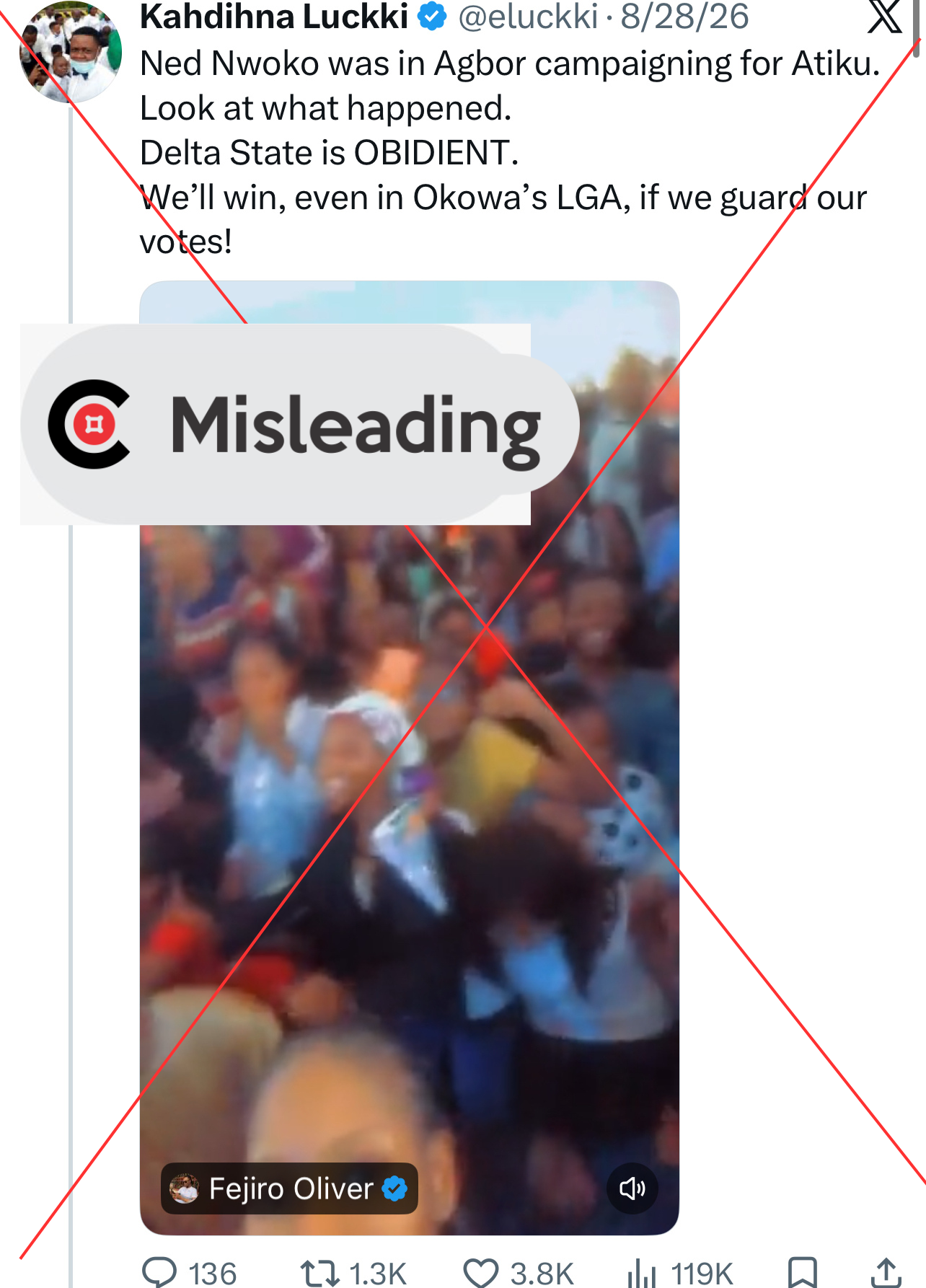
A VIDEO of Ned Nwoko addressing a crowd in Agbor, Delta State, has resurfaced online with claims that the senator was campaigning for Atiku Abubakar, the African Democratic Congress (ADC) presidential candidate, ahead of the 2027 presidential election.

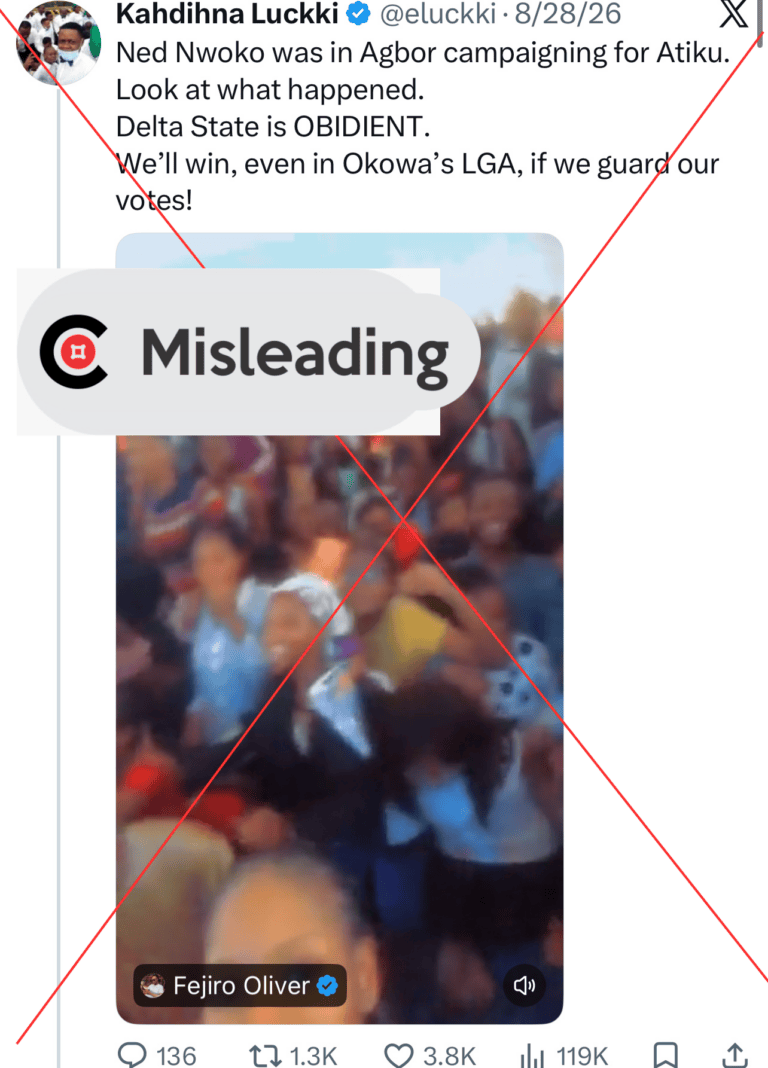
The video was shared on X by Kahdihna Luckki (@eluckki) on 28 August 2026, with the caption:

“Ned Nwoko was in Agbor campaigning for Atiku. Look at what happened. Delta State is OBIDIENT.We’ll win, even in Okowa’s LGA, if we guard our votes!”

Nwoko is a Nigerian lawyer, politician and philanthropist who represents Delta North senatorial district in the senate.

The post had generated 119,000 views, 1,300 reposts, 3,800 likes and 136 comments as of the time of the screenshot.

CLAIM

Video shows Ned Nwoko campaigning for Atiku Abubakar in Agbor ahead of the 2027 presidential election, with the crowd chanting Peter Obi’s name.

Screenshot of the viral post

FINDINGS

Findings by The FactCheckHub show that the claim is MISLEADING.

A reverse image search of keyframes from the footage shows that the video was already circulating online in February 2023, shortly before Nigeria’s 2023 general election.

An earlier version of the video was posted on X by @fejirooliver86. The accompanying caption stated that Nwoko had visited Agbor to campaign for Abubakar and Ifeanyi Okowa, the Peoples Democratic Party (PDP) presidential and vice presidential candidates in the 2023 election.

Nwoko was also a member of the PDP at the time. The post further stated that members of the crowd were chanting “PVC OBI” and “OBIDIENT.”

Atiku is now the ADC’s presidential candidate for the 2027 election, while Nwoko is currently a member of the All Progressives Congress (APC). The resurfaced footage, however, shows Nwoko during the 2023 election campaign and does not provide evidence that he was campaigning for Atiku ahead of the 2027 election.

VERDICT

The claim that the video shows Ned Nwoko addressing a crowd in Agbor was recorded during the 2023 presidential election campaign, not in 2026. Nwoko was then a PDP member, while Atiku Abubakar was the party’s presidential candidate. Nwoko left the PDP in January 2025 and subsequently joined the APC.

No, ASUU has not shut down all federal universities

0

A social media post claiming that all federal universities in Nigeria are currently shut because the Academic Staff Union of Universities (ASUU) has commenced a nationwide strike has gone viral.

The post was made on X by Mr. Papito (@1danfulcreation) on 17 September 2026, with the caption:

“ASUU is on strike but they are hiding the news. All the Federal Universities are currently striking, but Tinubu and compromised media and covering the headline!!!Nigerians wake up!!!”

The post had generated 7,400 reposts, 22,000 likes, and 458 comments as of the time of the screenshot.

CLAIM

All federal universities in Nigeria are currently on strike, but the government and the media are hiding the development.

FINDINGS

Findings by The FactCheckHub show that the claim is FALSE.

ASUU had not declared a nationwide strike across all federal universities as of 17 September 2026.

Rather, the union’s national leadership had threatened to reactivate its suspended nationwide strike if the federal government and state governments failed to resolve outstanding issues affecting university lecturers.

According to report published by Punch on 11 September, ASUU president Christopher Piwuna said the union could activate its suspended strike “without any further notice” over issues including the incomplete implementation of the December 2025 agreement, unpaid salaries and unremitted deductions.

Channels Television reported that ASUU specifically described its position as a warning that the suspended industrial action could be activated if the government failed to respond to its demands. The report noted that this was not an immediate declaration of a nationwide strike.

Similarly, Punch reported on 11 September that ASUU had threatened to resume its suspended nationwide strike, rather than announcing that the strike had already commenced.

However, some individual ASUU branches had embarked on industrial action.

For example, the ASUU chapter at the University of Port Harcourt (UNIPORT) declared an indefinite strike on 16 September over incomplete salary payments and responsibility allowances. Punch reported that the branch took the decision after the university management failed to resolve the issues raised by the union.

Similarly, the ASUU chapter at Nnamdi Azikiwe University, Awka (UNIZIK) had embarked on a strike over incomplete payment of August salaries. However, the action was suspended on 11 September after the university paid the outstanding salaries. Punch reported that lecturers were directed to immediately resume their academic and administrative duties.

There were also industrial actions involving some state-owned universities. On 16 September, ASUU declared an indefinite strike across Lagos State University (LASU), Lagos State University of Education (LASUED) and Lagos State University of Science and Technology (LASUSTECH) over unresolved demands. TheCable reported that the three institutions are owned by the Lagos State government.

These developments show that some university branches were on strike, but there was no nationwide strike covering all federal universities.

The claim that the development was being hidden by the media is also unsupported. Major Nigerian news organisations, including Channels Television, Punch, Premium Times and TheCable, had reported ASUU’s nationwide strike threat and the industrial actions by individual university branches.

Therefore, while ASUU branches at some universities had taken industrial action, ASUU had not commenced a nationwide strike involving all federal universities as claimed in the viral post.

VERDICT

The claim that ASUU had placed all federal universities in Nigeria on a nationwide strike as of 17 September 2026 is FALSE. The union had threatened to reactivate its suspended nationwide strike, while individual branches at some universities had embarked on separate industrial actions.

No, Peter Obi has not announced plans to leave his coalition

0

A POST claiming that Peter Obi, presidential candidate of the Nigeria Democratic Congress (NDC), is planning to leave his political coalition has surfaced on social media.

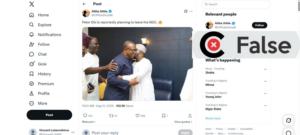
A verified X user, @OfficialAzzaki, shared an image showing Obi embracing former vice president Atiku Abubakar and the presidential candidate for the African Democratic Congress (ADC), accompanied by the caption:

“Peter Obi is reportedly planning to leave the NDC. 🔥”

As of 18 September 2026, the post has generated over 100,000 views, 320 likes and 150 comments.

READ: PM News front page altered to link Peter Obi to ‘madness’ testimony

CLAIM

Peter Obi is planning to leave his political coalition.

Screenshot of the viral post

FINDINGS

Findings by The FactCheckHub show that the claim is FALSE.

The FactCheckHub conducted a reverse image search of the photograph attached to the viral post. The search showed that the image is an old file photograph of Obi and Abubakar.

The photograph was originally published by Punch on 13 October 2018, in a report on Abubakar’s selection of Obi as his running mate on the Peoples Democratic Party (PDP) presidential ticket for the 2019 election.

Further checks by The FactCheckHub found no reports from official media outlets, credible national dailies or major broadcast platforms confirming that Obi has announced plans to leave or defect from his current political alignment.

Meanwhile, a review of public records and recent media reports found that Obi continues to grant interviews, issue public statements and participate in political engagements.

READ ALSO: Old Peter Obi video resurfaced with misleading claim he defended ‘Yahoo boys’

The FactCheckHub contacted Obi’s spokesperson for a response to the claim but had not received a reply at the time of publication.

VERDICT

The claim that Peter Obi is planning to leave his political coalition is FALSE. The image used to support the post is an old file photograph from October 2018, and there is no official statement or credible media report supporting the claim.

PM News front page altered to link Peter Obi to ‘madness’ testimony

0

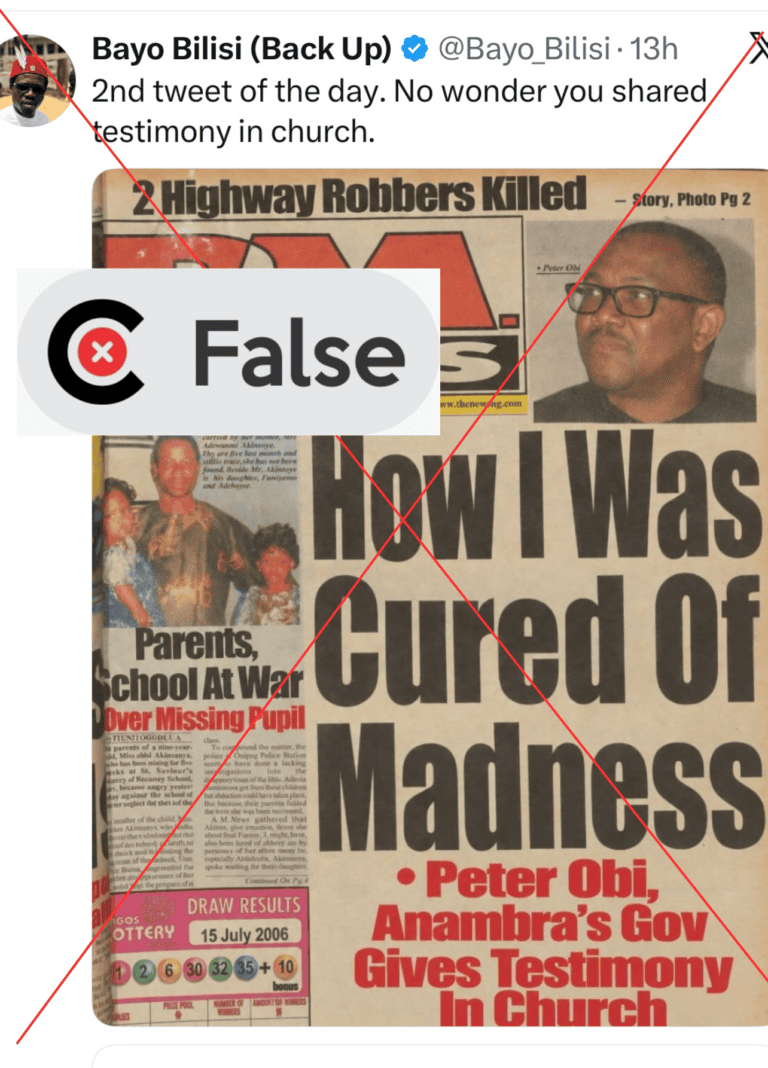
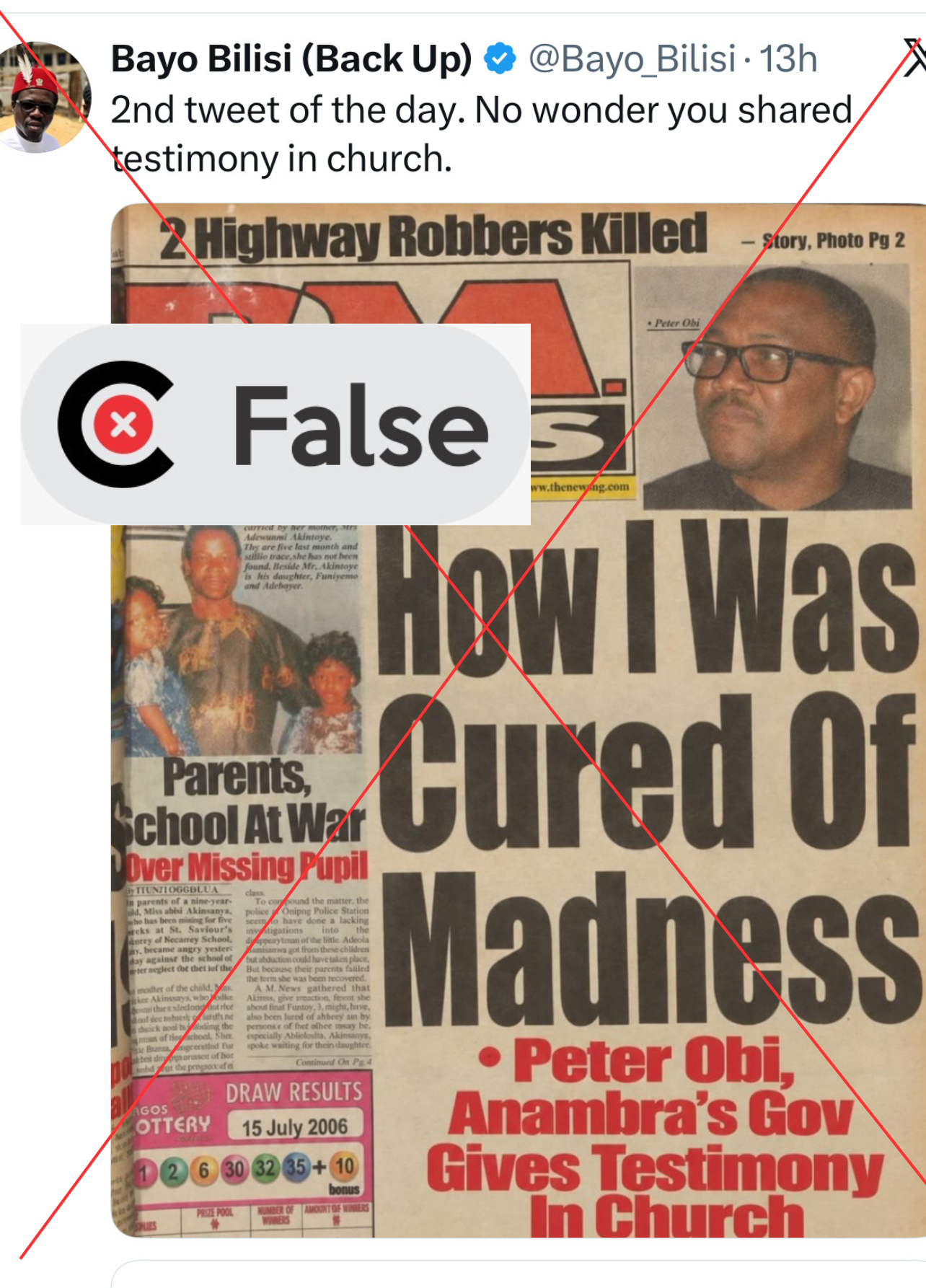
A newspaper page has surfaced on social media with a claim suggesting that Peter Obi, former Anambra State governor and presidential candidate of the Nigeria Democratic Congress (NDC), testified in church about being cured of “madness.”

An X user, @Bayo_Bilisi, shared the image with the caption:

“2nd tweet of the day. No wonder you shared testimony in church.”

The post was accompanied by a photograph purportedly showing a July 2006 edition of PM News. As of 17 September 2026, the post had generated over 180 reposts and more than 400 likes.

Another X user @diponet1, also shared the purported newspaper page in a post that had attracted more than 150 likes and 77 shares as of 17 September 2026.

CLAIM

Newspaper page shows Peter Obi giving a testimony in church about how he was cured of madness.

Screenshot of the viral post

FINDINGS

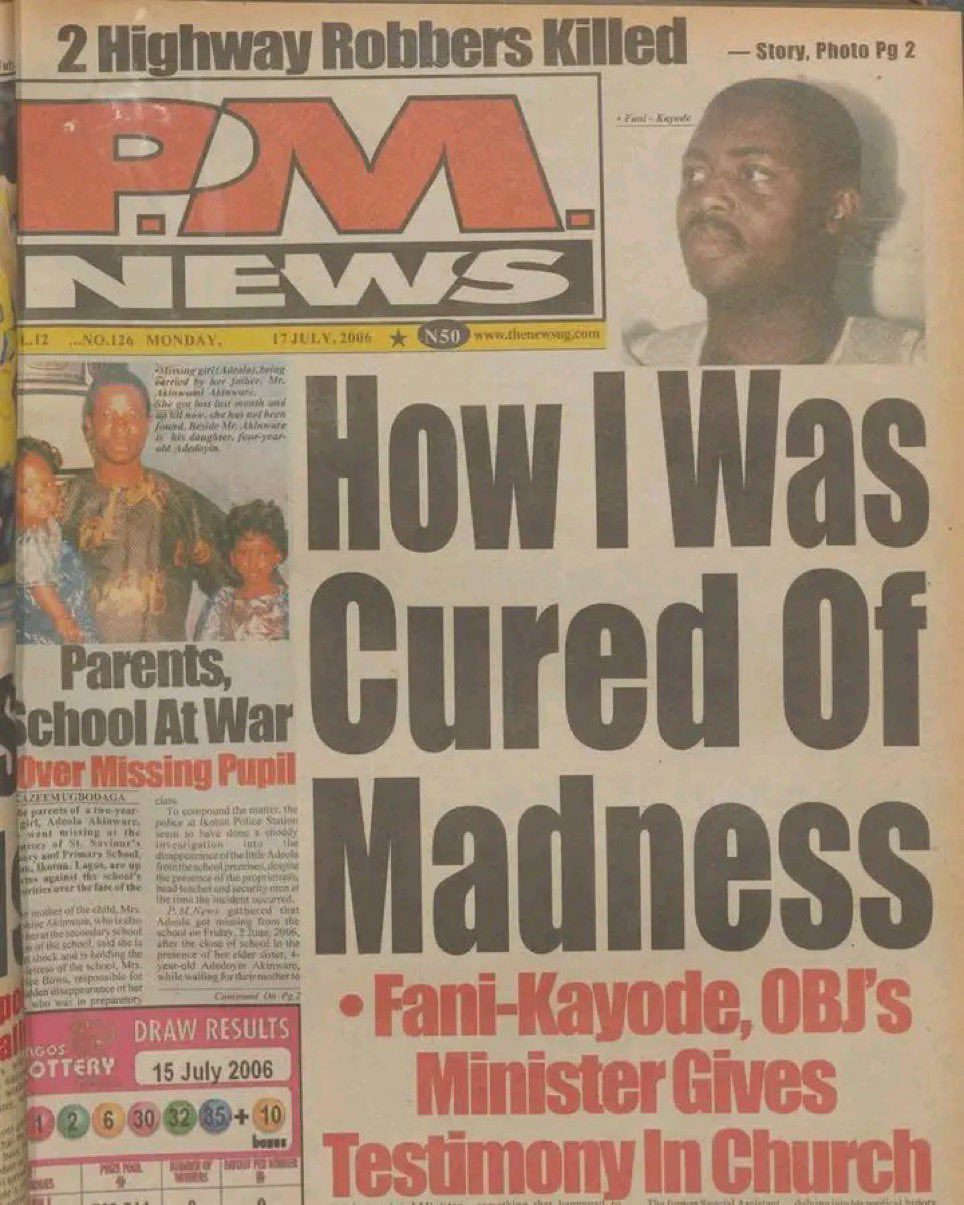
Findings by The FactCheckHub show that the newspaper clipping was altered.

A comparison of the circulating image with the original PM News edition archived by Archivi.ng, a startup that digitises newspaper editions, shows that the photograph and the identity of the person featured in the story were altered.

The original edition of PM News dated 17 July 2006 carries the headline: “HOW I WAS CURED OF MADNESS.”

The newspaper’s original page identifies Femi Fani-Kayode as the person featured in the story. His photograph appears beside the headline, while the sub headline identifies him as a minister in the Obasanjo administration who gave a testimony in church.

Screenshot of the original publication

Fani-Kayode, also known as FFK, is a Nigerian lawyer, politician and public commentator. He has been involved in Nigerian politics for several years and has belonged to different political parties, including the Peoples Democratic Party (PDP) and the All Progressives Congress (APC). He previously served as aviation minister and as special assistant on public affairs to former president Olusegun Obasanjo.

The circulating version, however, has replaced Fani-Kayode’s photograph and altered the accompanying text to read:

“Peter Obi, Anambra’s Gov Gives Testimony In Church.”

The alteration therefore creates the impression that Obi gave the testimony reported in the 2006 newspaper.

The claim is particularly misleading because Obi was governor of Anambra State at the time. But the original newspaper did not identify him as the person featured in the “How I Was Cured of Madness” story.

VERDICT

The claim that Peter Obi gave a testimony about how he was cured of madness is FALSE. The newspaper clipping circulating with his photograph and name has been altered. The original version identifies Femi Fani-Kayode, not Peter Obi, as the person who gave the testimony.

NYSC has no pension scheme for former corps members from 2011–2023

0

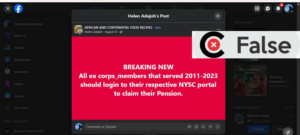
A SOCIAL media post claims that all former corps members who served between 2011 and 2023 are eligible to claim pensions by logging into their National Youth Service Corps (NYSC) portals to claim pensions.

The post, shared by a Facebook user on 15 August 2026, Helen Adejoh, reads:

“BREAKING NEW All ex corps_members that served 2011-2023 should login to their respective NYSC portal to claim their Pension.”

As of 17 September, the post has generated over 100 likes and more than 20 comments, with commenters asking how to go about it.

READ: Are HND holders barred from NYSC?

CLAIM

Ex-corps members who served between 2011 and 2023 are instructed to log into their NYSC portals to claim pensions.

screenshot of the post

FINDINGS

Findings by The FactCheckHub show that the claim is FALSE.

The NYSC scheme was established to promote national unity and foster common ties among Nigerian youths following the Nigerian civil war.

A review of the NYSC’s official social media platforms and website, where official announcements and directives are published, found no notice directing former corps members to log into their portals to claim pensions.

Furthermore, the NYSC introduced its digital biometric mobilisation system in 2014, replacing the previous manual process, according to Vanguard. Therefore, corps members who served before 2014, including those who served between 2011 and 2013, would not have NYSC portal accounts to log into.

James Emmanuel, a data expert and analyst at The ICIR, who completed his national service in 2013, confirmed that his mobilisation was entirely manual. He said he has no profile on the NYSC portal and that his set has never received any communication about post-service pensions.

READ ALSO: Deepfake image falsely depicts Poco Lee in UK courtroom

Additionally, Section 16(2)(a) of the NYSC Act empowers the NYSC directorate, with the president’s approval, to make byelaws governing the pay, allowances and other emoluments of corps members. The provision relates to benefits during the service year; it does not establish a pension scheme or provide for post-service pension payments to former corps members.

VERDICT

The claim that former corps members who served between 2011 and 2023 should log into their NYSC portals to claim pensions is FALSE. The NYSC has issued no such directive, those who served before the introduction of its digital portal in 2014 would not have online accounts, and the scheme does not provide pension payments to former corps members.

Fake products, real dangers: The hidden risks of counterfeit goods

0

THE recent outcry over suspected fake products in Nigerian markets has renewed concerns about the health risks posed by counterfeit and substandard products used and consumed daily by millions of people.

In recent weeks, Nigerians have taken to social media to share photographs and videos of products they suspected to be fake, including yoghurt, toothpaste, beverages, food and other household consumables.

The videos have raised fresh questions about how counterfeit products find their way into shops and markets and, more importantly, what consumers may be putting into their bodies without knowing.

One such video was posted on 1 September by Nigerian doctor Aniekwe Donald, who shared a detailed comparison video showing tubes he identified as genuine and counterfeit Oral-B toothpaste side by side.

The clip, which highlighted differences in packaging quality, seals, texture, translucency and taste, was widely shared across social media.

In the video, Donald demonstrated what he described as differences between the products, including seals he said were absent on the genuine product, thicker and less translucent paste, and a less minty flavour in the suspected counterfeit version.

He also recounted visiting between five and seven shops where, according to him, suspected counterfeit Oral-B toothpaste was on sale, with some of the sellers apparently unaware that the products could be fake.

Donald warned about the potential health consequences of using counterfeit toothpaste, including the possibility that manufacturers of unregulated products could use unsafe ingredients. The video went viral across various social media platforms. 

Around the same period, other toothpaste-related alerts circulated online, adding to growing concerns about products that consumers use every day.

Similarly, another account, @mariolexx, posted a video showing shirtless men packaging fake Hollandia yoghurt in a room. The account later posted a video showing two yoghurts to demonstrate the difference between the original and a counterfeit one. 

A Nigerian X user, Julius Adebayo, also shared a video showing counterfeit popular Four Cousins drinks and tomato paste being produced in an unaccredited facility.

The videos have fuelled a wider conversation about the authenticity and safety of products on Nigerian shelves.

While social media comparisons alone cannot establish that every product described online as fake is counterfeit, the concerns are occurring against a backdrop of repeated discoveries of unregistered, counterfeit and substandard consumer products by regulatory authorities.

A disturbing pattern

Nigeria’s battle against counterfeit and substandard products has repeatedly brought regulators to some of the country’s biggest markets.

Although fake medicines have long attracted public attention, recent enforcement operations show that the problem extends to products Nigerians eat, drink and use every day.

In August 2025, the National Agency for Food and Drug Administration and Control (NAFDAC) seized more than 10,000 cartons of unregistered products at the Lagos Trade Fair Market. The products included tomato paste, creams, soaps, body sprays, washes, air fresheners and toothpaste.

Earlier this year, NAFDAC also warned Nigerians about the distribution of unregistered and suspected counterfeit toothpaste.

In April 2026, the agency issued a public alert concerning products labelled as Colgate toothpaste, which it said were suspected to be counterfeit and unregistered. 

The agency recently said it had destroyed or seized more than ₦1.54 trillion worth of fake and substandard products nationwide since 2023. The products included counterfeit medicines but also counterfeit milk, skin-lightening creams, fake insecticides, cosmetics and other regulated products.

The agency’s repeated seizures show that the problem is not restricted to a single product or sector.

From toothpaste and cosmetics to food products and beverages, counterfeiters can target products that are familiar to consumers and package them to resemble established brands.

The similarity between genuine and suspected counterfeit products is one of the concerns raised by the recent social media videos.

A consumer may buy a product because of a familiar name, logo or packaging without knowing whether it was manufactured by the legitimate company or under conditions that meet safety requirements.

The health risks of fake products

But the consequences of counterfeit products can extend far beyond financial loss. Unlike a counterfeit handbag or electronic device, fake or substandard products that are eaten, drunk or applied to the body can directly affect health.

A product that has not passed regulatory checks may contain ingredients, additives or chemicals whose safety and concentration have not been verified. Its manufacturing environment may also fail to meet required hygiene standards.

This is particularly important for food and beverages. Products prepared, packaged or stored under poor sanitary conditions can become contaminated before they reach consumers. Similarly, counterfeit products may carry misleading labels, making it difficult for consumers to know their actual ingredients, manufacturing source or expiry status.

Nigeria has previously recorded deaths linked to products meant for human consumption that contained dangerous substances.

In 2008 and 2009, an outbreak of acute kidney failure among Nigerian children was traced to My Pikin, a teething mixture contaminated with diethylene glycol, a toxic chemical. An investigation involving Nigerian health authorities and the U.S. Centers for Disease Control and Prevention (CDC) found that children who consumed the contaminated product developed acute renal failure.

The case remains one of Nigeria’s clearest examples of the potentially fatal consequences of unsafe products entering the supply chain. It showed how a product purchased for routine use could expose consumers to a toxic substance they had no reason to expect.

In April 2024, NAFDAC recalled a batch of Benylin Paediatric cough syrup after laboratory tests found an unacceptably high level of diethylene glycol, a chemical that can cause acute kidney injury and can be fatal when consumed.

The episode nevertheless demonstrated that a product could carry the name and packaging of an established brand and still contain a dangerous substance that consumers cannot detect by looking at it.

Speaking with The FactCheckHub, Adewale Samuel Adeleye, President of the Association of Resident Doctors and Senior Registrar in the Department of Community Medicine and Public Health at the University of Abuja Teaching Hospital, warned that the circulation of counterfeit and unregulated products could escalate into a public health emergency.

Adeleye said products that come into contact with the human body, whether consumed or applied externally, require proper regulation and supervision.

“Everything we put in our mouth, anything we rub on our body, anything that has to do with the human body, they are supposed to be regulated,” he said.

According to him, the responsibility for preventing the circulation of harmful products does not rest with NAFDAC alone. He said government regulators, manufacturers, communities and consumers all have roles to play in ensuring that products reaching the public are safe.

He said NAFDAC’s responsibility should cover the entire production process, including inspection of manufacturing facilities, the source and quality of raw materials, processing methods, storage, packaging and labelling.

Adeleye also called for more proactive market surveillance, saying regulators could purchase suspiciously cheap products from markets and subject them to laboratory analysis to determine their contents.

“I was in the market today, some people selling all kinds of toothpaste, one two for one five,” he said, referring to products being sold at unusually low prices.

He identified affordability and accessibility as two factors that could drive consumers towards counterfeit products. According to him, consumers facing financial pressure may choose cheaper products, while products sold in open markets may be easier to access than those sold through more regulated outlets.

“If you go to market now to buy any of this quality toothpaste, you will spend nothing less than two to three thousand Naira for one. And now, I am seeing it everywhere in market today, two for one thousand five hundred,” he said.

Adeleye said enforcement alone would not solve the problem if consumers remained unaware of how to identify suspicious products or where to report them.

“The awareness at the local level, awareness to the community, awareness to the consumer, the end users, is not there,” he said.

He said sustained public education could help consumers recognise products with suspiciously low prices, unusual smells or tastes, poor packaging, missing manufacturer information or other signs that differ from products they normally purchase.

The health consequences, he warned, could be serious. Adeleye linked exposure to potentially harmful substances in counterfeit cosmetics, food products and other consumer goods to long-term health problems, including kidney disease and some forms of cancer.

“Some of these metallic or heavy metals that are used in making some of these soups, some of these creams, some of these things we put in our body,” he said. “This heavy metal that I’m using can cause, you know, chronic kidney disease. It can also be responsible for some form of cancer.”

He stressed that the health risks associated with counterfeit consumables were fundamentally different from those posed by fake non-consumable goods.

“So, we’re talking about, you know, if we are talking about maybe if you buy a shoe now, it’s a fake. It’s a whole different ballgame. You buy your clothes, it’s a fake. But talking about what people are consuming inside their body, inside their body system,” he said.

For consumers, Adeleye advised Nigerians to avoid products whose quality cannot be verified, particularly those intended for consumption or application to the body.

“Anything that is not regulated, anything that we cannot verify the quality of, we should try as much as possible to stay away from them,” he said.

He urged consumers to be cautious when a product is significantly cheaper than the same product sold elsewhere and to examine its packaging, manufacturer details, ingredients and other identifying information.

He also advised Nigerians to report suspicious products to the appropriate authorities rather than continuing to use them.

“As a public health expert, prevention is always better and cheaper than cure,” Adeleye said. “Try to prevent all of this avoidable death by taking conscious effort to look at what we put in our mouth and what we use on our body.”

He added that protecting consumers from harmful products required a collective effort involving regulators, producers, communities and individuals.

“It’s not a one-man show. Everybody has their own role to play,” he said.

On his part, Yusuf Hassan, a public health pharmacist, described the circulation of fake, adulterated and improperly produced food and drinks as a serious public health threat in Nigeria.

Hassan said unsafe consumables could add to the country’s existing burden of communicable and non-communicable diseases, particularly when products are made with contaminated water, unsafe chemicals, poor-quality ingredients or under unhygienic conditions.

According to him, exposure to such products can result in food poisoning, organ damage and other acute or long-term health problems, with children, pregnant women, older people and people with underlying health conditions particularly vulnerable.

He said the consequences extend beyond individual consumers, as widespread circulation of unsafe products could increase pressure on families and an already stretched healthcare system.

“What may appear to be simply a consumer-protection issue is, in fact, a significant public-health and health-security concern,” Hassan said.

He urged Nigerians to be more deliberate about the products they purchase and where they buy them.

Hassan advised consumers to patronise reputable outlets, check product labels, expiry dates, packaging and seals, and watch out for signs of tampering, unusual colour, smell or appearance.

For regulated packaged products, he said consumers should verify registration information where possible and be cautious when products are sold at prices that appear unusually low.

He also encouraged consumers to report suspicious products and sellers to the relevant authorities rather than simply discarding the products.

“Consumer vigilance cannot replace effective regulation, but millions of vigilant consumers can significantly strengthen the surveillance system by helping regulators identify dangerous products quickly,” he said.

On the role of regulatory agencies, Hassan said NAFDAC and other relevant authorities needed to strengthen their capacity to move from largely reactive enforcement to proactive, intelligence-driven surveillance.

He called for increased investment in human resources, laboratory and testing capacity, digital product-verification systems, market surveillance and stronger regulatory presence at the state and local levels.

According to him, regulators must be able to identify suspicious products quickly, trace their sources and distribution networks, and remove them from circulation before they cause widespread harm.

He also called for stronger collaboration between NAFDAC, other regulatory and law-enforcement agencies, state and local authorities, manufacturers, retailers and consumer groups.

Hassan said enforcement must also carry meaningful consequences for people who deliberately manufacture or distribute dangerous products.

“Nigeria needs to make it increasingly difficult to produce a fake product, easier for consumers and retailers to verify an authentic one, and much more costly for anyone caught putting the health of Nigerians at risk,” he said.

What are health authorities doing?

Following the growing concerns over suspected fake and unsafe products, NAFDAC has defended its efforts to curb the circulation in Nigerian markets.

NAFDAC Director-General, Prof. Mojisola Adeyeye, while addressing journalists in Lagos, said the agency had removed 7,210 products from circulation after visiting 6,233 facilities across the 36 states and the Federal Capital Territory between May and July 2026. 

While acknowledging the concerns raised by Nigerians, Adeyeye said social media allegations alone could not establish that a product was counterfeit, adulterated or unsafe without scientific verification.

“The strength of the publication could have been enhanced by a proper scientific evaluation rather than relying primarily on emotionally driven and perhaps commercially motivated social media narratives,” the agency said in its response.

NAFDAC said credible reports of suspected counterfeit or unsafe products remained important sources of regulatory intelligence, but urged consumers to use its established complaint channels so it could investigate and verify allegations.

According to figures provided by the agency, food and water accounted for the most products removed during the three months, with 3,633 products. Drugs and herbals followed with 2,459 products, while cosmetics accounted for 911 products. Medical devices accounted for 183 products, chemicals 21, and vaccines and biologics three.

NAFDAC said the exercise covered routine and proactive post-market surveillance across the country, with about 80 per cent of its post-market surveillance activities directed at detecting and curbing fake, falsified, substandard and otherwise non-compliant products.

The agency said the activities include inspections, sampling, laboratory assessments, investigation of complaints and intelligence, removal of non-compliant products from circulation and enforcement against those responsible.

In defending its enforcement record, NAFDAC cited a coordinated operation in February and March 2025 in which more than 137 40-foot truckloads of counterfeit and substandard products valued at over N1.5 trillion were evacuated and destroyed in major markets including Idumota in Lagos, Onitsha and Ariaria Market in Aba.

The agency also cited the destruction of more than N15 billion worth of fake, expired, counterfeit and banned medicines in Ibadan in February 2026, as well as the seizure of more than 10 million doses of counterfeit malaria medicines and cosmetics valued at about N3 billion during a raid at Lagos Trade Fair Market.

NAFDAC said it had also secured 64 convictions for counterfeiting, with prison sentences ranging from one to seven years without an option of fine.

The agency said its surveillance activities uncovered operators allegedly refilling 19-litre CWAY-branded water bottles with water from unapproved sources and selling them to hotels and supermarkets. The operators were sanctioned.

NAFDAC also pushed back against the perception that all unsafe products found in Nigerian markets fall exclusively under its regulatory control.

The agency said fresh agricultural produce such as apples, grapes and oranges is not solely under its control, pointing to the role of the Nigeria Agricultural Quarantine Service in the quarantine control of agricultural commodities.

It said food safety requires coordinated action across the farm-to-fork chain, involving primary production, processing, distribution, retail and consumption.

NAFDAC also raised concerns about the adulteration of palm oil with azo dyes and the reported use of bleach and other harmful chemicals in the production of fufu and other staple foods.

According to the agency, it does not have direct and absolute regulatory oversight over unbranded palm oil, fufu and other traditionally packaged staple foods sold in open markets. It said sub-national authorities also have a responsibility to monitor such products in line with the National Policy on Food Safety and Quality.

However, NAFDAC maintained that packaged and registered food products undergo regulatory procedures intended to establish their safety and quality.

For consumers, NAFDAC urged Nigerians to report suspected non-compliant regulated products through its official complaint channels rather than relying solely on social media. The agency also provides product verification services through its official platforms, allowing consumers to check registered products using their NAFDAC registration numbers.



Deepfake image falsely depicts Poco Lee in UK courtroom

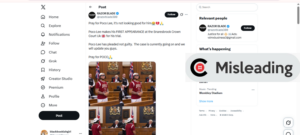
AN image showing Nigerian entertainer Iweh Pascal Odinaka, popularly known as Poco Lee, standing inside a UK court during his trial has surfaced on social media, with a claim suggesting that the footage shows his first court appearance.

The claim was posted by a verified X user, @razorblade300, with the caption:

“Pray for Poco Lee, it’s not looking good for him 😭😭💔🙏 Poco Lee makes his FIRST APPEARANCE at the Snaresbrook Crown Court Uk 🇬🇧 for his trial. Poco Lee has pleaded not guilty. The case is currently going on and we will update you guys. Pray for POCO 🙏”

The post has generated over 96,000 views, and more than 260 likes.

An X user @jorubiang3422 even commented under the post that “he is having a great time at court” due to the attire and his expression.

READ: Old Peter Obi video resurfaced with misleading claim he defended ‘Yahoo boys’

CLAIM

Image shows Poco Lee making his first court appearance at Snaresbrook Crown Court in the UK.

Screenshot of the viral post

FINDINGS

Findings by The FactCheckHub show that the claim is MISLEADING.

The FactCheckHub traced the original image of Poco Lee used in the clip to an earlier social media post published by Pocolee himself on his Instagram page on 13 August 2026. The original photograph shows Poco Lee standing outdoor near a waterfront structure, wearing the exact same red Gucci t-shirt, cap, and sunglasses seen in the claim.

This means that the figure was digitally extracted from the original background and placed into a courtroom setting.

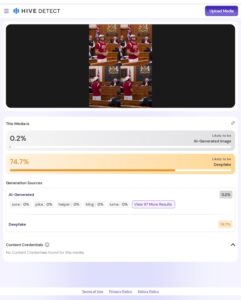
A forensic analysis of the image using Hive Moderation, a detector tool, returned a 74.7% likelihood that the imagery is deepfake or digitally manipulated.

result of the analysis

Further examination of the clip showed characteristics consistent with AI-generated imagery, including distorted facial features on background figures, irregular judicial emblems, and unnatural lighting, indicating that the courtroom scene depicted alongside Poco Lee is not real but digitally composite.

The ICIR reported that legal proceedings against Poco Lee are currently active at Snaresbrook Crown Court in London following allegations of sexual offences.

Following proceedings on Tuesday, 15 September 2026, the court fixed 8 February 2027 for his plea hearing, with his trial scheduled to commence on 8 March 2027.

READ ALSO: Nigeria 2027: The fake promises candidates never made

However, under Section 41 of the UK Criminal Justice Act 1925, photography and video recording inside UK courtrooms are strictly prohibited.

The image therefore does not provide evidence that Poco Lee was filmed during a court appearance as suggested by the social media post.

VERDICT

The claim that the image shows Poco Lee during a court appearance in the UK is MISLEADING. The footage has been digitally manipulated to create a deepfake courtroom scene.

Altered photo falsely shows bishop wearing Tinubu insignia

0

A photograph of Archbishop Leonard Bature Kawas, President-General of the Charismatic Bishops Conference of Nigeria (CBCN), has surfaced on social media with a Tinubu-associated insignia apparently added to his cap.

The image was shared on X by @Dismanae2x on 11 September 2026, with the caption:

“Even bishop don endorse Tinubu for 2027 election. Omoh.”

The post had recorded about 1,100 views, eight reposts and 16 likes as of 16 September 2026.

Another X user, @Princeujay, also shared the photograph with the caption, “Bishop that needs to be given money before advocating for good governance. Na Bishop?”

The post had generated about 1,200 views, 70 reposts and 111 likes.

CLAIM

Photo shows Archbishop Leonard Bature Kawas wearing a cap bearing a Tinubu-associated insignia.

Screenshot of the viral post

FINDINGS

Findings by The FactCheckHub show that the photograph has been altered.

A comparison of the viral photograph with the original version shows that the Tinubu-associated insignia visible on the cap in the circulating image is absent from the original photograph.

The original photograph was taken during the visit by members of Charismatic Bishops Conference of Nigeria to the office of the Secretary to the Government of the Federation in June 2024.

In the original photograph, however, Kawas’ cap does not contain the symbol visible in the viral version. The symbol has been superimposed on the image, altering the appearance of the original photograph.

The alteration is significant because it creates the impression that Kawas was photographed publicly wearing a political insignia associated with Tinubu.

There is, however, a separate factual development that may have contributed to the circulation of the altered photograph.

On 9 September 2026, Kawas announced that the Charismatic Bishops Conference of Nigeria had endorsed President Bola Tinubu’s bid for re-election in the 2027 presidential election. The announcement was made at the CBCN’s 2026 synod in Abuja.

The Federal Ministry of Information and National Orientation reported that Kawas declared the conference’s support for Tinubu, saying, “We support him now. We support him today, we support him tomorrow, and we support him for as long as he’s willing to be our president.”

He subsequently said, “This house has endorsed him for 2027 presidency.”

The endorsement was also reported by TVC News and Vanguard, which both identified Kawas as the person who announced the CBCN’s position.

Therefore, the underlying claim that Kawas and the CBCN endorsed Tinubu’s bid for a second term in for the 2027 presidential election is supported by multiple reports. However, the circulating photograph is not authentic.

VERDICT

The photograph is MISLEADING. Archbishop Leonard Bature Kawas and the Charismatic Bishops Conference of Nigeria did endorse President Bola Tinubu for the 2027 presidential election. However, the Tinubu-associated insignia visible on Kawas’ cap in the viral photograph was not present in the original photograph and was added to the image.

AI-generated woman falsely portrayed as Neymar’s companion in viral video

A video showing Brazilian footballer Neymar da Silva Santos Júnior, popularly known as Neymar, smiling and posing for a photo with a Black woman has surfaced on social media, with a claim suggesting that the woman is a real person.

An X account, @RichardMbayo, shared the video with the caption:

“Continue bleaching your skin yet black/dark-skinned queens are winning.”

The post had generated over 800 reposts and more than 10,000 likes as of 14 September 2026.

CLAIM

Video shows Neymar posing with a Black woman.

FINDINGS

Findings by The FactCheckHub show that the claim is MISLEADING.

The FactCheckHub traced the video to an Instagram account with the username @INESSA_Garcie.

Checks of the account’s history show that it has published and circulated several videos featuring the same Black woman alongside Neymar. Examples of the videos can be seen here and here.

A comparison of the videos shows that the woman appears repeatedly in different scenes with Neymar, including instances where she appears to be having a conversation with him and posing for photographs.

The FactCheckHub also conducted a face search of the woman using PimEyes, a facial recognition search engine. The search did not return evidence establishing that the woman is a real person appearing in the footage.

Further examination of the videos showed characteristics consistent with AI-generated imagery, indicating that the woman depicted alongside Neymar is not a real person but an AI-generated figure.

The video therefore does not provide evidence that Neymar posed for a photograph with a real Black woman as suggested by the social media post.

VERDICT

The claim that the video shows Neymar posing with a real Black woman is MISLEADING. The footage has been digitally generated or manipulated to depict Neymar alongside an AI-generated woman.

Old video of Lagos illegal drug factory raid recirculates online

A VIDEO showing security operatives uncovering an alleged illegal drug factory has resurfaced on social media with a claim that a factory producing fake malaria drugs was recently discovered in Ikotun, Lagos State, southwest Nigeria.

An X user, A D É K Ú N L É, with the handle @kunle_pata, made the claim with a caption:

“A factory producing fake malaria drugs was found in Ikotun 😭😭😭”

He later quoted the post with a caption:

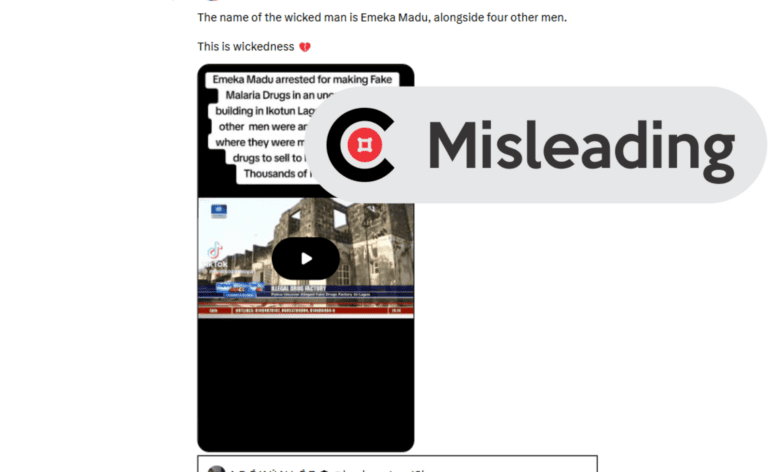
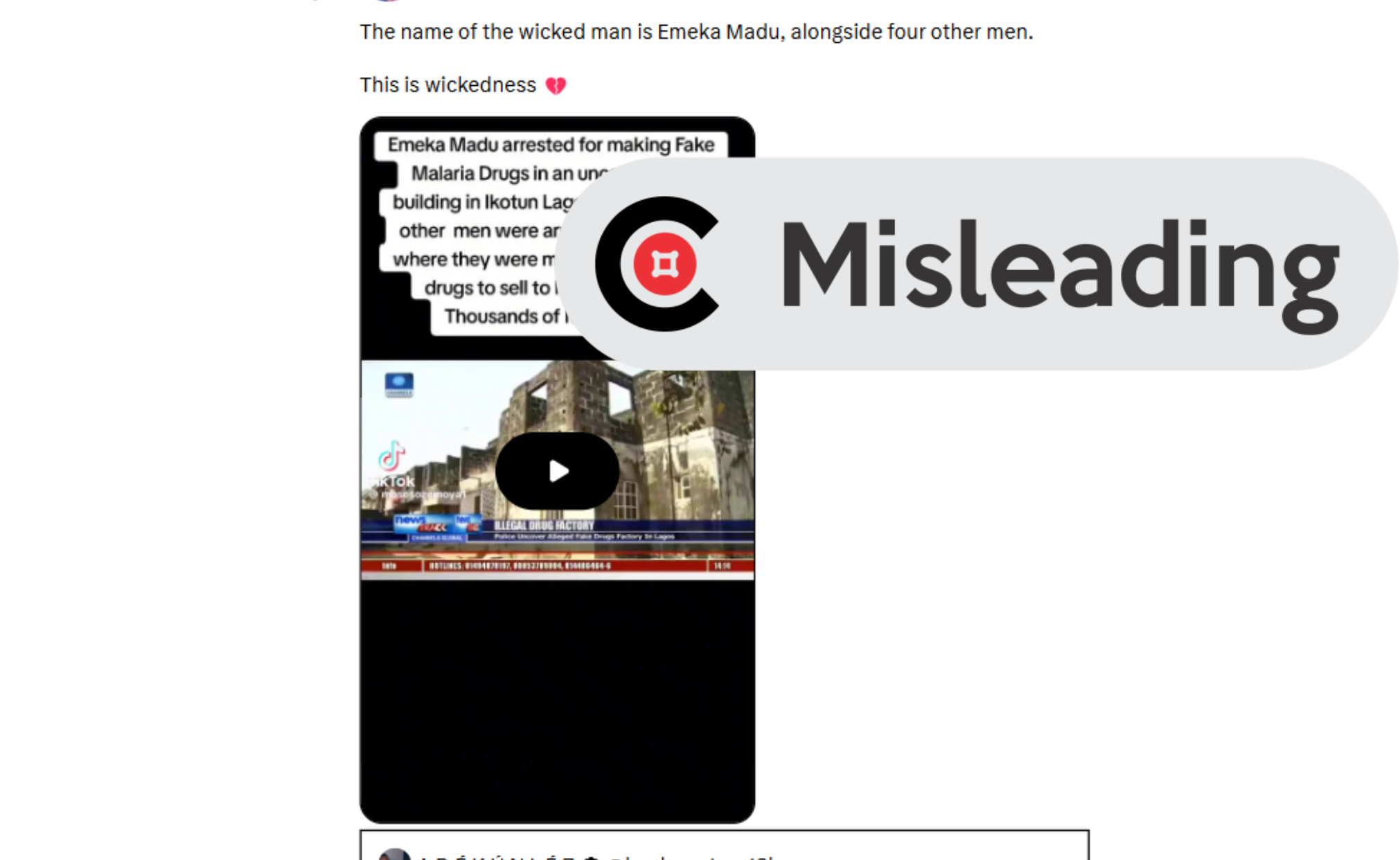
“The name of the wicked man is Emeka Madu, alongside four other men. This is wickedness.”

The video itself contains a text overlay claiming:

“Emeka Madu arrested for making Fake Malaria Drugs in an uncompleted building in Ikotun Lagos. Emeka and 4 other men were arrested at the site where they were manufacturing fake drugs to sell to Nigerians.”

The posts had generated over 94,000 views, 960 reposts, 1,000 likes and 181 comments at the time of filing this report.

CLAIM

A video shows the recent discovery of a factory producing fake malaria drugs in Ikotun, Lagos State.

screenshot of the viral post

FINDINGS

Findings by The FactCheckHub show that the claim is MISLEADING.

A reverse image search conducted on keyframes from the viral video traced the footage to an earlier report published by Channels Television on 15 December 2018.

The original video showed officers of the Nigeria Police Force uncovering an illegal drug factory in the Ikotun area of Lagos, where suspected counterfeit drug manufacturers were arrested.

According to the report, security operatives raided the facility, where suspected fake drugs were allegedly being produced, packaged and distributed to different parts of the country.

The police arrested Emeka Madu, also known as Cabara, who was identified as the alleged owner and leader of the group operating the suspected illegal drug factory. Other suspects arrested were Eze Young, Chijoke Umunna and Kingsley Obilo.

The police said the suspects were arrested while allegedly producing suspected fake drugs using machines fabricated for processing, manufacturing and packaging the products.

However, contrary to the impression created by the viral posts, the incident did not occur recently. The footage has been publicly available since December 2018.

VERDICT

The claim that the video shows a recent discovery of a factory producing fake malaria drugs in Ikotun, Lagos State, is MISLEADING. The footage dates back to December 2018 and shows police uncovering a suspected illegal drug factory and arresting alleged counterfeit drug manufacturers in Ikotun.